
NRR
What is Customer Success?
In most companies, it is a department or a team. I would argue that it should be foundational in a company’s culture. Companies need to focus on providing products and services that solve critical business problems for their clientele. By doing so, they create a predictable revenue stream and install base that supports future growth.
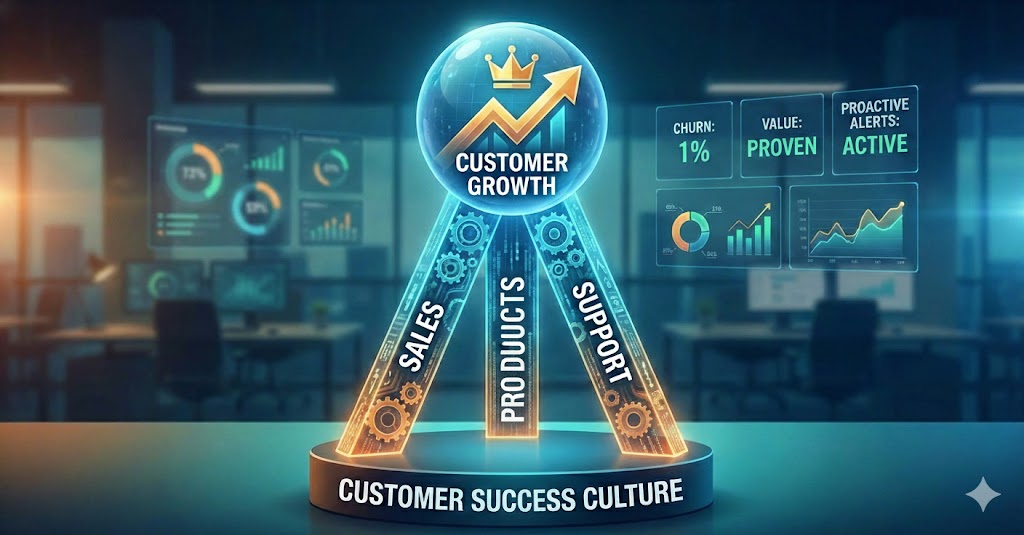
In a quarterly executive meeting a decade or so ago, the head of the Support organization stated this team was the most important. The head of Engineering then stated that her team was the most important. I chimed in and stated, “Without Sales, nothing happens, but ultimately, if all teams are not focused on the same objective, like a tripod, then all teams will ultimately fail.” Our CEO agreed, and that was the end of the discussion.
You could also argue that Marketing and Services should be included, and I would agree, since it goes back to all teams being focused on a singular, overarching goal.
In a previous post about creating Customers for Life, I wrote about an implementation to address customer churn, a byproduct of the company’s failure in one or more areas. This was a wake-up call for me, as we were very focused on the success of our largest accounts and most productive channel partners – totaling 70% of our revenue, but we took the other “less valuable” accounts for granted. The lesson learned was that 30% of $62M is a large number (a “long tail”), and by applying the same techniques to those accounts, we increased organic growth while minimizing churn, improving our overall Net Revenue Retention (NRR) rate.
Why Customer Success Teams Struggle
- Lack of Ownership: They don’t own the accounts and often lack the motivation and accountability for each customer’s health and success.
- Stay Reactive: They are reactive rather than proactive advocates for customers.
- Lack of Resources: They are spread too thin and lack the capacity to actively engage with all but a few customers.
- Enter Too Late: They are not introduced early in the sales process, which is a great way to demonstrate commitment to the prospect’s success if they select you as a vendor.
- Stay Low in the Org Chart: They do not develop relationships beyond a small operational team, limiting executive visibility and expansion potential.
- Ad Hoc in Nature: They lack formal processes, including detailed documentation, that help ensure consistency and continuity over time.
How to Position Your Team for the Win
- SWOT: Review your strengths and weaknesses. Why do companies buy from you? (or, what are you really selling?) What are you known for? What do people like and appreciate? Where do you fall short? (opportunities for others) Accentuate the positive and focus on improvements where needed.
- We often received customer feedback that when they called our support team, their problem was solved on the initial call. With other vendors, it often took 2-3 people to reach someone knowledgeable who could help. We promoted this when selling and reinforced the importance of maintaining this positive image to our internal teams.
- We also received feedback that some of our technical features were lagging behind the competition, so my team and I helped identify the most critical features, then worked with Engineering to prioritize them and focus on bringing in new customers who needed them. It was a win-win.
- Be Proactive: It is often possible to anticipate problems or make improvements based on your understanding of the customer and their history. Being part of the solution means that you don’t wait for the next problem to engage.
- When I had my consulting company, we provided managed services for several large companies. We had proprietary monitoring tools that reported conditions that often led to outages if left unchecked. We addressed the issue and informed the customer once it was resolved. Our monthly summary report listed the likely outages avoided, the average duration of similar outages, and the cost avoided (based on the hourly cost of downtime). Key people saw our value at least monthly, so when it came time to renew our service, the process was fast and painless.
- Become the Internal Liaison: The customer success team should serve as the main conduit for information. Introduce your Services or Engineering teams to the customer early. This doesn’t just solve problems; it uncovers new opportunities to provide value (and sell additional services) that position the customer for even greater success. Engagement and a sense of partnership go a long way.
- I will often introduce the Services team when problems or needs arise. Their expertise and insights can be very valuable, often leading to services that position the customer for even greater success.
- Go Above and Beyond: People remember that. Teams begin to rely on you. And Executives begin to see your company and products as critical to their success. This creates long-term value for your company.
- Focus on the Future: Ask your customers, “How can we help with your upcoming initiatives and projects?” This is a great way to learn what they will be working on, to show your interest in their success, and to identify how your company and products can help them achieve it.
These are things that have been very successful for me when I was leading two large global regions, when I was a top Account Executive at a company with a small customer success team, and as a Consultant. I set expectations, led by example, and they began doing much more of what I expected from the customer success team. We started seeing improvements in the first 30 days.
While leadership doesn’t have to come from designated leaders, cultural changes usually require the commitment, involvement, and support of the organization’s top executives. Everyone can positively influence a company’s direction and success.
When the customer wins and views you as a key partner, your concerns about churn become minimized.
Beyond the Hunt: Fueling Sustainable Enterprise Sales Growth
The software start-up world is obsessed with “Hunters” – salespeople laser-focused on landing new customers. Job boards are overflowing with companies in “growth phases,” desperate for new logos. Understandably, the revenue from each new customer can mean a 10-20x multiple in company valuation in the VC-fueled race toward an exit. What happens after the deal closes ultimately determines a company’s success. Sustainable growth requires a systematic approach for ongoing customer success and satisfaction.
The Long Game: Profitability and Sustainability

My experience leading a large business unit and running my own company has taught me that sustainable growth requires more than just a flood of new logos. Here’s why:
- Cash flow is King: Lines of credit can vanish overnight (remember Silicon Valley Bank?). Relying solely on external funding is risky.
- Not All New Business is Good Business: Unprofitable accounts, high-churn risks, and customers with limited growth potential can drain your resources faster than you can acquire them. Efficiency matters for scalability.
- Profits Drive Long-Term Growth: Organic, profit-fueled growth, especially when driven by innovation, creates a much more resilient and valuable business.
- The effort and costs associated with closing new customers can be high in many industries. Your install base business helps fund new growth.
- Churn negatively offsets growth (think net revenue retention, or NRR) and limits profits that fund growth.
The Power of the Hybrid Sales Model
To achieve sustainable growth, you need either an extensive, fully integrated organization that seamlessly transitions from sales to implementation (few companies can do this) or a hybrid sales team that excels at both hunting (50-70%) and farming (30-50%). Landing a new customer is hard work, but retaining and growing them is just as challenging and crucial. Customer acquisition costs are often too high to justify losing a customer only a year or two after the initial win. Treating new customers as assets (not commodities) is essential to long-term success.
Mastering Strategic Accounts: Turnarounds and Growth
Large, strategic accounts—Tier 1 companies with strong brand recognition and significant revenue potential—present unique challenges. In my experience, these accounts often fall into two categories: those I initially closed and then grew (ideal, as you have already laid the foundation for success), and those I inherited in a neglected state and had to turn around.
Turnarounds require a unique skill set. They demand as much time and sometimes even more effort than landing a new logo, blending aspects of both hunting and farming. It takes commitment, skill, patience, and effort to understand an organization and find new ways to deliver value. Relationships and trust take time to develop, and in this situation they are in question (or worse).
The lesson learned is that it is better to take a proactive approach to keep adding value for those accounts, rather than neglect them and spend a lot of time, money, and effort rebuilding trust and earning their business again.
Case Study: From Churn Risk to Multi-Million Dollar Expansion
Take, for example, a large Financial Services company I inherited when their Strategic Account Manager left. The account had been neglected for two years and was riddled with problems. We lacked executive relationships and higher-level visibility within the organization. They were evaluating competitors, and we knew nothing about it! Even though they were an existing customer, we were the underdog.
I started by organizing a day-long on-site meeting to understand their pain points and needs. We identified several immediate issues, shared our vision for the future, began building trust, and demonstrated our commitment to their success. Following this, we spent a few hours getting to know the team over dinner. It was an eye-opener for me, as they shared more about their needs, how best to approach them, and their disappointment with our company’s past efforts.
The result? First and foremost, we saved the account. Within three months, I closed a $500K expansion deal, followed by a $500K consulting engagement and then a $3.25M two-year cloud expansion and upgrade prepay deal. My team and I rebuilt the relationship, solved critical problems (even going beyond our product scope), and provided a clear path forward with our AI-powered platform. I became a trusted advisor who was valued by their executive team. It was a true win-win.
The Bottom Line: Building a Sustainable Sales Engine
Install base growth and customer retention are critical for long-term success, especially with larger customers. The approach has to be multi-dimensional. It is a team effort, and the Account Executive is the quarterback. Relationship management, customer success teams, support, and services all play a role. Effective communication is bi-directional, with the customer having insight into what is coming down the road and input into the direction of the products they rely on. This becomes a true partnership that adds significant value to both organizations.
Does this hybrid approach apply to every company? If you’re IBM or Oracle, your offerings are broad and deep, and your customers are largely locked-in. “Land and expand” is part of their DNA. And if you’re selling end-of-life products, your focus might shift towards maximizing the “long tail” through customer success and services to minimize costs and maximize profitability.
However, for most growth-stage Cloud and SaaS companies, the hybrid sales model is more essential to their success than they probably realize.
Call to Action:
- Evaluate your sales team structure and compensation plans. Do they incentivize both new customer acquisition and ongoing account growth?
- Invest in training and development for your sales team. Equip them with the skills needed to excel at both hunting and farming. It can be a difficult transition, but it is worth it in the long run.
- Need help building a high-performing hybrid sales team or turning around strategic accounts? Let’s connect!
Creating Customers for Life
The goal for any business, regardless of the products you sell or the services you provide, should be maintaining a satisfied customer base that is loyal to your business. The idea is to create a mutually beneficial relationship that motivates people to keep working with you, even when competitive products or incentives are available (e.g., those pushing for a “Corporate Standard” involving another product).
The best part is that this concept applies to all companies and all Product Life Cycle stages. Whether your company is on a rapid growth trajectory towards ‘Unicorn status,’ or your offerings are mature and viewed as ‘less exciting.’ The approach will also help if your products decline and you seek the ‘longest tail’ possible. At each phase, credible threats from competitors seek to grow by eroding your business.

Several years ago, I was responsible for two product lines in two major geographic regions (Americas and APAC/Japan). Our attrition rate (“churn”) was traditionally slightly below the industry average, and our net revenue rate (NRR), which reflects overall growth by factoring in churn, was around 100, indicating the business was flat. We began seeing an increase in churn and a corresponding decrease in organic growth. Both were indicators that something needed to change.
After discussing tactical approaches, our small leadership team agreed this was a strategic issue we needed to address. The result was an understanding that we needed to create ‘Customers for Life.’
Everyone agreed with the concept, but due to various differences (culture, who our customer was – end customer vs. channel partner, buying patterns, etc.), we agreed to try what was best for each of our regional businesses and share the results and lessons learned.
My approach focused on developing strong relationships that fostered collaboration and ultimately led to growth and success for both parties. The basic premise was simple:
- People tend to buy from people they like, respect, and trust. Become one of those people for your customers.
- Helping companies achieve better business outcomes leads to greater success for our customers and us.
How did we do it? It was a systematic process that my team used that included the following:
- Develop simple profiles for each customer (e.g., products used, date of first purchase, footprint size, usage and payment trends, industry).
- Estimate their overall impact based on product footprint size, annual spend with us, company size, engagement and interactions, and growth potential. Companies and organizations with the most at stake or the most to gain became our Tier 1 priority. These are the customers that we invested even more time and effort with.
- Make contact multiple times yearly, not just when you want money.
- These “out of cycle” contacts became very important for maintaining and growing the relationship.
- When issues or concerns came up, we often learned about them earlier and addressed them before renewal, which helped expedite the process.
- Ask questions about key initiatives, milestones, and concerns.
- We documented the responses, which helped seed following conversations and demonstrate a genuine interest in what they were doing.
- If we noticed changes in their industry or region, we asked about them and probed whether we could help.
- Follow-up!
- Lack of follow-through is the fastest way to lose your customer’s trust and respect. Being reliable and helpful increases your value.
- Request meetings to understand how they use our products and get a brief update on what our company has been doing.
- Face-to-face meetings are always preferred, as you tend to learn much more than in remote meetings.
- Learning more about their business, systems, goals, and challenges creates opportunities to add value and become more of a partner in that customer’s success.
- Ask “What would it look and feel like when you successfully overcame those challenges and achieved your goals?” and “What is a realistic timeframe for making that happen?” to get the customer emotionally focused on that better future state, and then look for ways to “Weave your value proposition into the fabric of their dreams and goals.“
- We looked at how they used our products and offered suggestions to do more, do something better or more efficiently, call out potential problems, and discuss best practices. Often, we had a technical expert follow up and provide an hour or two of free assistance to explore those suggestions. We invested in their ongoing success.
- Look for opportunities to congratulate them.
- It demonstrates that they are important enough that you are paying attention. Google Alerts made this easy.
- Regularly ask our customers if there is anything that we could do to help them.
- They would often reciprocate, leading to increased references and referrals.
- Helping our install base customers, even if it wasn’t directly related to our products, was good business.
- Continuous Improvement – Analyze the results and refine the process as needed.
Before the meeting, we would spend an hour or two researching the company, its history, and significant events for it and within its industry, and identify its top 2-3 competitors. My consulting background came in handy as I “looked between the lines” to better understand the situation as we planned the meeting, focusing on what we wanted to walk away with and what we wanted the customer to walk away with. Preparation matters.
As we met with our Customers and Channel Partners, we would explain what ‘Customer for Life’ meant to us and the potential benefits to them. Before the meeting, we would check whether we had (or they wanted) an NDA so they could speak freely and with confidence. Trust was important. The information disclosed helped us understand their situation, and we mapped it against other customers to identify actionable trends. Showing interest and understanding created credibility. Asking relevant questions helped conversations move to substantive issues faster. From there, we focused on specific points that would positively impact that customer.
Over the course of two years, my team and I helped our customers innovate by providing different perspectives and ideas, modernizing (e.g., moving to spatial analytics to get a more granular understanding of their own business, cloud-enabling their systems to increase responsiveness to their business and control costs), improving their systems and growing their businesses, and more. We became their trusted advisors and advocates within our company.
We also received feedback that helped us improve our products and a variety of processes – something that benefited all customers. Occasionally, we learned about problems they were having. We took ownership of the issue, brought in the right people, and helped the customer find a resolution. Collaboration and success created stronger relationships – especially with the largest customers and companies.
The results: Customer churn decreased by 50%, organic growth increased by slightly more than 20%, and NRR increased by over 5%. This program made a several-million-dollar positive impact with relatively little effort. We had achieved our objectives, improved our bottom line, and shared our lessons learned with the other two teams.
The concepts behind Strategic Account Management, Voice of the Customer, Customer Experience, Customer Loyalty, and Customer Success blended into a manageable, practical approach and delivered strong ROI. My biggest lesson learned was that adopting this mindset and creating a repeatable process should be started sooner rather than later – before problems arise.
Every day you are not creating your own ‘Customers for Life,’ there is a good chance that your competition is. Don’t let that happen to your business.

