
Business Intelligence
What is Customer Success?
In most companies, it is a department or a team. I would argue that it should be foundational in a company’s culture. Companies need to focus on providing products and services that solve critical business problems for their clientele. By doing so, they create a predictable revenue stream and install base that supports future growth.
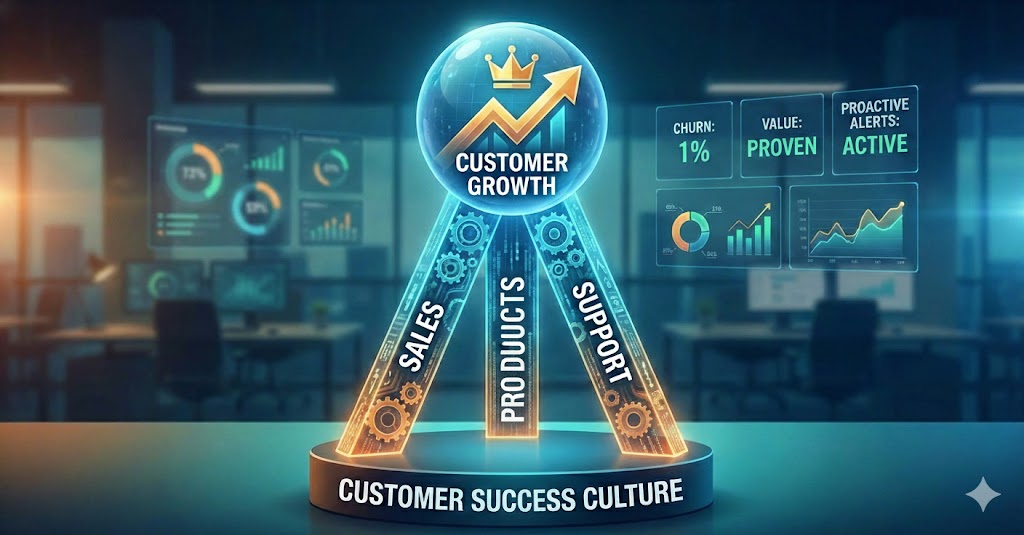
In a quarterly executive meeting a decade or so ago, the head of the Support organization stated this team was the most important. The head of Engineering then stated that her team was the most important. I chimed in and stated, “Without Sales, nothing happens, but ultimately, if all teams are not focused on the same objective, like a tripod, then all teams will ultimately fail.” Our CEO agreed, and that was the end of the discussion.
You could also argue that Marketing and Services should be included, and I would agree, since it goes back to all teams being focused on a singular, overarching goal.
In a previous post about creating Customers for Life, I wrote about an implementation to address customer churn, a byproduct of the company’s failure in one or more areas. This was a wake-up call for me, as we were very focused on the success of our largest accounts and most productive channel partners – totaling 70% of our revenue, but we took the other “less valuable” accounts for granted. The lesson learned was that 30% of $62M is a large number (a “long tail”), and by applying the same techniques to those accounts, we increased organic growth while minimizing churn, improving our overall Net Revenue Retention (NRR) rate.
Why Customer Success Teams Struggle
- Lack of Ownership: They don’t own the accounts and often lack the motivation and accountability for each customer’s health and success.
- Stay Reactive: They are reactive rather than proactive advocates for customers.
- Lack of Resources: They are spread too thin and lack the capacity to actively engage with all but a few customers.
- Enter Too Late: They are not introduced early in the sales process, which is a great way to demonstrate commitment to the prospect’s success if they select you as a vendor.
- Stay Low in the Org Chart: They do not develop relationships beyond a small operational team, limiting executive visibility and expansion potential.
- Ad Hoc in Nature: They lack formal processes, including detailed documentation, that help ensure consistency and continuity over time.
How to Position Your Team for the Win
- SWOT: Review your strengths and weaknesses. Why do companies buy from you? (or, what are you really selling?) What are you known for? What do people like and appreciate? Where do you fall short? (opportunities for others) Accentuate the positive and focus on improvements where needed.
- We often received customer feedback that when they called our support team, their problem was solved on the initial call. With other vendors, it often took 2-3 people to reach someone knowledgeable who could help. We promoted this when selling and reinforced the importance of maintaining this positive image to our internal teams.
- We also received feedback that some of our technical features were lagging behind the competition, so my team and I helped identify the most critical features, then worked with Engineering to prioritize them and focus on bringing in new customers who needed them. It was a win-win.
- Be Proactive: It is often possible to anticipate problems or make improvements based on your understanding of the customer and their history. Being part of the solution means that you don’t wait for the next problem to engage.
- When I had my consulting company, we provided managed services for several large companies. We had proprietary monitoring tools that reported conditions that often led to outages if left unchecked. We addressed the issue and informed the customer once it was resolved. Our monthly summary report listed the likely outages avoided, the average duration of similar outages, and the cost avoided (based on the hourly cost of downtime). Key people saw our value at least monthly, so when it came time to renew our service, the process was fast and painless.
- Become the Internal Liaison: The customer success team should serve as the main conduit for information. Introduce your Services or Engineering teams to the customer early. This doesn’t just solve problems; it uncovers new opportunities to provide value (and sell additional services) that position the customer for even greater success. Engagement and a sense of partnership go a long way.
- I will often introduce the Services team when problems or needs arise. Their expertise and insights can be very valuable, often leading to services that position the customer for even greater success.
- Go Above and Beyond: People remember that. Teams begin to rely on you. And Executives begin to see your company and products as critical to their success. This creates long-term value for your company.
- Focus on the Future: Ask your customers, “How can we help with your upcoming initiatives and projects?” This is a great way to learn what they will be working on, to show your interest in their success, and to identify how your company and products can help them achieve it.
These are things that have been very successful for me when I was leading two large global regions, when I was a top Account Executive at a company with a small customer success team, and as a Consultant. I set expectations, led by example, and they began doing much more of what I expected from the customer success team. We started seeing improvements in the first 30 days.
While leadership doesn’t have to come from designated leaders, cultural changes usually require the commitment, involvement, and support of the organization’s top executives. Everyone can positively influence a company’s direction and success.
When the customer wins and views you as a key partner, your concerns about churn become minimized.
Lessons Learned from GTM Consulting
For the past two years, I have performed part-time, contract go-to-market consulting. My wife had a surgery that went wrong 18 months ago, so I needed something that would allow me to take care of her, stay sharp, earn money, and help companies grow. What I encountered was quite different from what I expected, so I thought I would pass it along.

Most of the work was with small to midsize companies, but the problems and needs mirrored what I have encountered at larger companies. The main difference is that large companies tend to look to software to address problems. In contrast, smaller companies often lack the budget for what they view as a solution that increases complexity.
Here are my Top 5 findings:
- GTM plans are often developed at the highest levels, often in isolation, without market testing and validation.
- An interesting aside is that the company is often really seeking sales optimization but believes it is doing things “well enough” today and therefore needs to focus on new offerings and revenue streams.
- New perspectives on past performance and failures are well received but more surprising than anticipated. This leads to a better understanding of needs, which builds consensus moving forward.
- Sales teams are sometimes pitted against one another, rather than working together to help everyone achieve more (Coopetition – “A rising tide lifts all boats.”)
- Sometimes the competing team isn’t sales, but support. The team wants to help the customer (which is great), but works outside its defined scope instead of bringing in the services and sales teams to work jointly to solve the customer’s problem.
- Sales teams are focused on selling features rather than solving business problems.
- Training those teams on solution selling and understanding the prospect’s needs pays off.
- CRMs are not consistently used and often reflect idealized fiction rather than reality.
- Old, dead, or unqualified opportunities; lack of recent contact or interaction; deals that have slipped more than once; and a lack of understanding (company, needs, players, business environment) all point to an unrealistic pipeline.
- Sales management and teams are not leveraging AI to help focus their efforts.
- Conversely, they may view AI as a panacea, investing time and money in tools that supplement a strong team rather than focusing on strengthening the team.
Here are the related Lessons Learned:
- Selling is a byproduct of problem-solving. You can’t solve problems if you don’t know what they are. Every interaction with a prospect should focus on gathering information, building trust and relationships, and leveraging prior interactions to demonstrate that your solution will solve their problem and ease their pain.
- Here’s solution sales again. Teaching teams to ask better questions, listen more, and validate their understanding increases their standing with prospects.
- Identifying common business problems and describing how your product or service solves them should be the foundation of the plan.
- Perform market analysis. How do other companies describe those problems? Their terminology, often found in job postings by competitors and your target audience, can help create effective messaging that resonates. Work to become the natural fit for what your prospects are seeking and the problems they are likely dealing with.
- Individual contributors get paid to win, but sales management needs to create incentives for collaborative efforts that lead to both wins and ongoing customer growth.
- Paying sales teams for net new business only causes them to ignore install base expansion opportunities. And, if another vendor solves their problems, it is only a matter of time before they replace you.
- For one company, I convinced them to implement a 2% SPIV (like a SPIFF, but team-focused) for every team member who actively contributed to team improvement. SPIV payments were quarterly, and there was a running total so the team could see the fund growth. Initial indications of a positive impact are good.
- Another benefit of collaboration is that it helps teams focus on approaches that work due to ongoing testing and refinement. Collaboration also helps teams focus on a more accurate ICP (ideal customer profile). Sales management can then feed their findings back to Marketing to tailor and fine-tune their efforts.
- CRMs often either lack information or are full of wishful thinking. They focus on activities, and not progress and next steps.
- Using MEDPICC as a foundation for qualification is a much better start.
- Sales managers need to validate the information independently to ensure their teams are upfront and honest. Trust, coaching, and collaboration work together for the win.
- Chasing deals that are unlikely to close wastes valuable resources.
- AI is not a panacea, but it is very effective for research, market validation, prospecting, and meeting preparation.
- Going in prepared builds respect and credibility, saves time, and helps you quickly qualify prospects in or out.
- There may be opportunities to nurture prospects who have potential but aren’t qualified for immediate deals, seeding the pipeline for future opportunities. This could be a great place to leverage AI for personalized journeys with highly relevant curated content.
So, what are your thoughts? Have you seen some of these problems yourself? How did you handle them? Let me know in the comments below.
And if you are looking for assistance with your business, contact me.
Using Themes for Enhanced Problem Solving
Thematic Analysis is a powerful qualitative approach used by many consultants. It involves identifying patterns and themes to better understand how and why something happened, providing context for other quantitative analyses. It can also be used when developing strategies and tactics because of its “cause and effect” nature.
Typical analysis tends to be event-based. Something happened that was unexpected. Some type of triggering or compelling event is sought to either stop something from happening or to make something happen. With enough of the right data, you may be able to identify patterns that help predict what will happen next based on past events. This data-based understanding may be simplistic or incomplete, but often it is sufficient.

But people are creatures of habit. If you can identify and understand those habits and place them within the context of a specific environment that includes interactions with others, you may be able to identify patterns within the patterns. Those themes can be much better indicators of what may or may not happen than the data itself. They become better predictors of things to come and can help identify more effective strategies and tactics to achieve your goals.
This approach requires that a person view an event (desired or historical) from various perspectives to help understand:
- Things that are accidental but predictable because of human nature.
- Things that are predictable based on other events and interactions.
- Things that are the logical consequence of a series of events and outcomes.
Aside from the practical implications of this approach, I find it fascinating relative to AI and Predictive Analysis.
For example, you can proactively monitor data, activities, and patterns by understanding recurring themes and triggers. That provides actionable intelligence that can be automated and incorporated into a larger system. Machine Learning and Deep Learning can analyze tremendous volumes of data from various sources in real-time.
Combine that with Semantic Analysis (and products like AllegroGraph) to harness the power of language through taxonomies and ontologies. The monitoring system would better understand what is happening (not just be aware of it), possibly determine how and why it happened, and result in even more focused and accurate predictions. Finally, include spatial and temporal data such as IoT, metadata from photographs, etc., and you should be able to view something as though you were very high up – providing the ability to “see” what is on the path ahead. It is obviously not that simple, but it is exciting.
This approach provides a multi-dimensional view of events and their causality, giving you the means to identify and prevent complex problems before they negatively affect a business.
Keeping these thoughts in mind will help you see details others have missed. Better tools can make for better analysis, better strategies, and better outcomes. Who wouldn’t want that?
Spurious Correlations Follow-up
In an earlier post, I wrote about spurious correlations. Over the weekend, I ran across a site that focuses on finding and posting amusing, spurious correlations. While the posts are intended to be funny, they make some very valid points. So, check it out, let me know what you think, and have some fun!
Big Data – The Genie is out of the Bottle!
Back in early 2011, other members of the Executive team at Ingres and I were betting on the future of our company. We knew we needed to do something big and bold, so we decided to build what we thought the standard data platform would be in 5-7 years. A small minority of team members didn’t believe this was possible and left, while the rest focused on making it happen. We made three strategic acquisitions to fill gaps in our Big Data platform. Today (as Actian), we have nearly achieved our goal. It was a leap of faith back then, but our vision turned out to be spot-on, and our gamble is paying off today.
My mailbox is filled daily with stories, seminars, white papers, etc., about Big Data. While it feels like this is becoming more mainstream, reading and hearing the various comments on the subject is interesting. They range from “It’s not real” and “It’s irrelevant” to “It can be transformational for your business” to “Without big data, there would be no <insert company name here>.”

What I continue to find amazing is hearing comments about big data being optional. It’s not – that genie has already been let out of the bottle. Incredible opportunities await companies that understand and embrace its potential. I like to tell people that big data can be their unfair advantage in business. Is that really the case? Let’s explore that assertion and find out.
We live in the age of the “Internet of Things.” Data about nearly everything is everywhere, and we have tools to correlate it and understand so many things (activities, relationships, likes and dislikes, etc.). With smart devices that enable mobile computing, we have an extra dimension: location. And, with new technologies such as Graph Databases (based on SPARQL), graphical interfaces to analyze that data (such as Sigma), and identification technology such as Stylometry, it is getting easier to identify and correlate that data. Someday, this will feed into artificial intelligence, becoming a superpower for those who know how to leverage it effectively.
We are generating increasingly large volumes of data about everything we do and everything going on around us, and tools are evolving to make sense of that data better and faster than ever. Organizations that perform the best analysis, get answers fastest, and act on that insight quickly are more likely to win than organizations that look at a smaller slice of the world or adopt a “wait and see” posture. So, that seems like a significant advantage in my book. But is it an unfair advantage?
First, let’s remember that big data is just another tool. Like most tools, it can be misused and abused. Whether a particular application is viewed as “good” or “bad” depends on the goals and perspective of the entity using the tool (which may be the polar opposite of the groups targeted by those people or organizations). So, I won’t try to judge the various use cases; instead, I’ll present a few and let you decide.
Scenario 1 – Sales Organization: What if you could understand what you were being told a prospect company needs and had a way to validate and refine that understanding? That’s half the battle in sales (budget, integration, and support/politics are other key hurdles). Data that helped you understand not only the actions of that organization (customers and industries, sales and purchases, gains and losses, etc.) but also the stakeholders’ and decision-makers’ goals, interests, and biases. This could provide a holistic view of the environment and allow you to provide a highly targeted offering, with messaging tailored to each individual. That is possible, and I’ll explain soon.
Scenario 2 – Hiring Organization: Many questions cannot be asked by a hiring manager. While I’m not an attorney, I would bet that State and Federal laws have not kept pace with technology. And while those laws vary state by state, there are likely loopholes allowing public records to be used. Moreover, implied data that is not officially considered could color a hiring manager’s or organization’s judgment. For instance, if you wanted to “get a feeling” that a candidate might fit in with the team or the culture of the organization or have interests and views that are aligned with or contrary to your own, you could look for personal internet activity that would provide a more accurate picture of that person’s interests.
Scenario 3 – Teacher / Professor: There are already sites in use to search for plagiarism in written documents, but what if you had a way to make an accurate determination about whether an original work was created by your student? Some people will do the work and write a paper for a student for a fee. So, what if you could not only determine that the paper was not written by your student but also determine who the likely author was?
Do some of these things seem impossible or at least implausible? Personally, I don’t believe so. Let’s start with the typical data our credit card companies, banks, search engines, and social network sites already have about us. Add to that the identified information available for purchase from marketing companies and various government agencies. That alone can provide a pretty comprehensive view of us. But there is so much more that’s available.
Consider the potential of gathering information from intelligent devices accessible through the Internet, your alarm and video monitoring system, etc. These are intended to be private data sources, but history has taught us that anything accessible is subject to unauthorized access and use (just think about the numerous recent credit card hacking incidents).
Even de-identified data (medical/health/prescription/insurance claim data is one major example), which receives much less protection and can often be purchased, could be correlated with a reasonably high degree of confidence to understand other “private” aspects of your life. The key is to look for connections (websites, IP addresses, locations, businesses, people), things that are logically related (such as illnesses/treatments/prescriptions), and then accurately identify (stylometry looks at things like sentence complexity, function words, co-location of words, misspellings and misuse of words, etc. and will likely someday take into consideration things like idea density). It is nearly impossible to remain anonymous in the Age of Big Data.
There has been a paradigm shift in the practical application of data analysis, and companies that understand and embrace it will likely perform better than those that don’t. This technology also raises new ethical considerations and will likely bring new laws and regulations. But for now, the race is on!

