
Month: April 2026
Curiosity-Led Execution
Most organizations don’t struggle because they lack solutions—they struggle because they misdiagnose problems. A structured, curiosity-led approach accelerates alignment, reduces rework, and leads to solutions that actually stick and solve the intended problem(s).
My Starting Point
I was not a fan of consultants when I first started working with them. Most were arrogant, had limited focus, and viewed problems or goals in isolation. I later learned that the same could be said for salespeople, executives, and more. It had less to do with the role and more to do with how people presented themselves as experts.
Switching to consulting was a tough sell. When I finally accepted a position, I expected to learn proven methodologies from seasoned experts. The lessons I learned weren’t always what I had expected, but always helped me improve.
Many of the senior consultants I worked with had been highly successful early in their careers. But over time, that success calcified into rigid frameworks and default approaches. They weren’t completely wrong—but they weren’t adaptable or as effective as they could have been, either.
It reminded me of the old metaphor: “If the only tool you have is a hammer, everything looks like a nail.”
At one point, I seriously questioned whether consulting was the right fit for me.
Then I stepped back and looked at the best consultants I had worked with—the ones clients trusted and who consistently delivered positive outcomes. I asked a simple question:
What do they do differently?
The answer wasn’t just expertise. It was curiosity, combined with the desire to deliver a positive experience and tangible outcomes.
From Depth to Insight
Early in my career, I went deep—sometimes excessively so.
I read dozens of manuals for a relational database system, cover to cover, just to understand how it worked. Then I spent years traveling, reviewing its source code at night, trying to understand why it worked the way it did. That understanding led to new ways of optimizing performance.
That effort paid off. I became recognized as an expert for that product, which opened the door to many challenging and exciting consulting engagements.
But it also revealed a limitation: Depth alone doesn’t scale.
What scaled was the mindset that I developed with it:
- Looking beyond surface-level symptoms to understand the root causes.
- Viewing problems from a systemic perspective. Understanding how systems interact (not just how they function) gave me a big-picture understanding that was the foundation of my assessment.
- Asking how and why decisions were made, not just what decisions were made, provided useful context.
I learned to read between the lines—technically and organizationally. To understand not just systems, but the people and processes behind them.
That context is powerful, but difficult to extract—especially quickly.
The Breakthrough: Structured Curiosity
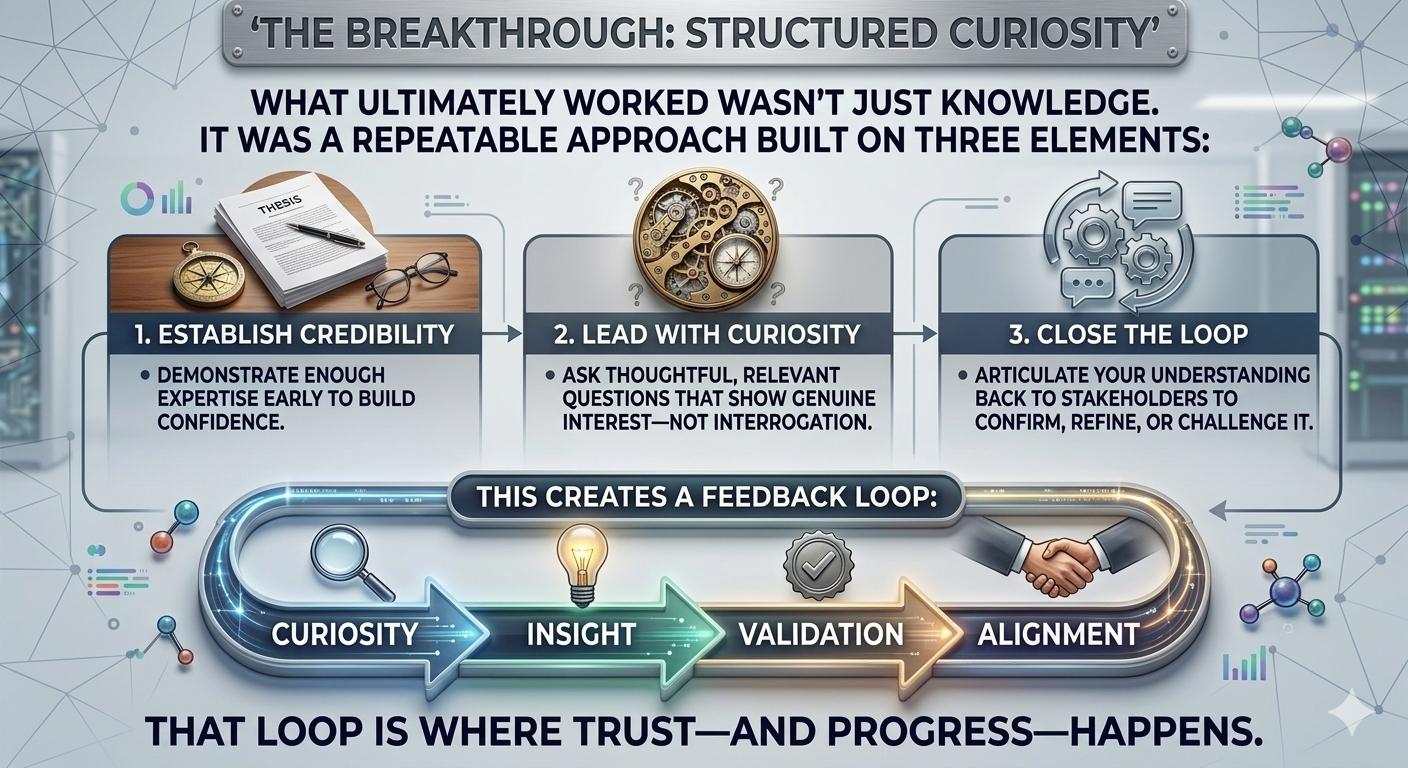
What ultimately worked wasn’t just knowledge. It was a repeatable approach built on three elements:
- Establish credibility
Demonstrate enough expertise early to build confidence. - Lead with curiosity
Ask thoughtful, relevant questions that show genuine interest—not interrogation. - Close the loop
Articulate your understanding back to stakeholders to confirm, refine, or challenge it.
This creates a feedback loop:
Curiosity → Insight → Validation → Alignment
That loop is where trust—and progress—happens.
A Practical Tactic: The “Columbo Technique”
One of the most effective tools I’ve used is commonly called the Columbo Technique.
The idea is simple: Lower defenses by creating psychological safety—and a sense of control.
Instead of pushing for answers, you:
- Ask informed questions
- Make partial observations
- Then, intentionally leave a gap
Something like:
“I might be missing something, but I’m not fully connecting how X impacts Y…”
This does two things:
- Signals humility (reducing resistance)
- Invites correction (which reveals deeper truth)
People tend to open up—not because they’re forced to, but because they want to contribute. They feel safe because you are focused on understanding the situation and solving the problem, and not pointing fingers or assigning blame.
And once that happens, you get access to what actually matters: the “why” behind the “what.”
Applying This in the Real World
This approach works across consulting, sales, and leadership—but only if you apply it deliberately.
Here’s how to operationalize it:
1. Start Broad Before Going Deep
Don’t jump to solutions. Map the landscape first:
- Stakeholders
- Systems
- Constraints
- History
2. Use Their Language
Mirror terminology and examples. It builds alignment faster than forcing your own framework.
3. Validate Early and Often
Don’t wait until the end to present conclusions. Share evolving understanding:
- “Here’s what I think I’m seeing…”
- “Does this match your experience?”
- “Can you help me identify reasons why this might not work?”
4. Balance Confidence with Curiosity
Too much confidence shuts people down.
Too much curiosity erodes credibility.
The balance is where influence lives.
5. Optimize for Adoption, Not Perfection
The best solution is the one that gets implemented and sustained—not the one that looks best on paper.
A great example of this is at a large insurance company, where I led a successful 18-month redesign and implementation of a common Risk Management System used across three distinct businesses.
Before I came, they spent two years and several million dollars with a Big 5 Consulting company. The output was several 3” binders filled with specifications, definitions, and design documents. It was amazing, but wasn’t implementable. I have seen that far too often on consulting engagements.
A section in the middle of this post describes what happened with that project.
Make It Repeatable with the CLEAR Framework
This simple, reusable model can help any company or role.
The C.L.E.A.R. Framework
C — Credibility
- Establish baseline trust quickly.
- Demonstrate you “speak their language.”
L — Learn
- Map systems, stakeholders, constraints, and history.
- Ask high-quality, layered questions.
E — Expose
- Surface gaps, contradictions, hidden dependencies.
- Use techniques like the “Columbo Method.”
A — Align
- Play back understanding.
- Build shared clarity before prescribing.
R — Recommend
- Deliver solutions optimized for adoption and results, not elegance alone.
Why This Matters
Knowledge explains. Curiosity transforms. When you lead with curiosity, you move faster—not slower.
You avoid rework.
You uncover hidden constraints early.
You gain stakeholder alignment before decisions are locked in.
And occasionally, you can help solve problems that have existed for years—in a matter of weeks—because you’re solving the right problem.
If this sounds interesting and you would like to discuss it further or seek out assistance, contact me here.

