
Technology
Curiosity-Led Execution
Most organizations don’t struggle because they lack solutions—they struggle because they misdiagnose problems. A structured, curiosity-led approach accelerates alignment, reduces rework, and leads to solutions that actually stick and solve the intended problem(s).
My Starting Point
I was not a fan of consultants when I first started working with them. Most were arrogant, had limited focus, and viewed problems or goals in isolation. I later learned that the same could be said for salespeople, executives, and more. It had less to do with the role and more to do with how people presented themselves as experts.
Switching to consulting was a tough sell. When I finally accepted a position, I expected to learn proven methodologies from seasoned experts. The lessons I learned weren’t always what I had expected, but always helped me improve.
Many of the senior consultants I worked with had been highly successful early in their careers. But over time, that success calcified into rigid frameworks and default approaches. They weren’t completely wrong—but they weren’t adaptable or as effective as they could have been, either.
It reminded me of the old metaphor: “If the only tool you have is a hammer, everything looks like a nail.”
At one point, I seriously questioned whether consulting was the right fit for me.
Then I stepped back and looked at the best consultants I had worked with—the ones clients trusted and who consistently delivered positive outcomes. I asked a simple question:
What do they do differently?
The answer wasn’t just expertise. It was curiosity, combined with the desire to deliver a positive experience and tangible outcomes.
From Depth to Insight
Early in my career, I went deep—sometimes excessively so.
I read dozens of manuals for a relational database system, cover to cover, just to understand how it worked. Then I spent years traveling, reviewing its source code at night, trying to understand why it worked the way it did. That understanding led to new ways of optimizing performance.
That effort paid off. I became recognized as an expert for that product, which opened the door to many challenging and exciting consulting engagements.
But it also revealed a limitation: Depth alone doesn’t scale.
What scaled was the mindset that I developed with it:
- Looking beyond surface-level symptoms to understand the root causes.
- Viewing problems from a systemic perspective. Understanding how systems interact (not just how they function) gave me a big-picture understanding that was the foundation of my assessment.
- Asking how and why decisions were made, not just what decisions were made, provided useful context.
I learned to read between the lines—technically and organizationally. To understand not just systems, but the people and processes behind them.
That context is powerful, but difficult to extract—especially quickly.
The Breakthrough: Structured Curiosity
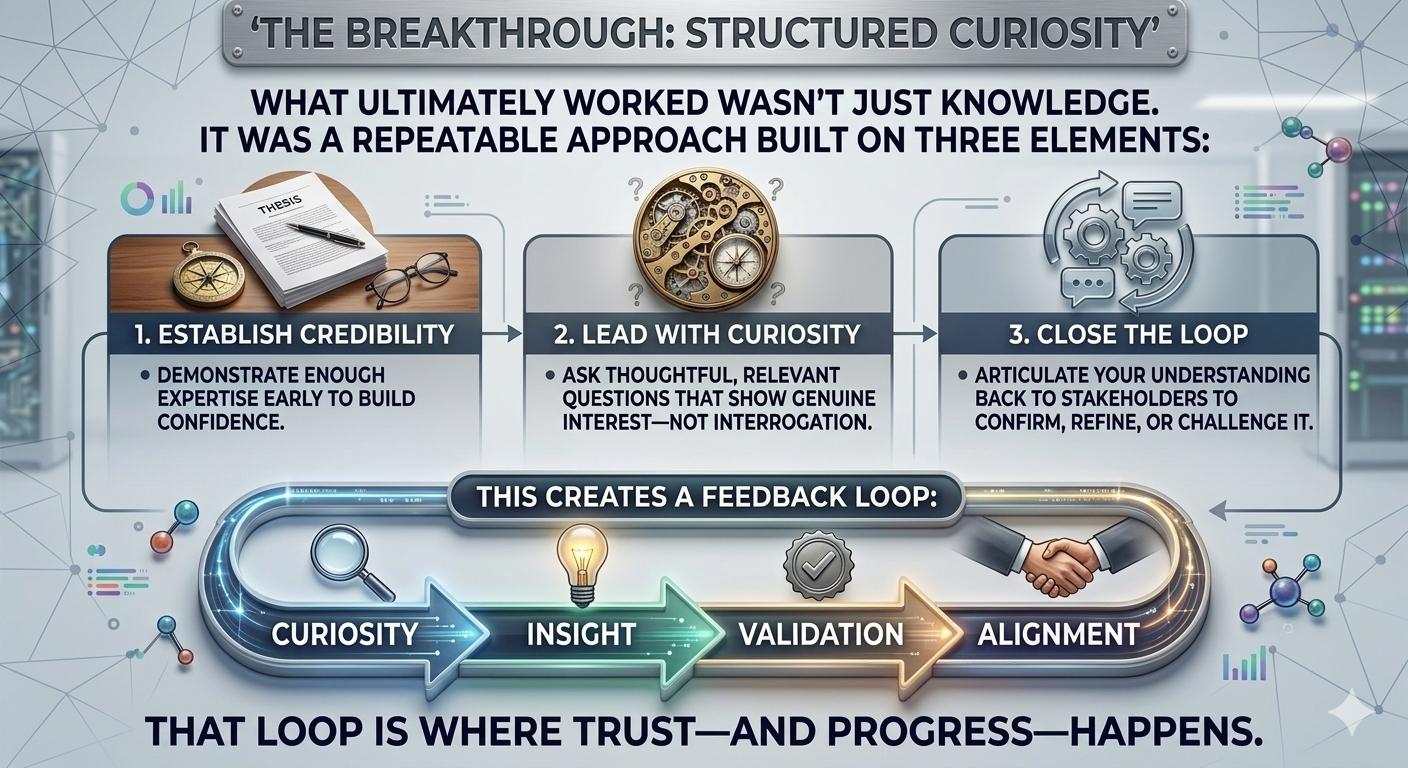
What ultimately worked wasn’t just knowledge. It was a repeatable approach built on three elements:
- Establish credibility
Demonstrate enough expertise early to build confidence. - Lead with curiosity
Ask thoughtful, relevant questions that show genuine interest—not interrogation. - Close the loop
Articulate your understanding back to stakeholders to confirm, refine, or challenge it.
This creates a feedback loop:
Curiosity → Insight → Validation → Alignment
That loop is where trust—and progress—happens.
A Practical Tactic: The “Columbo Technique”
One of the most effective tools I’ve used is commonly called the Columbo Technique.
The idea is simple: Lower defenses by creating psychological safety—and a sense of control.
Instead of pushing for answers, you:
- Ask informed questions
- Make partial observations
- Then, intentionally leave a gap
Something like:
“I might be missing something, but I’m not fully connecting how X impacts Y…”
This does two things:
- Signals humility (reducing resistance)
- Invites correction (which reveals deeper truth)
People tend to open up—not because they’re forced to, but because they want to contribute. They feel safe because you are focused on understanding the situation and solving the problem, and not pointing fingers or assigning blame.
And once that happens, you get access to what actually matters: the “why” behind the “what.”
Applying This in the Real World
This approach works across consulting, sales, and leadership—but only if you apply it deliberately.
Here’s how to operationalize it:
1. Start Broad Before Going Deep
Don’t jump to solutions. Map the landscape first:
- Stakeholders
- Systems
- Constraints
- History
2. Use Their Language
Mirror terminology and examples. It builds alignment faster than forcing your own framework.
3. Validate Early and Often
Don’t wait until the end to present conclusions. Share evolving understanding:
- “Here’s what I think I’m seeing…”
- “Does this match your experience?”
- “Can you help me identify reasons why this might not work?”
4. Balance Confidence with Curiosity
Too much confidence shuts people down.
Too much curiosity erodes credibility.
The balance is where influence lives.
5. Optimize for Adoption, Not Perfection
The best solution is the one that gets implemented and sustained—not the one that looks best on paper.
A great example of this is at a large insurance company, where I led a successful 18-month redesign and implementation of a common Risk Management System used across three distinct businesses.
Before I came, they spent two years and several million dollars with a Big 5 Consulting company. The output was several 3” binders filled with specifications, definitions, and design documents. It was amazing, but wasn’t implementable. I have seen that far too often on consulting engagements.
A section in the middle of this post describes what happened with that project.
Make It Repeatable with the CLEAR Framework
This simple, reusable model can help any company or role.
The C.L.E.A.R. Framework
C — Credibility
- Establish baseline trust quickly.
- Demonstrate you “speak their language.”
L — Learn
- Map systems, stakeholders, constraints, and history.
- Ask high-quality, layered questions.
E — Expose
- Surface gaps, contradictions, hidden dependencies.
- Use techniques like the “Columbo Method.”
A — Align
- Play back understanding.
- Build shared clarity before prescribing.
R — Recommend
- Deliver solutions optimized for adoption and results, not elegance alone.
Why This Matters
Knowledge explains. Curiosity transforms. When you lead with curiosity, you move faster—not slower.
You avoid rework.
You uncover hidden constraints early.
You gain stakeholder alignment before decisions are locked in.
And occasionally, you can help solve problems that have existed for years—in a matter of weeks—because you’re solving the right problem.
If this sounds interesting and you would like to discuss it further or seek out assistance, contact me here.
What is Customer Success?
In most companies, it is a department or a team. I would argue that it should be foundational in a company’s culture. Companies need to focus on providing products and services that solve critical business problems for their clientele. By doing so, they create a predictable revenue stream and install base that supports future growth.
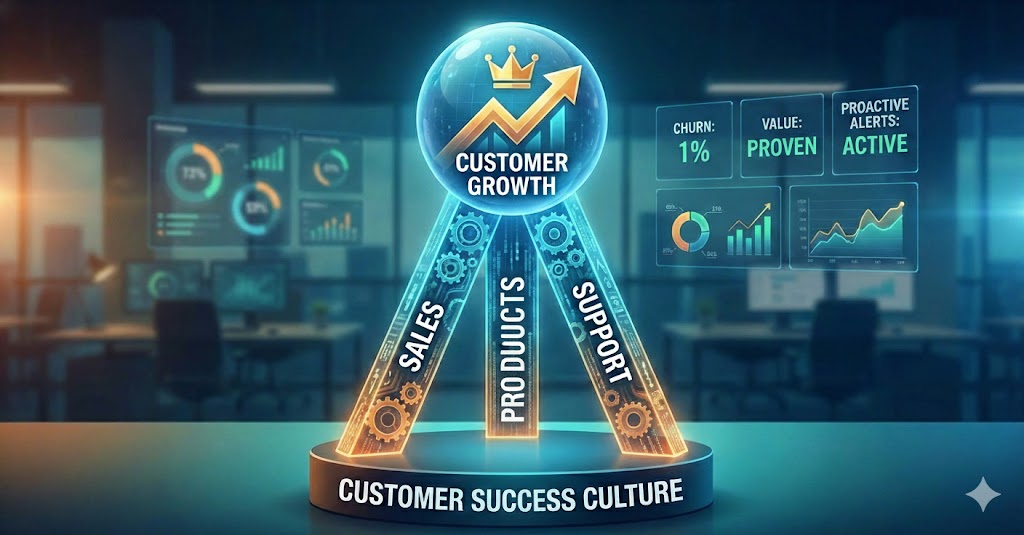
In a quarterly executive meeting a decade or so ago, the head of the Support organization stated this team was the most important. The head of Engineering then stated that her team was the most important. I chimed in and stated, “Without Sales, nothing happens, but ultimately, if all teams are not focused on the same objective, like a tripod, then all teams will ultimately fail.” Our CEO agreed, and that was the end of the discussion.
You could also argue that Marketing and Services should be included, and I would agree, since it goes back to all teams being focused on a singular, overarching goal.
In a previous post about creating Customers for Life, I wrote about an implementation to address customer churn, a byproduct of the company’s failure in one or more areas. This was a wake-up call for me, as we were very focused on the success of our largest accounts and most productive channel partners – totaling 70% of our revenue, but we took the other “less valuable” accounts for granted. The lesson learned was that 30% of $62M is a large number (a “long tail”), and by applying the same techniques to those accounts, we increased organic growth while minimizing churn, improving our overall Net Revenue Retention (NRR) rate.
Why Customer Success Teams Struggle
- Lack of Ownership: They don’t own the accounts and often lack the motivation and accountability for each customer’s health and success.
- Stay Reactive: They are reactive rather than proactive advocates for customers.
- Lack of Resources: They are spread too thin and lack the capacity to actively engage with all but a few customers.
- Enter Too Late: They are not introduced early in the sales process, which is a great way to demonstrate commitment to the prospect’s success if they select you as a vendor.
- Stay Low in the Org Chart: They do not develop relationships beyond a small operational team, limiting executive visibility and expansion potential.
- Ad Hoc in Nature: They lack formal processes, including detailed documentation, that help ensure consistency and continuity over time.
How to Position Your Team for the Win
- SWOT: Review your strengths and weaknesses. Why do companies buy from you? (or, what are you really selling?) What are you known for? What do people like and appreciate? Where do you fall short? (opportunities for others) Accentuate the positive and focus on improvements where needed.
- We often received customer feedback that when they called our support team, their problem was solved on the initial call. With other vendors, it often took 2-3 people to reach someone knowledgeable who could help. We promoted this when selling and reinforced the importance of maintaining this positive image to our internal teams.
- We also received feedback that some of our technical features were lagging behind the competition, so my team and I helped identify the most critical features, then worked with Engineering to prioritize them and focus on bringing in new customers who needed them. It was a win-win.
- Be Proactive: It is often possible to anticipate problems or make improvements based on your understanding of the customer and their history. Being part of the solution means that you don’t wait for the next problem to engage.
- When I had my consulting company, we provided managed services for several large companies. We had proprietary monitoring tools that reported conditions that often led to outages if left unchecked. We addressed the issue and informed the customer once it was resolved. Our monthly summary report listed the likely outages avoided, the average duration of similar outages, and the cost avoided (based on the hourly cost of downtime). Key people saw our value at least monthly, so when it came time to renew our service, the process was fast and painless.
- Become the Internal Liaison: The customer success team should serve as the main conduit for information. Introduce your Services or Engineering teams to the customer early. This doesn’t just solve problems; it uncovers new opportunities to provide value (and sell additional services) that position the customer for even greater success. Engagement and a sense of partnership go a long way.
- I will often introduce the Services team when problems or needs arise. Their expertise and insights can be very valuable, often leading to services that position the customer for even greater success.
- Go Above and Beyond: People remember that. Teams begin to rely on you. And Executives begin to see your company and products as critical to their success. This creates long-term value for your company.
- Focus on the Future: Ask your customers, “How can we help with your upcoming initiatives and projects?” This is a great way to learn what they will be working on, to show your interest in their success, and to identify how your company and products can help them achieve it.
These are things that have been very successful for me when I was leading two large global regions, when I was a top Account Executive at a company with a small customer success team, and as a Consultant. I set expectations, led by example, and they began doing much more of what I expected from the customer success team. We started seeing improvements in the first 30 days.
While leadership doesn’t have to come from designated leaders, cultural changes usually require the commitment, involvement, and support of the organization’s top executives. Everyone can positively influence a company’s direction and success.
When the customer wins and views you as a key partner, your concerns about churn become minimized.
Leading Next-Generation Sales Teams: The Mandate for Predictable Revenue

The sales landscape has fundamentally shifted. I keep reading posts and stories about AI replacing sales teams, and it may be for more commodity-type sales, but it will be some time before it replaces Enterprise sales teams. Building relationships and trust is the foundation for an executive to take a risk on your product, especially when it is critical to their success. AI is not yet at that level, and as behavior changes with every key release, building trust in AI will be challenging for many years to come. But today, AI can be a powerful enablement tool for your team when leveraged correctly.
Your prospects no longer need salespeople for information; they need us for Insight. They have done their research. They expect their time to be an investment, not a discovery exercise. Does your presence and knowledge project confidence and inspire trust? Does the prospect view you as someone interested in helping their business, or just someone trying to close a deal? Impress them, and you could earn the opportunity to dig deeper. Disappoint them, and good luck recovering.
Two years ago, I was selling to a Fortune 100 Financial Services company. I understood their business needs, and we met them easily. We demonstrated that we could take a key manual process that typically took 7 weeks to complete, automate it and maintain full compliance, and complete the task within 10 minutes. The SVP told me his priorities for selecting any new vendor were: 1 – Company Stability; 2 – Relationship with the Vendor; 3 – Product Quality; 4 – Product Value to their business; and 5 – Total Solution cost. Before selling their IP, the company fired the sales team, and the remaining execs stepped in and offered the deal at an even greater discount. It never sold because the executive team didn’t understand what mattered to this buyer. The company had a high-level relationship with the stakeholders, but lacked the trust and credibility that I had built over several months. This is one of the main reasons why I believe AI won’t take over Enterprise Sales anytime soon.
So, how do you get it right?
The question for every CRO or VP of Sales isn’t whether their team is busy, but whether their activity is revenue-focused and drives predictable, scalable results. There’s plenty of money to be made, but following the same old tired formulas seldom works.
For leaders aiming to build next-generation teams that deliver zero surprises in the forecast, the approach must be recalibrated around three core pillars: Strategic Preparation, High-Agency Coaching, and Outcome-Focused Messaging (“context”). It is much more than cold calling for two hours a day or having 5-10 meetings per week. Those things matter, but they are just activities if you are not targeting the right companies and people, or if your team blows it once you have found them. This will be a significant cultural shift for many companies.
Strategic Preparation: From “Discovery” to “Insight”
When a prospect books a meeting, they are giving us one of their most precious assets: time. If we treat that time as a standard discovery call, we set negative expectations, which signals the lack of perspective (the ‘P’ in PIE) and perceived value. This isn’t theory—it’s the PIE framework (Perspective, Insight, Experience) I’ve used for years to sell large deals, turn around at-risk customers, and scale teams.
The C-Suite Mandate: Accelerate deal velocity by focusing on specific quantifiable impact for your prospects, and increase win rates by targeting identifiable business pain.
- Come with an Understanding of their Market, Changes, and Competition. Before the first call, we must show we’ve already invested time in understanding their operational constraints, competitive pressures, and budget priorities. The goal is to move the conversation immediately from the tired, “What keeps you up at night?” to “We have seen [problem] with companies in your industry. Is that something you have experienced or have concerns about?”
- Long Discovery Calls or Presentations Typically Won’t Work. Customers are fatigued by generic questions. Every interaction must be purpose-driven and meaningful. If the call runs longer than planned, it must be because the conversation has become mutually valuable, not because the seller was ill-prepared and just kept talking.
- Discussions Must Be Targeted to the Problems They Are Most Likely Experiencing. This is where we leverage Insight (the ‘I’ in PIE). Use your background and AI to hypothesize the top three pain points before you dial. Our role is to validate these points, quantify the impact, and then introduce a Shared Vision of Success (our solution) anchored by measurable business outcomes.
Player-Coach: Enhancing Team Capabilities, Not Just Motivating Activity
If you are a sales leader who only focuses on closing your team’s most challenging deals, you are creating a dependency, not a capability. A Player-Coach must be accountable for the team’s numbers and its health. That can be a big job.
The C-Suite Mandate: Drive organic growth by building repeatable processes and cultivating high-agency talent.
- Not a One-Size-Fits-All Proposition. True coaching is not a template. It requires a methodical but human approach to diagnostics. That takes time, effort, and a genuine desire to help people grow.
- Identify Skills Gaps and Tailor Efforts. Test skills, identify gaps, and create targeted efforts to build skills that address someone’s specific deficiencies. This personalized attention builds the high-performance culture and accountability required to sustain long-term success.
- Leverage the Team – Role Playing and Team Reviews. We must create a culture where knowledge sharing and feedback loops are the norm. Leverage team reviews and structured role-playing to sharpen execution. This is how we transform luck into a predictable process.
Give teams the latitude to adjust their messaging and test approaches. Adapt messaging to business trends, changes in the competitive landscape, and changing terminology. Then, have your team share their experiences and findings (good and bad) for review, feedback, and refinement. Structured agility helps your team maintain its competitive edge.
The Leadership Mandate: Context Over Content
We are past the AI hype cycle. The C-Suite doesn’t care about the tool; they care about the ROI and the risk of poor execution. As leaders, we cannot just hand our teams a login and say, “Go use AI.” That’s a recipe for chaos and a quick erosion of professional credibility. We must lead by example.
We need to teach our teams that AI generates content (not always accurate), but humans provide context. The two work hand-in-hand.
- Do use AI to deepen your understanding of the prospect’s industry so you can become a true consultant. Use the technology to gain understanding and market intelligence and tie it to your Experience (the ‘E’ in PIE) as preparation before any call.
- Don’t use AI to automate a thousand bad emails. Mass communication is cheap; individualized insight is priceless.
- Do use AI to research the one hundred prospects that actually matter. Focused efforts yield significantly better results.
- Don’t use AI to fake expertise. This can quickly kill credibility, as any good consultant will tell you.
The “Million Dollar Deal“ isn’t won by a bot. A human wins it by understanding the nuances of the prospect’s business, building trust, and navigating the internal structure and politics. AI is simply the tool that clears the path so you can do that work faster and with better data. AI is leverage, not a crutch.
Call to Action: Are You Building a Team or a Capability?
The next-generation sales leader understands that customer success is at the heart of everything we do. We win when they succeed. Your most valuable asset isn’t your pipeline—it’s the predictable capability of the individuals on your team. Consistently doing the right things is critical to success.
The challenge for every business leader today is this: Are you enabling your teams to sell like consultants, or are you still measuring them (and driving their behavior) on activity-based metrics? Focus on building intelligent and creative teams that deliver consistent results with zero surprises. It doesn’t happen overnight, but it is an investment in your future success.
Let’s discuss how we can implement the PIE framework and position your team to deliver scalable, organic growth.
Lessons Learned from GTM Consulting
For the past two years, I have performed part-time, contract go-to-market consulting. My wife had a surgery that went wrong 18 months ago, so I needed something that would allow me to take care of her, stay sharp, earn money, and help companies grow. What I encountered was quite different from what I expected, so I thought I would pass it along.

Most of the work was with small to midsize companies, but the problems and needs mirrored what I have encountered at larger companies. The main difference is that large companies tend to look to software to address problems. In contrast, smaller companies often lack the budget for what they view as a solution that increases complexity.
Here are my Top 5 findings:
- GTM plans are often developed at the highest levels, often in isolation, without market testing and validation.
- An interesting aside is that the company is often really seeking sales optimization but believes it is doing things “well enough” today and therefore needs to focus on new offerings and revenue streams.
- New perspectives on past performance and failures are well received but more surprising than anticipated. This leads to a better understanding of needs, which builds consensus moving forward.
- Sales teams are sometimes pitted against one another, rather than working together to help everyone achieve more (Coopetition – “A rising tide lifts all boats.”)
- Sometimes the competing team isn’t sales, but support. The team wants to help the customer (which is great), but works outside its defined scope instead of bringing in the services and sales teams to work jointly to solve the customer’s problem.
- Sales teams are focused on selling features rather than solving business problems.
- Training those teams on solution selling and understanding the prospect’s needs pays off.
- CRMs are not consistently used and often reflect idealized fiction rather than reality.
- Old, dead, or unqualified opportunities; lack of recent contact or interaction; deals that have slipped more than once; and a lack of understanding (company, needs, players, business environment) all point to an unrealistic pipeline.
- Sales management and teams are not leveraging AI to help focus their efforts.
- Conversely, they may view AI as a panacea, investing time and money in tools that supplement a strong team rather than focusing on strengthening the team.
Here are the related Lessons Learned:
- Selling is a byproduct of problem-solving. You can’t solve problems if you don’t know what they are. Every interaction with a prospect should focus on gathering information, building trust and relationships, and leveraging prior interactions to demonstrate that your solution will solve their problem and ease their pain.
- Here’s solution sales again. Teaching teams to ask better questions, listen more, and validate their understanding increases their standing with prospects.
- Identifying common business problems and describing how your product or service solves them should be the foundation of the plan.
- Perform market analysis. How do other companies describe those problems? Their terminology, often found in job postings by competitors and your target audience, can help create effective messaging that resonates. Work to become the natural fit for what your prospects are seeking and the problems they are likely dealing with.
- Individual contributors get paid to win, but sales management needs to create incentives for collaborative efforts that lead to both wins and ongoing customer growth.
- Paying sales teams for net new business only causes them to ignore install base expansion opportunities. And, if another vendor solves their problems, it is only a matter of time before they replace you.
- For one company, I convinced them to implement a 2% SPIV (like a SPIFF, but team-focused) for every team member who actively contributed to team improvement. SPIV payments were quarterly, and there was a running total so the team could see the fund growth. Initial indications of a positive impact are good.
- Another benefit of collaboration is that it helps teams focus on approaches that work due to ongoing testing and refinement. Collaboration also helps teams focus on a more accurate ICP (ideal customer profile). Sales management can then feed their findings back to Marketing to tailor and fine-tune their efforts.
- CRMs often either lack information or are full of wishful thinking. They focus on activities, and not progress and next steps.
- Using MEDPICC as a foundation for qualification is a much better start.
- Sales managers need to validate the information independently to ensure their teams are upfront and honest. Trust, coaching, and collaboration work together for the win.
- Chasing deals that are unlikely to close wastes valuable resources.
- AI is not a panacea, but it is very effective for research, market validation, prospecting, and meeting preparation.
- Going in prepared builds respect and credibility, saves time, and helps you quickly qualify prospects in or out.
- There may be opportunities to nurture prospects who have potential but aren’t qualified for immediate deals, seeding the pipeline for future opportunities. This could be a great place to leverage AI for personalized journeys with highly relevant curated content.
So, what are your thoughts? Have you seen some of these problems yourself? How did you handle them? Let me know in the comments below.
And if you are looking for assistance with your business, contact me.
Why I Love Technology
Technology was not native to me, at least relative to children and young adults today. Simple four-function calculators started becoming popular when I was in Elementary School. I only had a single computer course in High School (it was the only one offered). We had a Timex Sinclair and, later, a Commodore 64 computer at home. It was fun, but I wasn’t hooked yet.
I started a car and motorcycle parts business when I was 18. Initially, I was looking for a way to get cheaper parts for myself and thought if I could make money doing it, then all the better. Nearly everything I did was manual. Then I learned about a Radio Shack TRS-80 at college that had a word processing program. I used that to create mailings to parts companies, distributors, and potential customers. Before long, I had a catalog of products I could sell and a small but loyal customer base buying products and services from me. If Quickbooks had been available back then, I may have kept the business running. Doing everything manually just took too much time. Even so, this was my first technology win, and I liked it.

A few years later, I was programming at a local marketing company. The MIS Director (what IT used to be called) purchased a new relational database product with a 4GL application language. This was in 1987, and this technology was very new. The product was sold as saving “75% of your development time and effort.” Most seasoned people in the group did not want to risk their reputations on something that might not work.
I was new and had nothing to lose, so for the next month, I read every manual cover-to-cover. Before long, I worked on new applications and soon became the in-house RDBMS/4GL expert. This led to a fast track of promotions and being selected to develop the majority of new custom applications sold by our company. It was not easy, but it was fun and good for my career.
My first and arguably most influential mentor was my manager at this job (Jim). He taught me how to design parameter-driven systems that were flexible and extensible. He also taught me that “good enough usually isn’t good enough.” Most people are lucky to have one really good mentor during their career. I’ve been blessed with four of them at different stages of my career. It has motivated me to return the favor and help others whenever possible. This job helped me grow in so many ways.
A few years later, I worked at a software company creating a new standard product on this database platform. Nobody was trained on the product, and most wrote their embedded C/SQL programs like any other 3GL program (i.e., non-transactionally). I pointed out to the VP of Development that this would be a problem. He didn’t want to hear that. I pushed for a concurrency test, and everything locked up. Many people were suddenly upset with me, but the longer you wait to solve problems like these, the more expensive it becomes.
We spent the next two months creating functions to manage transactions, optimizing everything (even table structures to get the best byte alignment), and making this new packaged system work. The VP now liked and respected me, which changed our working dynamics. That shifted the focus from people and personalities to technologies and results.
We also worked on other aspects of the system to enhance performance. We created a system much like Memcached in Perl (back in 1990) that allowed us to handle the workflow of even the fastest warehouses in near real-time. We did many leading-edge things at the time (HA clusters with automatic failover, automated restart of remote devices to resume work in progress to the point of failure, outsourcing to India using an X.400 connection that I configured, distributed systems, client/server systems, etc.) I learned a lot from that experience and was proud of the results.
Later, I worked for that database company (Ingres). This was in the heyday of consulting, where projects were huge, and rates were high. My first project (started on my second day on the job) was to redesign a Risk Management System at an insurance company that had started using our products. I soon found that the project had been in progress for two years and had binders full of specifications, but nothing was actionable. I did not make many friends those first two weeks, as I pointed these things out.
I offered to facilitate a JAD (joint application design) session with multiple lines of business. This pointed out issues that even they were unaware of and allowed us to begin designing a flexible system that would accommodate all lines of business. We used an agile approach to prototype the new system, demonstrations to get buy-in, and moved the project forward quickly. Six months later, the first part of that functionality went live. The system was fully functional within a year!
I had the opportunity to work on some of the largest databases at the time (roughly 300 GB total, which is small by today’s measures), work on leading-edge technology (Clustering, VLDB, and Enterprise Unix systems), and really become a true Consultant along the way (with the help of another mentor – Bill). I was sent to several Unix Internals courses and then worked with our Engineering team to improve our products and create configurations supporting other large companies with similar problems.
A few years later, I worked at a small start-up company that created the world’s first commercial JDBC driver. I have worked with many very smart people before, but now I worked with a couple of very brilliant people. My main contribution this time was on the business side, but we learned a lot from each other as we grew the business to over $1M in sales within the first year.
One thing that sticks with me is that I became interested in VRML (virtual reality modeling language) during this time. I had an idea (1997) that we could create a website to show the insides of buildings, productize them, and sell them to real estate companies and larger apartment complex owners. My idea was not well received by the team, but a few years later, systems like this were being developed, and a few people were making a lot of money. That taught me to have more faith in ideas based on new technology, regardless of what others thought. It also brought me back to an important concept in business and consulting: being able to communicate ideas and benefits in ways that are easy for everyone to understand, rather than focusing on the technology itself.
Over the years, these lessons learned have helped with BI (business intelligence) – building dashboards using relevant KPIs tailored to the specific audience, mobile computing, cloud computing, IoT, and big data. Most people think these things are “not important until they become important,” often 6 – 12 months (or more) later. From my perspective, the real trick isn’t in trying to understand the next big thing, but in considering better, easier, and more efficient ways of doing the things you do today.
This is why I love technology. It has helped me accomplish many things that have had a tangible impact on the businesses I have worked for and consulted with. It has taught me to think about problems and ideas from various perspectives and to leverage lessons learned in one area to help solve problems in another (i.e., transfer knowledge and skills from one area to another). Technology has provided me opportunities to learn about and work on solving business and technical problems in several industries as I ponder, “Why not?” It has been a wonderful journey.
My interest in technology has allowed me to meet and work with many interesting and incredible people throughout my career in many industries and settings. That’s much more than I ever expected when I took my first programming course so long ago, and it has become a significant aspect of almost everything I do. My diverse background has proven beneficial many times over, but the greatest gift has been the ability to consider other possibilities based on those experiences.
Welcome to this journey of discovery and sharing.

