
personal-development
Playing to Win, versus Playing Not to Lose
Life is funny. There are always ways to justify nearly anything you want (or don’t want) to do. For example, “The timing is not right” (“We’re not ready,” “The market will be better soon,” “We need to save more,” “We need to staff up first,” etc.) Justifications often include things like “We had a bad experience once” or “We are a very conservative organization” – comments that tend to lean towards risk aversion or a lack of confidence.

I’ve seen this in my own business after a large investment failed to yield the desired results, when I was a regional sales and services leader at a “growth-oriented” software company, and as a consultant. The root cause always varies, but the net effect is that those companies play it safe.
Why is that a problem? It may not be. Being content may not be a bad thing. Sometimes the status quo is enough. Having a reliable schedule, manageable stress levels, sufficient funds, and doing something you like with people you like may be the goal. But not everyone is built that way.
Growth usually means stepping out of your comfort zone, taking on risk, recognizing the need to adapt to stay ahead of the curve, and being OK with uncertainty. It means bringing on people with different backgrounds, skill sets, and perspectives than yourself. It can be very hard – especially if you are used to being in control and having the answers.
For me, the solution was twofold.
- We had to accept failure as an inevitable outcome. I believe this is where a lot of people stop. If you view failure as negative, then everything that stems from it (loss of money, a hit to your ego, and other setbacks) becomes your focal point. Lesson Learned: When you view it as a learning and self-improvement opportunity (“cognitive reframing”), it just becomes part of the cost of getting better.
From your team’s perspective, if everyone is as focused on the journey as you are on the outcome, people tend to view challenges logically rather than emotionally (thereby controlling fear). Success truly is a mental game. - We developed a structured approach for future investments (read more about it here). We treated each new venture like a project. It was focused, analytical, and unemotional. With this approach, speculative investments became easier each time. It’s amazing how that distance also helps switch the focus from risk to reward.
This understanding led to a presentation I gave that helped relaunch a company, helped several clients critically assess the risks and rewards of their plans, and may help someone consider whether they are focused on winning or simply on not losing.
As Richard Branson wrote in his book, Screw It, Let’s Do It: Lessons in Life, “If you opt for a safe life, you will never know what it’s like to win.” So, are you ready to play to win?
Curiosity-Led Execution
Most organizations don’t struggle because they lack solutions—they struggle because they misdiagnose problems. A structured, curiosity-led approach accelerates alignment, reduces rework, and leads to solutions that actually stick and solve the intended problem(s).
My Starting Point
I was not a fan of consultants when I first started working with them. Most were arrogant, had limited focus, and viewed problems or goals in isolation. I later learned that the same could be said for salespeople, executives, and more. It had less to do with the role and more to do with how people presented themselves as experts.
Switching to consulting was a tough sell. When I finally accepted a position, I expected to learn proven methodologies from seasoned experts. The lessons I learned weren’t always what I had expected, but always helped me improve.
Many of the senior consultants I worked with had been highly successful early in their careers. But over time, that success calcified into rigid frameworks and default approaches. They weren’t completely wrong—but they weren’t adaptable or as effective as they could have been, either.
It reminded me of the old metaphor: “If the only tool you have is a hammer, everything looks like a nail.”
At one point, I seriously questioned whether consulting was the right fit for me.
Then I stepped back and looked at the best consultants I had worked with—the ones clients trusted and who consistently delivered positive outcomes. I asked a simple question:
What do they do differently?
The answer wasn’t just expertise. It was curiosity, combined with the desire to deliver a positive experience and tangible outcomes.
From Depth to Insight
Early in my career, I went deep—sometimes excessively so.
I read dozens of manuals for a relational database system, cover to cover, just to understand how it worked. Then I spent years traveling, reviewing its source code at night, trying to understand why it worked the way it did. That understanding led to new ways of optimizing performance.
That effort paid off. I became recognized as an expert for that product, which opened the door to many challenging and exciting consulting engagements.
But it also revealed a limitation: Depth alone doesn’t scale.
What scaled was the mindset that I developed with it:
- Looking beyond surface-level symptoms to understand the root causes.
- Viewing problems from a systemic perspective. Understanding how systems interact (not just how they function) gave me a big-picture understanding that was the foundation of my assessment.
- Asking how and why decisions were made, not just what decisions were made, provided useful context.
I learned to read between the lines—technically and organizationally. To understand not just systems, but the people and processes behind them.
That context is powerful, but difficult to extract—especially quickly.
The Breakthrough: Structured Curiosity
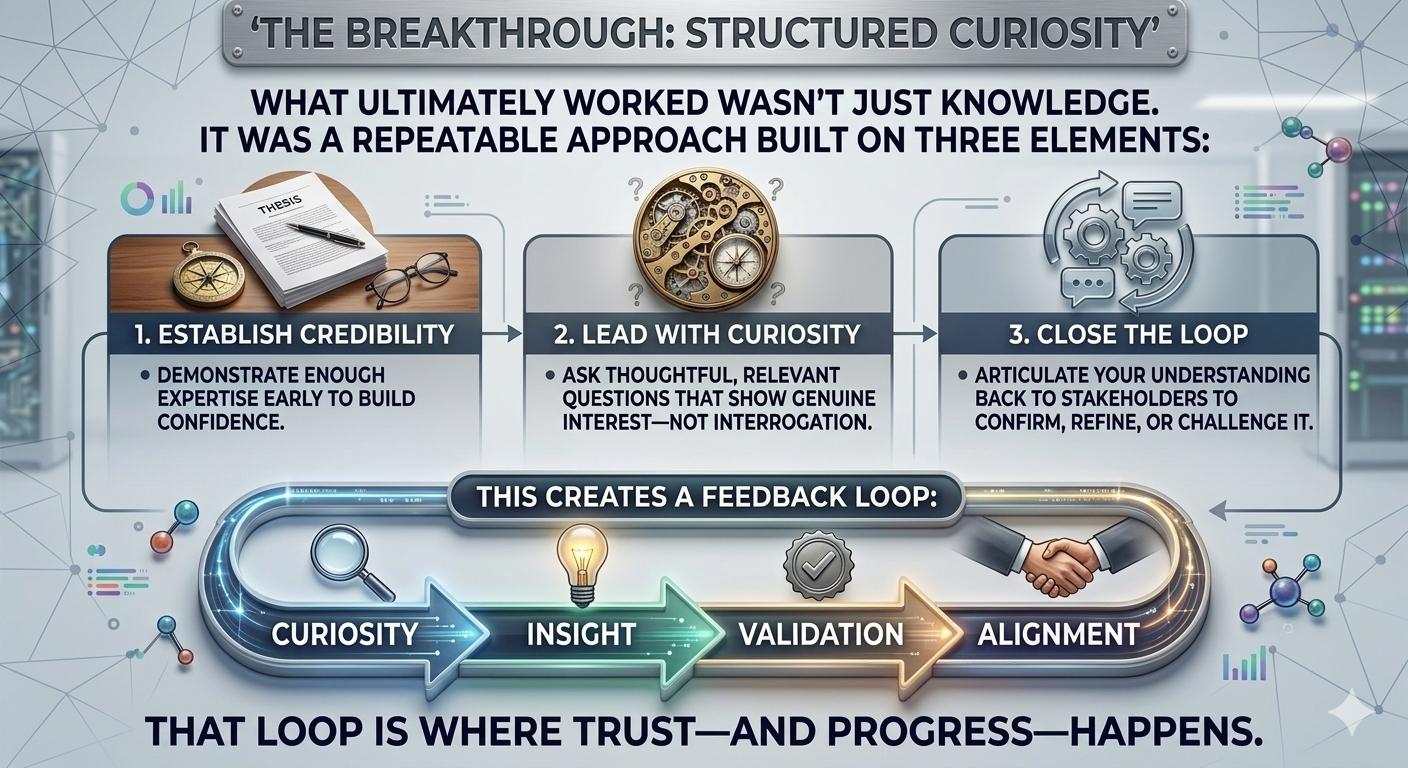
What ultimately worked wasn’t just knowledge. It was a repeatable approach built on three elements:
- Establish credibility
Demonstrate enough expertise early to build confidence. - Lead with curiosity
Ask thoughtful, relevant questions that show genuine interest—not interrogation. - Close the loop
Articulate your understanding back to stakeholders to confirm, refine, or challenge it.
This creates a feedback loop:
Curiosity → Insight → Validation → Alignment
That loop is where trust—and progress—happens.
A Practical Tactic: The “Columbo Technique”
One of the most effective tools I’ve used is commonly called the Columbo Technique.
The idea is simple: Lower defenses by creating psychological safety—and a sense of control.
Instead of pushing for answers, you:
- Ask informed questions
- Make partial observations
- Then, intentionally leave a gap
Something like:
“I might be missing something, but I’m not fully connecting how X impacts Y…”
This does two things:
- Signals humility (reducing resistance)
- Invites correction (which reveals deeper truth)
People tend to open up—not because they’re forced to, but because they want to contribute. They feel safe because you are focused on understanding the situation and solving the problem, and not pointing fingers or assigning blame.
And once that happens, you get access to what actually matters: the “why” behind the “what.”
Applying This in the Real World
This approach works across consulting, sales, and leadership—but only if you apply it deliberately.
Here’s how to operationalize it:
1. Start Broad Before Going Deep
Don’t jump to solutions. Map the landscape first:
- Stakeholders
- Systems
- Constraints
- History
2. Use Their Language
Mirror terminology and examples. It builds alignment faster than forcing your own framework.
3. Validate Early and Often
Don’t wait until the end to present conclusions. Share evolving understanding:
- “Here’s what I think I’m seeing…”
- “Does this match your experience?”
- “Can you help me identify reasons why this might not work?”
4. Balance Confidence with Curiosity
Too much confidence shuts people down.
Too much curiosity erodes credibility.
The balance is where influence lives.
5. Optimize for Adoption, Not Perfection
The best solution is the one that gets implemented and sustained—not the one that looks best on paper.
A great example of this is at a large insurance company, where I led a successful 18-month redesign and implementation of a common Risk Management System used across three distinct businesses.
Before I came, they spent two years and several million dollars with a Big 5 Consulting company. The output was several 3” binders filled with specifications, definitions, and design documents. It was amazing, but wasn’t implementable. I have seen that far too often on consulting engagements.
A section in the middle of this post describes what happened with that project.
Make It Repeatable with the CLEAR Framework
This simple, reusable model can help any company or role.
The C.L.E.A.R. Framework
C — Credibility
- Establish baseline trust quickly.
- Demonstrate you “speak their language.”
L — Learn
- Map systems, stakeholders, constraints, and history.
- Ask high-quality, layered questions.
E — Expose
- Surface gaps, contradictions, hidden dependencies.
- Use techniques like the “Columbo Method.”
A — Align
- Play back understanding.
- Build shared clarity before prescribing.
R — Recommend
- Deliver solutions optimized for adoption and results, not elegance alone.
Why This Matters
Knowledge explains. Curiosity transforms. When you lead with curiosity, you move faster—not slower.
You avoid rework.
You uncover hidden constraints early.
You gain stakeholder alignment before decisions are locked in.
And occasionally, you can help solve problems that have existed for years—in a matter of weeks—because you’re solving the right problem.
If this sounds interesting and you would like to discuss it further or seek out assistance, contact me here.
Getting Your Piece of the PIE

Whether you are selling, consulting, or managing, a foundational approach has consistently helped me succeed. I call it PIE – an acronym that stands for Perspective, Insight, and Experience. When applied effectively, these three elements provide a robust framework for solving problems, winning clients, and leading teams to remarkable outcomes.
Over the years, I’ve taught this methodology to my teams, and it’s been a critical driver of their success. While I usually reserve it for a small circle, I believe it’s time to share it more broadly. I built this methodology and other structured approaches/methodologies as part of developing high-performance teams. They provide the foundation for rapid qualification and faster wins.
Approaches like these are required for consistent, reliable, and scalable organic growth
Perspective – Broaden Your View to Stand Out:
To truly differentiate yourself in any field, you need a broad, informed perspective. This involves understanding the larger environment in which you operate: the market, competitive landscape, customer needs, technological advances, and regulatory shifts. A dynamic perspective evolves as you gain new experiences and encounter different approaches to solving similar problems across other businesses or industries.
This requires a broad understanding of the environment, market, competitive landscape, legal and technological changes, and more. It also grows and changes as you experience new and different things—especially when different approaches to similar problems are taken. It is how you start to stand out in the eyes of your prospects, customers, and team.
Earlier in my career, I taught technical courses. Usually, two or three people stood out. At least one wanted to prove they were better and smarter, and usually, one discussed strange approaches to solving problems. When you dug into those strange approaches, you often found something creative and brilliant coming from a different perspective on the problem. Curiosity and a desire to improve often drove their innovative approaches.
In business, perspective becomes your differentiator. When you can see things from a broader, more holistic viewpoint, you position yourself as someone who can offer more than just solutions—you offer foresight, adaptability, and creativity. You become the lighthouse that guides your clients around tricky situations and to a better destination.
Products create interest. Perspective creates confidence.
How to Apply This:
- Stay informed about industry trends, not just within your niche but across related sectors.
- Engage with diverse thinkers, challenge your assumptions, and be open to unconventional ideas.
- Regularly reassess your strategies in light of new information or shifts in the business environment.
Here is a post that discusses perspective as the starting point.
Insight – The Power of Seeing What Others Don’t:
Insight is one of the most valuable assets you can bring to any business interaction. Too often, people are trapped by existing tools, processes, and perceived constraints. Insight lets you cut through these limitations and spot opportunities for improvement that others miss.
Here’s where perspective plays a role in insight: the broader your view, the better you can generate actionable insights that can transform a business. My most successful deals and projects were not won because I followed the status quo—they were won because I brought fresh ideas to the table. By reframing the problem and presenting a path to a better solution, I created value that competitors cannot match.
How to Apply This:
- Question assumptions and typical approaches. Ask yourself, “Is this really the best way to solve the problem?”
- Look for inefficiencies, bottlenecks, and areas of waste in processes. These are often hidden opportunities for innovation.
- When engaging with clients or teams, offer insights that reframe their challenges and provide a path to improved outcomes by focusing on the “what” rather than the “how.”
Here’s a post that delves deeper into insightfulness.
Experience – The Foundation of Wisdom and Credibility:
Experience is the foundation that supports both perspective and insight. It’s the repository of lessons learned—both successes and failures—that shape your approach to problem-solving and innovation. The more varied and in-depth your experience, the better equipped you are to offer valuable insights and strategies.
Consulting, in particular, is fertile ground for gaining diverse experience. By working with multiple clients across industries, you gain exposure to a wide array of challenges and solutions. In sales, this experience translates into powerful stories that illustrate your ability to help clients achieve better outcomes. The more experience you accumulate, the more confident you’ll become in your ability to deliver meaningful results through transferable competence (taking skills and lessons learned from one domain and applying them to another).
How to Apply This:
- Reflect on your past experiences—what worked, what didn’t, and why. Use these lessons to guide future decisions.
- Build case studies from your experiences to demonstrate your expertise and credibility when engaging with clients or stakeholders.
- Continuously seek out new challenges that stretch your capabilities and expand your knowledge base.
As Albert Einstein wisely said, “The only source of knowledge is experience. You need experience to gain wisdom.” But it’s not just about accumulating experiences—it’s about leveraging them. Your past successes build confidence in your abilities, while your failures provide invaluable lessons that help you avoid costly mistakes in the future.

