
loyalty
The Strangest Feedback I Ever Received
My first job after my consulting company shut down was building a consulting organization for a spinoff database company. The CEO called me the week before, then invited me to meet him in Manhattan the following week. We met for a few hours, then he handed me a piece of paper with a title and salary. I thought about it for a minute, shook his hand, and said, “Thanks, boss.” We devoted the next few days developing a vision for the team that would boost sales and drive greater customer success.
We worked closely for the next six months, but there were times I could tell that I frustrated him. For example, we once met with a top 3 credit card company. They presented their needs, and he told them we could easily handle it.
On the way back to the hotel, I explained the architectural limitations that would make the project very challenging. Then I presented multiple ideas to accomplish what they needed – just not in the way they envisioned it. My focus was on creating a deal that worked, and not just closing a deal that could ultimately hurt our reputation.
A year or so later, I was on a multi-city road trip to visit customers and prospects with each member of the sales team. It was a Thursday afternoon; I had just arrived at a hotel in San Diego where I’d stayed dozens of times over eight years, and I was relaxed and feeling great.
The CEO called, telling me that one of the architects he hired had just given his notice, and asked me if I thought we should try to get him to stay. I explained that this person was extremely talented and worked well with everyone, but he wasn’t working on the things he was hired to do and had been noticeably unhappy for the past several months. I asked if we planned to revive the project this person helped develop, and the answer was ‘no’.
I went on to explain that while this guy was a great person and technical asset, he wasn’t a good fit for the company now or where it was heading, which is why I recommended letting him go. I said we could use his salary to hire one or two people interested in our current direction and get a better return on that investment.
To me, this was a logical decision, and not an emotional one. Most companies have limited resources, and to win, you need to find the greatest leverage for every dollar spent.
His response was, “The thing I love about you is also the thing that I sometimes hate about you.”

There was a brief pause of silence, then I replied, “OK, I’ll bite. What is that?” He said that, unlike everyone else who reported to him, I consistently told him what he needed to hear instead of what he wanted to hear. He told me he valued my perspective, which is why he called, but I often frustrated him by telling him something contrary to his beliefs.
This candid conversation didn’t damage our relationship, and it reinforced a core truth about leadership: loyalty demands clarity first, then compliance.
Safe leaders surround themselves with “yes-men” to protect their egos. Exceptional leaders seek out individuals who care enough about the mission and its success to risk temporary friction. This is about doing the right thing, versus who is right.
Leaders should create an environment where all opinions and data are welcomed during the planning phase. Disagreement isn’t disrespect; it is a risk-mitigation strategy. This is where clearly articulating your concerns persuasively helps. True alignment sometimes requires strong but professional debate behind closed doors: looking for flaws and weaknesses in a plan, refining it as needed, and then executing the final decision as a unified team.
So, do you have the courage to provide the truth – even if it is unpopular? Can you do so in a convincing and professional manner? They might hate it in the moment, but they will value your integrity in the end, especially if you are seen as someone focused on improvement and success, and not just a contrarian.
This is what should be expected of executives within an organization, for the overall good of that organization.
What is Customer Success?
In most companies, it is a department or a team. I would argue that it should be foundational in a company’s culture. Companies need to focus on providing products and services that solve critical business problems for their clientele. By doing so, they create a predictable revenue stream and install base that supports future growth.
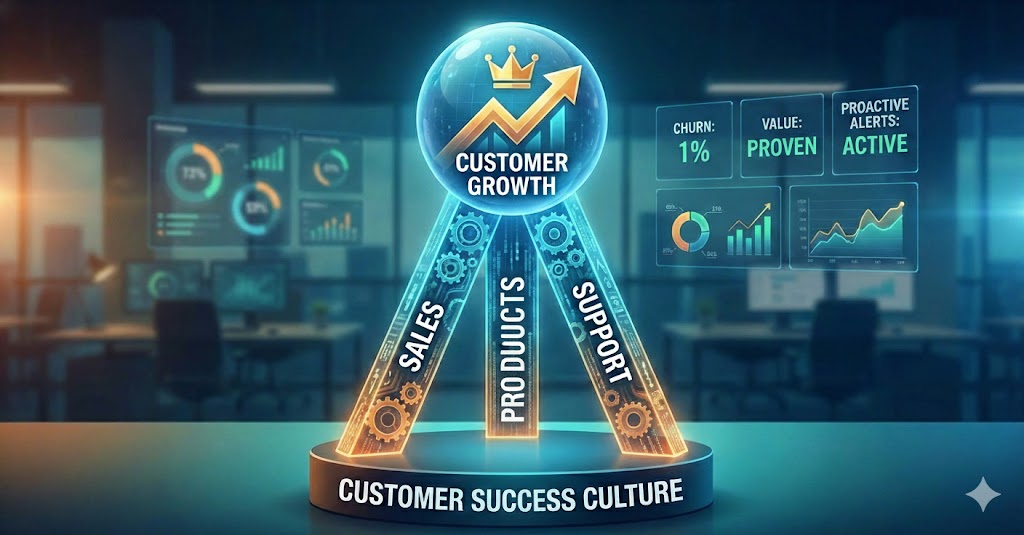
In a quarterly executive meeting a decade or so ago, the head of the Support organization stated this team was the most important. The head of Engineering then stated that her team was the most important. I chimed in and stated, “Without Sales, nothing happens, but ultimately, if all teams are not focused on the same objective, like a tripod, then all teams will ultimately fail.” Our CEO agreed, and that was the end of the discussion.
You could also argue that Marketing and Services should be included, and I would agree, since it goes back to all teams being focused on a singular, overarching goal.
In a previous post about creating Customers for Life, I wrote about an implementation to address customer churn, a byproduct of the company’s failure in one or more areas. This was a wake-up call for me, as we were very focused on the success of our largest accounts and most productive channel partners – totaling 70% of our revenue, but we took the other “less valuable” accounts for granted. The lesson learned was that 30% of $62M is a large number (a “long tail”), and by applying the same techniques to those accounts, we increased organic growth while minimizing churn, improving our overall Net Revenue Retention (NRR) rate.
Why Customer Success Teams Struggle
- Lack of Ownership: They don’t own the accounts and often lack the motivation and accountability for each customer’s health and success.
- Stay Reactive: They are reactive rather than proactive advocates for customers.
- Lack of Resources: They are spread too thin and lack the capacity to actively engage with all but a few customers.
- Enter Too Late: They are not introduced early in the sales process, which is a great way to demonstrate commitment to the prospect’s success if they select you as a vendor.
- Stay Low in the Org Chart: They do not develop relationships beyond a small operational team, limiting executive visibility and expansion potential.
- Ad Hoc in Nature: They lack formal processes, including detailed documentation, that help ensure consistency and continuity over time.
How to Position Your Team for the Win
- SWOT: Review your strengths and weaknesses. Why do companies buy from you? (or, what are you really selling?) What are you known for? What do people like and appreciate? Where do you fall short? (opportunities for others) Accentuate the positive and focus on improvements where needed.
- We often received customer feedback that when they called our support team, their problem was solved on the initial call. With other vendors, it often took 2-3 people to reach someone knowledgeable who could help. We promoted this when selling and reinforced the importance of maintaining this positive image to our internal teams.
- We also received feedback that some of our technical features were lagging behind the competition, so my team and I helped identify the most critical features, then worked with Engineering to prioritize them and focus on bringing in new customers who needed them. It was a win-win.
- Be Proactive: It is often possible to anticipate problems or make improvements based on your understanding of the customer and their history. Being part of the solution means that you don’t wait for the next problem to engage.
- When I had my consulting company, we provided managed services for several large companies. We had proprietary monitoring tools that reported conditions that often led to outages if left unchecked. We addressed the issue and informed the customer once it was resolved. Our monthly summary report listed the likely outages avoided, the average duration of similar outages, and the cost avoided (based on the hourly cost of downtime). Key people saw our value at least monthly, so when it came time to renew our service, the process was fast and painless.
- Become the Internal Liaison: The customer success team should serve as the main conduit for information. Introduce your Services or Engineering teams to the customer early. This doesn’t just solve problems; it uncovers new opportunities to provide value (and sell additional services) that position the customer for even greater success. Engagement and a sense of partnership go a long way.
- I will often introduce the Services team when problems or needs arise. Their expertise and insights can be very valuable, often leading to services that position the customer for even greater success.
- Go Above and Beyond: People remember that. Teams begin to rely on you. And Executives begin to see your company and products as critical to their success. This creates long-term value for your company.
- Focus on the Future: Ask your customers, “How can we help with your upcoming initiatives and projects?” This is a great way to learn what they will be working on, to show your interest in their success, and to identify how your company and products can help them achieve it.
These are things that have been very successful for me when I was leading two large global regions, when I was a top Account Executive at a company with a small customer success team, and as a Consultant. I set expectations, led by example, and they began doing much more of what I expected from the customer success team. We started seeing improvements in the first 30 days.
While leadership doesn’t have to come from designated leaders, cultural changes usually require the commitment, involvement, and support of the organization’s top executives. Everyone can positively influence a company’s direction and success.
When the customer wins and views you as a key partner, your concerns about churn become minimized.
The Imperative Of Customer Trust In 2024
I read a Forbes article that outlined findings for increasing and maintaining customer trust in business today. The summary points are below, and here is a link to the full article.

These points were foundational to the Customer for Life program that I implemented a decade ago. Treating people right is timeless. So, check out the Forbes article and the linked post, then go build stronger relationships with your customers!
What are you doing to improve CX today?
In challenging times, minor frustrations can lead to harmful, long-term negative sentiment. Your approach to Customer Experience (CX) matters more than ever during this pandemic crisis. Your business needs to protect relationship capital and see this as an opportunity to appeal to your next generation of loyal customers.

Recently, I sold a few gold coins on an auction website. The transactions were great and concluded quickly. However, the payment arm of this organization appears to have a bug in its tracking system for USPS Registered Mail. The transaction status displayed “shipped,” but when you clicked the “Tracking” button, it was clear the package had been delivered a few weeks earlier. Still, they were holding a significant amount of money without a clear release date.
While that was a little frustrating, what happened next changed my feelings about this company. I sent several emails to Support and received canned responses. I used their chat option and spoke to a couple of “people” who were either chatbots or should be replaced by chatbots, because no matter what information I provided, the response was always the same and not helpful.
Now, think about tens, hundreds, or even thousands of customers or prospects having problems getting information about your products and services, getting assistance with questions or support for problems, and working with your company in general. In times of increased stress, uncertainty, or competition, the customer experience for each anticipated archetype must be as ideal as possible to increase engagement and loyalty.
Consistently positive interactions, from interactions with branding and marketing, to the customer journey, to onboarding new customers, to successful implementations and support, increase lifetime customer value, repeat business, and overall business growth. Every touchpoint should increase your emotional connection with that customer.
I’ve always told my teams that “People buy easy,” so, as a group or organization, we aim to make it as efficient and frictionless as possible to conduct business with us. By doing that, being fair, and acting with integrity, we earn loyal customers who support our business’s growth.
Relationships develop over time, and each interaction helps determine the eventual outcome. Understanding what differentiates your company and products in your customers’ and prospects’ eyes can help you create more meaningful, consistent, and valuable interactions. People appreciate a positive customer experience, so those efforts may ultimately lead to developing Customers for Life.
Now is the time to evaluate your end-to-end processes, procedures, guidelines, and interfaces. Be extremely critical as you ask yourself, “Is this how I would like to be treated as a customer?” By making CX a strategic priority, your business or organization will eliminate friction and ensure customers are treated well and feel valued. Moreover, as you increase install base loyalty and engagement, you will be rewarded with renewals, expansion, references, referrals, and suggestions to improve your products. Everyone wins.
Investments in CX today can deliver an immediate payback and increase long-term growth.

