Latest Event Updates
The Importance of Proper Pricing

Pricing is one of those things that can make or break a company. Doing it right takes an understanding of your business (cost structure and growth / profitability goals), the market, your competition, and more. Doing it wrong can mean the death of your business (fast or slow), the inability to attract and retain the best talent, as well as creating a situation where you will no longer have the opportunity to reach your full potential.
These problems apply to companies of all sizes – although large organizations are often better positioned to absorb the impact of bad pricing decisions or sustain an unprofitable business unit. Understanding all possible outcomes is an important aspect of pricing related to risk and risk tolerance.
When I started my consulting company in 1999, we planned to win business by pricing our services 10%-15% lower than the competition. It was a bad plan that didn’t work. Unfortunately, this approach is something you see all too often in businesses today.
We only began to grow after increasing our prices (about 10% more than the competition) and focused on justifying that with our expertise and the value provided. We were (correctly) perceived as a premium alternative, and that positioning helped us grow.
Several years ago, I had a management consulting engagement with a small software company. The business owner told me they were “an overnight success 10 years in the making.” His concern was that they might not be able to capitalize on recent successes, so he was looking for an outside opinion.
I analyzed his business, product, customers, and competition. His largest competitor is the industry leader in this space, and products from both companies were evenly matched from a feature perspective. My client’s product even had a few key features that were better for management and compliance in Healthcare and Union environments that his larger and more popular competitor lacked. So, why weren’t they growing faster?
I found that competition was priced 400% higher for the base product. When I asked the owner, he told me their goal was to be priced 75% – 80% less than the competition. He could not explain why he did this other than to state that he believed that his customers would be unwilling to pay any more than that. His lack of confidence in his product became evident to companies interested in his solution.
He often lost head-to-head competition against that competitor, but almost never on features. Areas of concern were generally the size and profitability of the company and the risk created by each for prospects considering his product.
I shared the graph (below) with this person, explaining how proper pricing would increase their profitability and annual revenue and how both of those items would help provide customers and prospects with confidence. Moreover, this would allow the company to grow, eliminate single points of failure in key areas (Engineering and Customer Support), add features, and even spend money on marketing. Success breeds success!

In another example, I worked with the Product Manager of a large software company responsible for producing quarterly product package distributions. This work was outsourced, and each build cost approximately $50K. I asked, “What is the break-even point for each distribution?” That person replied, “There really isn’t a good way to tell.”

By the end of the day, I provided a Cost-Volume-Profit (CVP) analysis spreadsheet that showed the break-even point. Even more important, it showed the contribution margin and demonstrated there was very little operating leverage provided these products (i.e., they weren’t very profitable even if you sold many of them).
My recommendations included increasing prices (which could negatively impact sales), investing in fewer releases per year, or finding a more cost-effective way of releasing those products. Without this analysis their “business as usual” approach would have likely continued for several years.
Companies are in business to make money – pure and simple. Everything you do as a business owner or leader needs to be focused on growth. Growth is the result of a combination of factors, such as the uniqueness of the product or services provided, quality, reputation, efficiency, and repeatability. Many of these are the same factors that also drive profitability. Proper pricing can help predictably drive profitability, and having excess profits to invest can significantly impact growth.
Some customers and prospects will do everything possible to whittle your profit margins down to nothing. They are focused on their own short-term gain and not on the long-term risk created for their suppliers. Those same “frugal” companies expect to profit from their own business, so it is unreasonable to expect anything less from their suppliers.
My feeling is that “Not all business is good business,” so it is better to walk away from bad business in order to focus on the business that helps your company grow and be successful.
One of the best books on pricing I’ve ever found is “The Strategy and Tactics of Pricing: A Guide to Profitable Decision Making” by Thomas T. Nagle and Reed K. Holden. I recommend this extremely comprehensive and practical book to anyone responsible for pricing or with P&L responsibility within an organization. It addresses the many complexities of pricing and is truly an invaluable reference.
In a future post, I will write about the metrics I use to understand efficiency and profitability. Metrics can be your best friend when optimizing pricing and maximizing profitability. This can help you create a systematic approach to business that increases efficiency, consistency, and quality.
At my company we developed a system where we know how long common tasks would take to complete, and had efficiency factors for each consultant. This allowed us to create estimates based on the type of work and the people most likely to work on the task and fix-bid the work. Our bids were competitive, and even when we were the highest-priced bid we often won because we would be the only (or one of the few) companies to guarantee prices and results. Our level of effort estimates were +/- 4%, and that helped us maintain a 40%+ minimum gross margin for every project. This analytical approach helped our business double in revenue without doubling in size.
There are many causes of poor pricing, including a lack of understanding of cost structure; Lack of understanding of the value provided by a product or service; Lack of understanding of the level of effort to create, maintain, deliver, and improve a product or service; and Lack of concern for profitability (e.g., salespeople who are paid on the size of the deal, and not on margins or profitability).
But, with a little understanding and effort, you can make small adjustments to your pricing approach and models that can have a huge impact on your business’s bottom line.
Doing it like Mike
My son is playing basketball this year (previously, he played football and soccer), and recently we went shopping for new shoes. Each store had pictures of Michael Jordan. I used to love watching MJ play with the Chicago Bulls. He was the epitome of skill and professionalism. To this day, he inspires me.
Some people are naturally talented but must still work hard to achieve their full potential. Hard work is an important aspect of being the best at anything, but it takes more than that. It takes doing things in a manner that allows you to continuously improve, as well as a positive mindset and a commitment to success. Once people reach that high-performance level, their jobs look easy, and they may even appear to be a “natural” – just like Mike. But that is just the tip of the iceberg.
Most of my career changes have been unplanned. Opportunities presented themselves, the job seemed interesting, and before I knew it, I was fully immersed in something related but different. The potential reward outweighed the real risk.
Many of these things have not come naturally to me. Each time I focused on understanding the requirements for doing the job well, then looked for examples of exceptional performance, and finally created a systematic approach that allowed me to measure performance and identify areas of improvement on an ongoing basis. From then on it was analyzing my results, thinking daily about even the smallest improvements, and then trying to do even better the next day.
Good enough was never good enough. Introspection can be challenging, so one thing that I have done is to take time to celebrate wins and intentionally focus on remembering how that feels. Those memories can be motivational in times of stress or frustration and help you get back on track quickly.
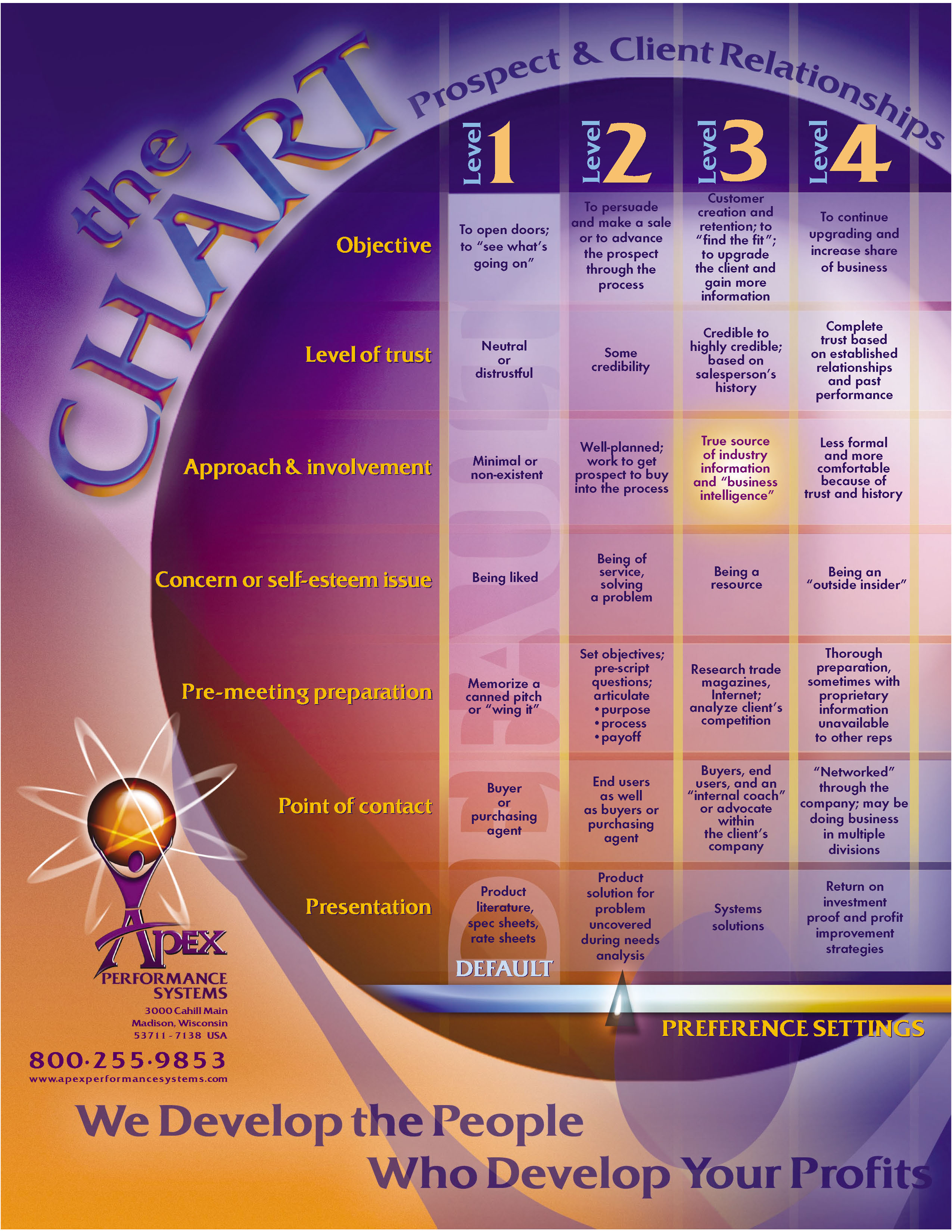
Sales have been a large part of my consulting management jobs since the mid-1990s, but it wasn’t until I owned my own company that this became a true priority. I ran across a good book, The Accidental Salesperson, by Chris Lytle. Back then, Chris Lytle had “MAX Training,” and a large part of their focus was increasing your “level” with regard to Prospect and Client relationships. The training was good and was complementary to systems like Miller Heiman.
What each of these systems do is help you prepare, plan, and execute to the best of your ability. And just like basketball, it takes practice to master. With mastery comes success and the illusion that something is easy (or you are lucky). The Seneca quote, “Luck is what happens when preparation meets opportunity,” is so true.
Regardless of the system used, what is most important is that you are trying to be the best at is to look at both positive and negative examples to see what you can learn from them. There are lessons to be learned everywhere! Understanding what makes it good or bad helps you improve as part of an ongoing improvement process.
Incorporating new tools and techniques into what has already been proven to work will help you improve your game. Returning to the sports analogy, this could be part of what made Michael Jordon so good. He would see something interesting, improve it, and then make it his own.
For example, I get many horrible sales calls and emails. The people have obviously not done any preparation, do not know anything about me or the company I work for, and often remind me of why I stopped listening to them by referring to the number of times they have tried contacting me. On the other hand, some talented sales professionals have done their homework, understand their products and the competition, and understand why what they are selling should matter to me – and can articulate that quickly and confidently. I will speak with them and occasionally buy from them. And in either case I provide my team with real-life examples of good and bad sales techniques.
So, think of the best example of whatever it is you do, and see what you can do to become more like them. This isn’t about imitation but rather about uncovering the secrets of their success and learning from them. And have some fun doing it!
A missed opportunity for Geospatial
I have a Corvette that I like to work on for fun and relaxation. It gives me an excuse to learn something new and an opportunity to hone my troubleshooting skills. It can be a fun way to spend a few hours on a weekend.
A few weekends ago I was looking for a few parts for a small project. This was spur of the moment and really didn’t need to be done now (as the car will be stored soon for the winter). I found the parts I needed from a single company, but then something strange happened.
This website had my address, knew the two parts that I wanted, but failed to make the process easy and almost lost a sale. I needed to manually check five different store locations to see if they had both parts. In this case two of the five did. One store was about 5 miles from my house and the other about 20 miles away.
Just think how helpful it would have been for this website to use the data available (i.e., inventory and locations) and present me with the two options or better yet default me to the closest store and note the other store as an option. Using spatial features this would be extremely easy to implement. It’s the equivalent to the “Easy Button” that one office supply uses in their commercials.
Now, take this example one step further. The website makes things quick and easy, leaving me with a very pleasant shopping experience. It could then recommend related items (it did, but by that time I had wasted more time than necessary and was questioning whether or not I should start that project that day). The website could have also created a simple package offer to try to increase my shopping cart value.
All simple things that would generate more money through increased sales and larger sales. It would seem that this would be very easy to justify from both a business and technical perspective, assuming the company is even aware of this issue.
I frequently tell my team that, “People buy easy.” Help them understand what they need to accomplish their goals, price it fairly, demonstrate the value, and they make the rest of the sales process easy to complete. This makes happy customers and leads to referrals. It just makes good business sense to do this.
So, while geospatial technology might not be the solution to all problems, this is a specific use case where it would. The power of computing systems and applications today is that there is so much that can be done so fast, often for reasonably low investment costs in technology. But the first step getting there is to ask yourself, “How could we be making this process easier for our customers?”
A little extra effort and insight can have a huge payoff.
Lessons Learned from Small Business Ownership

I learned many valuable lessons over the course of the 8+ years that I owned my consulting business. Many were positive, a few were negative, but all were educational. These lessons shaped my perceptions about and approaches to business, and have served me well. This post will just be the first of many on the topic.
My lessons learned covered many topics: How to structure the business; Business Goals; Risk; Growth Initiatives and Investment; Employees and Benefits; Developing a High-Performance Culture; Marketing and Selling; Hiring and Firing; Bringing in Experts; Partners and Contractors; The need to let go; Exit Strategies and more.
In my case these lessons learned were compounded by efforts to start a franchise for the consulting system we developed, and then our expansion to the UK with all of the challenges associated with international business.
It’s amazing how more significant those lessons are (or at least feel) when the money is coming out of or going into “your own pocket.” Similar decisions at larger companies are generally easier, and (unfortunately) often made without the same degree of due diligence. Having more “skin in the game” does make a difference when it comes to decision making and risk.
Businesses are usually started because someone is presented with a wonderful opportunity, or because they feel they have a great idea that will sell, or because they feel that they can make more money doing the same work on their own. Let me start by telling you that the last reason is usually the worst reason to start a business. There is a lot of work to running a business, a lot of risk, and many expenses that most people never consider.
I started my business because of a great opportunity. There were differences of opinion about growth at the small business I was working for at the time, and this provided me with the opportunity to move in a direction that I was more interested in (shift away from technical consulting and move towards business / management consulting). Luckily I had a customer (and now good friend) who believed in my potential and the value that I could bring to his business. He provided both the launch pad and safety net (via three month initial contract) that I needed to embark on this endeavor. For me the most important lesson learned is to start a business for the right reasons.
More to come. And, if you have questions in the meantime just leave a comment and I will reply. Below are some of the statistics on Entrepreneurship that can be pretty enlightening:
Bureau of Labor Statistics stats on Entrepreneurship in the US
Connecting the Dots Faster

When I started consulting, an experienced consultant told me, “The best Consultants are experts at becoming Experts.” I started my consulting career with that goal in mind. After a few years realized that “Good consults are people who can learn enough quickly to ask intelligent questions and then connect the dots faster.” This is a great skill for anyone, regardless of the industry or business.
It’s impossible to be an expert at everything. I believe having great depth in a few areas (true expertise) and breadth of knowledge in many areas (enhancing context and insight) is important. Both types of knowledge alone are valuable, but combined, they add a dimension that allows a person to be far more effective and potentially much more valuable because it leads to the ability to pick up on the dependencies and nuances that others miss.
Just think – How much more effective is a salesperson who understands technology and project management concepts when working to demonstrate fit and create a sense of urgency? Or, an Attorney who understands the complexity of service offerings and delivery – enhancing their ability to construct agreements that are highly protective yet not overly complex or onerous. Or a programmer who thinks beyond the requirements and looks for ways to improve or simplify the process. Extra knowledge helps with the big picture understanding, and that often leads to providing more value by “thinking outside the box.” Additional knowledge and skills almost always help us become more effective, regardless of what we may be doing.
Increased knowledge and a desire to do amazing things create opportunities to make a huge and immediate impact. Sometimes it is because you are asking the questions that others may be thinking but simply cannot articulate in a clear manner. It helps you see the gaps and holes that others miss. And most importantly, it helps you “connect the dots” before others do (often many months before something obvious to you becomes obvious to others). A large consultancy once used the phrase “seeing around corners” to make this concept tangible.
So, if you buy into the concept that knowledge is good, the next question is usually, “What is the best way to learn?” People learn in different ways, so there really is no one single best way to learn. Understanding how you learn best will help you learn faster.
I’m a fan of reading. A good book may reinforce ideas you already know, introduce you to a few concepts or ideas that seem like they could help (giving you something to test), and often present many ideas that you know or feel just won’t work. Just don’t become one of those people who changes their beliefs and approach with every book they read (or what I refer to as “The book of the month club manager.“)
I’m also a fan of hands-on learning. The experience of doing something the first time is important. Keeping detailed notes (what works, what doesn’t make sense, what you did to figure it out, workarounds, etc.) enhances the value of that experience. It’s amazing what you can learn when you “get your hands dirty.”
What about formal education? I’ve never been a fan of the person who wants to get a degree in order to get a promotion. There are certainly some professions where education is critical to success (often through legitimacy as much as anything else). My advice to people is to work towards a specific degree because it is important as a personal goal and because it could possibly help you get a different or better job in the future. I will never criticize anyone for learning, going to school, or getting another certification or degree.
I believe the best way to get ahead is to learn the position, innovate, optimize, and deliver incredible results. You won’t “knock it out of the park” every time, but those “base hits” will help you score and ultimately win.
This is not to say that formal education is bad; I don’t believe that at all. I was working on my MBA at the same time I was expanding my consulting business from the US to the UK. I had a concentration in International Business, so I could apply many things I was learning right away. This bit of serendipity both enhanced my learning experience and helped me make better decisions that had real implications for my business. The funny thing was that I was working on that degree to raise the bar for my children, so this was just a bonus for me.
There are also other great ways to learn – ways that only require an investment of your time. There are many good free online courses. If you are interested in learning something or need to know more about it, there is almost always a place to find free or low-cost training. These are great investments in yourself and your future, and may help you learn to connect those dots faster.
Below are links to a few good free learning websites. Do yourself a favor and check them out. And, if you know of others, leave a comment and recommend them to others. Enjoy!
OpenCulture (directory with content from multiple sources)
Open Education Database (directory with content from multiple sources
 Where Ideas, Experiences, and Lessons Learned Intersect