management
What is Customer Success?
In most companies, it is a department or a team. I would argue that it should be foundational in a company’s culture. Companies need to focus on providing products and services that solve critical business problems for their clientele. Failing to do that will ultimately lead to the death of products and ultimately corporate decline.
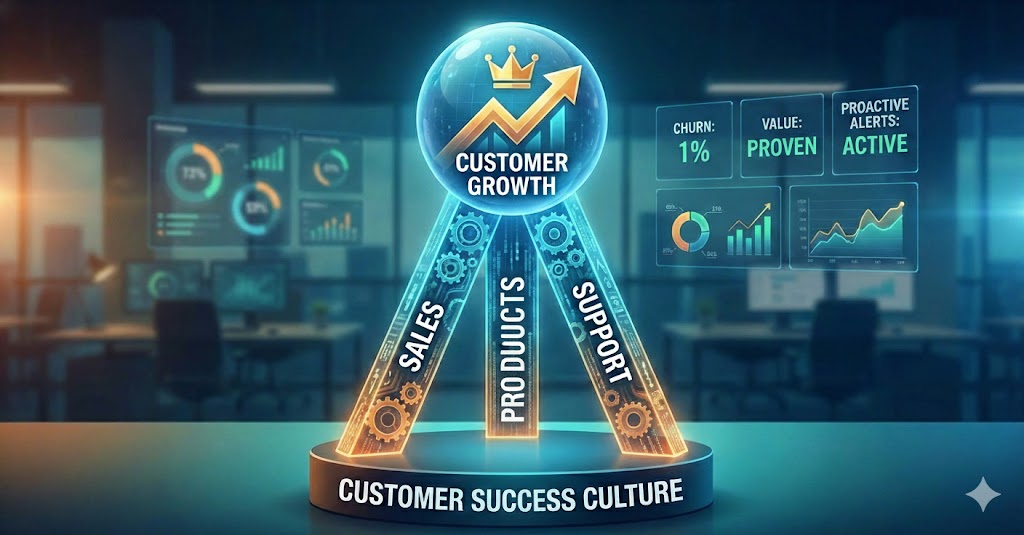
In a quarterly executive meeting a decade or so ago, the head of the Support organization stated this team was the most important. The head of Engineering then stated that her team was the most important. I chimed in and stated, “Without Sales, nothing happens, but ultimately, if all teams are not focused on the same objective, like a tripod, then all teams will ultimately fail.” Our CEO agreed with me, and that was the end of the discussion.
You could also argue that Marketing and Services should be included, and I would agree, since it goes back to all teams being focused on a singular, overarching goal.
In a previous post about creating Customers for Life, I wrote about a tactical implementation to address customer churn, which is the byproduct of failure in one or more areas. This was a wakeup call for me, as we were very focused on the success of our largest accounts and most productive channel partners – totaling 70% of our revenue, but we took the other “less valuable” accounts for granted. The lesson learned was that 30% of $62M is a large number, and by applying the same techniques to those accounts, we increased organic growth while minimizing churn.
Why Customer Success Teams Struggle
- Lack of Ownership: They do not own the accounts and often lack the motivation and accountability for the health and success of each customer.
- Stay Reactive: They are reactive rather than proactive advocates for customers.
- Lack of Resources: They are spread too thin and lack the capacity to actively engage with all but a few customers.
- Enter Too Late: They are not introduced early in the sales process, which is a great way to demonstrate commitment to the prospect’s success if they select you as a vendor.
- Stay Low in the Org Chart: They do not develop relationships beyond a small operational team, limiting executive visibility and expansion potential.
- Ad Hoc in Nature: They lack formal processes, including detailed documentation, that help ensure consistency and continuity over time.
How to Position Your Team for the Win
- SWOT: Review your strengths and weaknesses. Why do companies buy from you? (or, what are you really selling?) What are you known for? What do people like and appreciate? Where do you fall short? (opportunities for others) Accentuate the positive and focus on improvements where needed.
- We often received feedback from customers that when they called our support team, their problem was often solved on the initial call. With other vendors, it often required going through 2-3 people to get to someone knowledgeable who could help. We promoted this when selling and reinforced the importance of maintaining this positive image to our internal teams.
- We also received feedback that some of our technical features were lagging behind the competition, so my team and I helped identify the most critical features, then worked with Engineering to prioritize them and focus on bringing in new customers who needed them. It was a win-win.
- Be Proactive: It is often possible to anticipate problems or make improvements based on your understanding of the customer and their history. Being part of the solution means that you don’t wait for the next problem to engage.
- When I had my consulting company, we provided managed services for several large companies. We had proprietary monitoring tools that would report conditions that often led to outages if unchecked. We would address the issue and inform the customer once it was resolved. Our monthly summary report listed the likely outages avoided, the average duration of similar outages, and the cost avoided (based on the hourly cost of downtime). Key people saw our value at least monthly, so when it came time to renew our service, the process was fast and painless.
- Become the Internal Liaison: The customer success team should serve as the main conduit for information. Introduce your Services or Engineering teams to the customer early. This doesn’t just solve problems; it uncovers new opportunities to provide value (and sell additional services) that position the customer for even greater success. Engagement and a sense of partnership go a long way.
- I will often introduce the Services team when problems or needs arise. Their expertise and insights can be very valuable, often leading to services that position the customer for even greater success.
- Go Above and Beyond: People remember that. Teams begin to rely on you. And Executives begin to see your company and products as critical to their success. This creates long-term value for your company.
- Focus on the Future: Ask your customers, “How can we help with your upcoming initiatives and projects?” This is a great way to learn what they will be working on, to show your interest in their success, and to identify how your company and products can help them achieve it.
These are things that have been very successful for me when I was leading two large global regions, when I was a top Account Executive at a company with a small customer success team, and as a Consultant. I set expectations, led by example, and they began doing much more of what I expected from the customer success team. We started seeing improvements in the first 30 days.
While leadership doesn’t have to come from designated leaders, cultural changes usually require the commitment, involvement, and support of the organization’s top executives. Every person has the potential to make a positive impact on a company’s direction and success.
When the customer wins and views you as a key partner, you don’t have to worry about churn.
Success is a Mental Game
This assertion is as true in business as in sports, individually and in teams. So, let’s break it down.

When I watch my local football team, I occasionally see a shift in facial expressions from excitement to frustration – often right before the end of the first half. Sometimes, they recover during halftime and come out renewed and ready to win, but the “gloom and doom” expressions usually translate into suboptimal performance and mistakes. It is frustrating because you know they have the talent to win.
The same thing happens in business – especially in Sales. Sometimes it occurs in the middle of a sales cycle, similar to the example above. Unfortunately, too many people allow a few data points to determine their future trajectory. Why is that?
Whether you own a company or manage a group of people, good leaders aim to optimize their workforce by balancing factors that result in happy and loyal employees doing their best for themselves, their customers, and their company. Many motivational theories exist, such as Expectancy Theory, Reinforcement Theory, the Role of Instrumentality, Intrinsic vs. Extrinsic Motivation, and more. Since one size rarely fits all, the challenge becomes an effort of reward-focused personalization, which can be a lot of work.
People will often win or lose before they even start. Their negativity, self-doubt, and anticipation of failure become a self-fulfilling prophecy. This post focuses on self-motivation, attitude, mindset, and creating the habits that lead to better success.
Below are four simple questions that someone should ask themselves when they question their ability to succeed in a position, company, or industry. There are always many ways to point the finger of blame elsewhere, but the first step should be to look in the mirror.
- Do you believe that you can win where you are today? If not, why are you still there? Customers and prospects can sense insincerity, so if you don’t believe in yourself, you shouldn’t expect them to believe in you. Maybe the company is terrible, and everyone is failing. If that is true, then it is probably time to look elsewhere.
- What have you learned from past successes and failures, and how have you adapted based on those lessons learned?
- What are some early indicators of success or failure that you have identified? Are you adapting to the situation if you run into those indicators now? It could be that the best approach is to cut your losses on this attempt and move to the next sooner rather than later (i.e., qualify out quickly).
- What are you doing to improve your skills? It is funny how small, continuous improvement efforts lead to a greater sense of confidence. Greater confidence often translates to increased success.
I have found that consistently doing the right things is the best way to maximize my success. Start developing habits and routines that have led to winning in the past, but don’t expect them to work forever. Everything changes, and you should change, too. Look for things that are working for others, try them out, and if they work, incorporate them into your routines.
Success truly is a mental game, and everyone can win. The person who continues to win over time is the person who does not get stuck in time. Be curious, get excited, and adapt. And once you get there, start helping others. Having mentors is nice, but it is also great to become one.
As the saying goes, The rising tide lifts all boats. Winning can be a team sport, but it begins with individual contributors having winning attitudes. Unfortunately, the same can be said for losing, so decide now what you want and go forward with energy and confidence.
Shouldn’t Sales Forecasting be Easy? What about Accuracy?
I’m sure that everyone has read articles that state some “facts” for managing your “sales pipeline” or “sales funnel.” Things like needing 10x-30x of your goal at the start of the process, down to needing 2x-3x coverage at the start of a quarter to help increase your odds of achieving your goal. Now, if it was only that easy…
First, what are you measuring? The answer to this question is something that anyone with a sales quota should be able to succinctly answer. For example, are you measuring?
- Bookings – Finalized Sales Orders
- What happens when Sales Operations, Finance, or Legal push back on a deal? You have a PO, but has the deal really been closed?
- Billings – Invoicing Completed
- This includes dependencies that have the potential to introduce delays that may be unexpected and/or outside of your control.
- Revenue – An in-depth understanding of Revenue Recognition rules is key.
- How much revenue is recognized and when it is recognized varies based on a variety of factors, such as:
- Is revenue Accrued or Deferred? This is especially key for multi-year prepaid deals.
- Is revenue recognized all at once – such as for the sale of Perpetual Software Licenses? (even this is not always black and white)
- Is revenue recognized over time – such as with annual subscriptions that are ratable on a monthly basis?
- Is revenue based on work completed / percentage of completion? This is more common with Services and Construction. Combining contracts, such as selling custom consulting services with a new product license, can complicate this.
- Are there clauses in a non-standard agreement that will negatively affect revenue recognition? This is where your Legal team becomes an invaluable contributor to your success.
- Cash Flow – Is this really Sales forecasting?
- The answer is ‘no’ in terms of Accounting rules and guidance.
- But, if you have a start-up or small business, this can be key to “keeping the lights on,” in which case the types of deals and their structure will be biased towards cash flow enhancement and/or goals.
- How much revenue is recognized and when it is recognized varies based on a variety of factors, such as:
My advice is to work closely with your CFO, Finance Team, Sales Operations Team, and Legal team to understand the goals and guidelines and then take that one step further to create policies that are approved by those stakeholders and are then shared with the Sales team to avoid any ambiguity around process and expectations.
So, now the hard part is over, right?
 It could be that easy if you only have one well-established product, a stable install base, and no real competitive threats, where the rate of growth or decline is on a steady and predictable path and where pricing and average deal sizes are consistent. I have not seen a business like that yet, but I would have to believe that at least a few exist.
Next, what are you building into your model to maximize accuracy? Every product or service offered may be driven by independent factors, so a flat model that evenly distributes sales over time (monthly or quarterly) is just begging to be inaccurate. For example:
- One product line that sells perpetual licenses may depend on release cycles every 18-36 months.
- A second product line may be driven mainly by renewals and expansion on fairly stable timelines and billings.
- A third product line may be new with no track record and in a competitive space – meaning that even the best projections will be speculative.
- Finally, services could be associated with each product line and driven by more dependent and independent factors (new implementations, upgrades, implementing new features, platform changes and modernization, routine engagements, training, etc.)
Historical trends are one important factor to consider, especially because they tend to be the things you have the greatest control over. This starts with high-level sales conversion rates and goes down to average sales cycle, seasonal trends, organic growth rates, churn rates, and more. Having accurate data over time that can be accurately correlated is extremely helpful. But factors such as Product SKU changes, licensing model changes, new product bundles, etc., increase the complexity of that effort and potentially decrease the accuracy of your results.
Correlating those trends to external factors, such as overall growth of the market, relative growth of competitors, economic indicators, corporate indicators (profits, earns per share, distributions, various ratios, ratings, etc.), commodity and futures prices (especially if you install base tends to skew towards something like the Petroleum Industry), specific events, and so forth can be a great sanity check.
The best case is that those correlations increase your forecasting accuracy for the entire year. In all likelihood, they provide valuable inputs that allow you to dynamically adjust sales plans as needed to ensure overall success. But, making those changes should not be done in a vacuum, and communicating the potential need for changes like that should be done at the earliest point where you have a fair degree of confidence that change is needed.
There will always be unexpected events that negatively impact your plans. Changes to staffing or the competitive landscape, reputational changes, economic changes, etc., can all occur quickly and with “little notice.” That is especially true if you are not actively looking for those subtle indicators (leading and trailing) and nuances that place a spotlight on potential problems and give you time to do as much as possible to proactively address them. Be prepared and have a contingency plan!
Forecasting accuracy drives confidence, which leads to the ability to do things like getting funding for new campaigns or initiatives. Surprises, even positive ones, are generally disliked simply because the results are different than the expectations, which begins to fuel other doubts and concerns.
Confidence comes from understanding, good planning, helping everyone with a quota, and the teams supporting them to do what is needed when it is needed to optimize the process and then to have an effective approach to determine whether deals really are on track or not so that you can provide guidance and assistance before it is too late.
It may not be easy, but it is the thing that helps drive companies to the next level on a sustainable growth trajectory. In the end, that matters the most to the stakeholders of any business.
As an aside, myriad rules, regulations, and guidance statements are provided by various sources that apply to each business scenario. I am neither an Accountant nor an Attorney, so consult with the appropriate people within your organization or industry as part of your routine due diligence.
The Value Created by a Strong Team
I participated in an amazing team-building exercise as a Board Member for the Children’s Hospital Foundation of Wisconsin. We were going down a path that led to a decision on whether or not to invest $150M in a new addition. The CEO at the time, Jon Vice, wisely determined that strong teams were needed for each committee in order to thoroughly vet the idea from every possible perspective.

The process started with being given a book to read (“Now, Discover Your Strengths” by Marcus Buckingham & Donald O. Clifton, Ph.D.) and then completing the “Strengthsfinder” assessment using a code provided in the book. The goal was to understand gaps in perception (how you view yourself vs. how others view you) so that you could truly understand your own strengths and weaknesses. Then, teams were created with people having complementary skills to help eliminate weaknesses from the overall team perspective. The results were impressive.
Over my career, I have been involved in many team-building exercises and events – some of which provided useful insights. However, most failed to combine the findings meaningfully, provide useful context, or offer actionable recommendations. Key areas that were consistently omitted were Organizational Culture, Organizational Politics, and Leadership. Those three areas significantly impact value creation vis-à-vis team effectiveness and commitment.
When I had my consulting company, we had a small core team of business and technology consultants and would leverage subcontractors and an outsourcing company to allow us to take on more concurrent projects as well as larger, more complex projects. This approach worked for three reasons:
- We had developed a High-Performance Culture that was based on:
- Purpose: A common vision of success, understanding why that mattered, and understanding how that was defined and measured.
- Ownership: Taking responsibility for something and being accountable for the outcome. This included responsibility for the extended team of contractors. Standardized procedures helped ensure consistency and make it easier for each person to accept responsibility for “their team.”
- Trust: Everyone understood that they not only needed to trust and support each other, but in order to be effective and responsive, the others would need to trust their judgment. If there was a concern, we would focus on the context and process improvements to understand what happened and implement changes based on lessons learned. Personal attacks were avoided for the good of the entire team.
- Empowerment: Everyone understood that there was risk associated with decision-making while at the same time realizing that delaying an important decision could be costly and create more risk. Therefore, it was incumbent upon each member to make good decisions as needed and then communicate changes to the rest of the team.
- Clear and Open Communication: The people on the team were very transparent and honest. When there was an issue, they would attempt to resolve it first with that person and then escalate if they could not reach an agreement and decided to seek the team’s consensus. Everything was out in the open and done in the spirit of being constructive and collaborating. Divisiveness is the antithesis of this tenet.
People who were not a good fit would quickly wash out, so our core team consisted of trusted experts. A friendly competition helped raise the bar for the entire team, but when needed, the other team members became a safety net for each other.
We were all focused on the same goal, and everyone realized that the only way to be successful was to work together for the team’s success. Win or lose, we did it together. The strength of our team created tremendous value – internally and for our customers that we sustained for several years. That value included innovation, higher levels of productivity and profitability, and an extremely high success rate.
This approach can work at any level but is most effective when it starts at the top. When employees see their company leaders behaving in this manner, it provides the model and sets expectations for everyone under them. If there is dysfunction within an organization, it often starts at the top – by promoting or accepting behaviors that do not benefit the whole of the organization. But, with a strong and positive organizational culture, the value of strong teams is multiplied and becomes an incredible competitive advantage.
Creating Customers for Life (4 minute read)
The goal for any business, regardless of the products you sell or the services you provide, should be maintaining a satisfied customer base that is loyal to your business. The idea is to create a mutually beneficial relationship that motivates people to want to continue working with you despite the availability of competitive products or motivations (e.g., those pushing for a “Corporate Standard” involving another product.)
The best part is that this concept applies to all companies and all Product Life Cycle stages. Whether your company is on a rapid growth trajectory towards ‘Unicorn status,’ your offerings are mature and viewed as ‘less exciting.’ The approach will also help if your products decline and you seek the ‘longest tail’ possible. At each phase, there are credible threats from competitors that seek to grow through the erosion of your business.

Several years ago, I was responsible for two product lines in two major geographic regions (Americas and APAC/Japan). Our attrition rate (“churn”) was traditionally slightly below the industry average. We began seeing an increase in churn and a corresponding decrease in organic growth. Both were indicators that something needed to change.
After discussing tactical approaches to address this, our small leadership team agreed that this was a strategic issue we needed to address. The result was an understanding that we needed to create ‘Customers for Life.’ Everyone agreed with the concept, but due to various differences (culture, who our customer was – end customer vs. channel partner, buying patterns, etc.), we agreed to try what was best for each of our regional businesses and share the results and lessons learned.
My approach focused on developing strong relationships that fostered collaboration and ultimately led to growth and success for both parties. The basic premise was simple:
- People tend to buy from people they like, respect, and trust. Become one of those people for your customers.
- Helping companies achieve better business outcomes leads to greater success for our customers and us.
How did we do it? It was a systematic process that my team used that included the following:
- Develop simple profiles for each customer (e.g., products used, date of first purchase, size of footprint, usage and payment trends, industry).
- An optimal size – based on the size of the product footprint, annual amount spent with us, or size of the company- was used to prioritize companies and organizations with the most significant potential impact.
- Make contact multiple times yearly, not just when you want money.
- These “out of cycle” contacts became very important.
- Ask questions about key initiatives, milestones, and concerns.
- We documented the responses, which helped seed following conversations and demonstrate a genuine interest in what they were doing.
- Follow-up!
- Request meetings to understand how they use our products and get a brief update on what our company has been doing.
- Meeting people face-to-face is always good.
- Learning more about their business, systems, goals, and challenges created opportunities to add value and become more of a partner in success with that customer.
- Look at what they were doing with our products and offer suggestions to do more, do something better or more efficiently, call out potential problems and offer suggestions, and discuss best practices. Often, we would have a technical expert follow up and provide an hour or two of free assistance relating to those findings.
- Look for opportunities to congratulate them.
- It demonstrates that they are important enough that you are paying attention. Google Alerts made this easy.
- Regularly ask our customers if there is anything that we could do to help them.
- They would often reciprocate, leading to increased references and referrals.
- Continuous Improvement – Analyze the results and refine the process as needed on an ongoing basis.
Before the meeting, we would spend an hour or two researching the company, its history, and significant events for it and within its industry, and identify its top 2-3 competitors. My consulting background came in handy as I “looked between the lines” to better understand the situation as we planned the meeting, focusing on what we wanted to walk away with and what we wanted the customer to walk away with from that meeting.
As we met with our Customers and Channel Partners, we would explain what ‘Customer for Life’ meant to us and the potential benefits to them. Before the meeting, we would check to see if we had (or they wanted) an NDA so they could speak freely and with confidence. Trust was important. The information disclosed would help us understand their situation, and we would map this against other customers in search of actionable trends. Showing interest and understanding created credibility. Asking relevant questions allowed conversations to progress to substantive issues in less time. From there, we focused on specific points that would positively impact that customer.
Over the course of two years, my team and I helped our customers innovate by providing different perspectives and ideas, modernizing (e.g., moving to spatial analytics to get a more granular understanding of their own business, cloud-enable their systems to increase responsiveness to their business and often control costs), improve their systems and grow their businesses, and more. We also received feedback that helped us improve our products and a variety of processes – something that benefitted all customers. Occasionally, we learned about problems they were having. We took ownership of the issue, brought in the right people, and helped the customer find a resolution. Collaboration and success created strong relationships with many customers – especially in the segment with the largest customers and companies.
From a business perspective, our customer churn decreased by 50% over the same period, and organic growth increased slightly more than 20%. We had achieved our objectives and improved our bottom line. The concepts behind Strategic Account Management, Voice of the Customer, Customer Experience, Customer Loyalty, and Customer Success had blended into a manageable practical approach and provided a great ROI.
One of my biggest lessons learned was that adopting this mindset and creating a repeatable process should be started sooner rather than later.
Every day you are not creating your own ‘Customers for Life,’ there is a good chance that your competition is. Don’t let that happen to your business.
 Where Ideas, Experiences, and Lessons Learned Intersect