sales
Creating Customers for Life (4 minute read)
The goal for any business, regardless of the products you sell or the services you provide, should be maintaining a satisfied customer base that is loyal to your business. The idea is to create a mutually beneficial relationship that motivates people to want to continue working with you despite the availability of competitive products or motivations (e.g., those pushing for a “Corporate Standard” involving another product.)
The best part is that this concept applies to all companies and all Product Life Cycle stages. Whether your company is on a rapid growth trajectory towards ‘Unicorn status,’ your offerings are mature and viewed as ‘less exciting.’ The approach will also help if your products decline and you seek the ‘longest tail’ possible. At each phase, there are credible threats from competitors that seek to grow through the erosion of your business.

Several years ago, I was responsible for two product lines in two major geographic regions (Americas and APAC/Japan). Our attrition rate (“churn”) was traditionally slightly below the industry average. We began seeing an increase in churn and a corresponding decrease in organic growth. Both were indicators that something needed to change.
After discussing tactical approaches to address this, our small leadership team agreed that this was a strategic issue we needed to address. The result was an understanding that we needed to create ‘Customers for Life.’ Everyone agreed with the concept, but due to various differences (culture, who our customer was – end customer vs. channel partner, buying patterns, etc.), we agreed to try what was best for each of our regional businesses and share the results and lessons learned.
My approach focused on developing strong relationships that fostered collaboration and ultimately led to growth and success for both parties. The basic premise was simple:
- People tend to buy from people they like, respect, and trust. Become one of those people for your customers.
- Helping companies achieve better business outcomes leads to greater success for our customers and us.
How did we do it? It was a systematic process that my team used that included the following:
- Develop simple profiles for each customer (e.g., products used, date of first purchase, size of footprint, usage and payment trends, industry).
- An optimal size – based on the size of the product footprint, annual amount spent with us, or size of the company- was used to prioritize companies and organizations with the most significant potential impact.
- Make contact multiple times yearly, not just when you want money.
- These “out of cycle” contacts became very important.
- Ask questions about key initiatives, milestones, and concerns.
- We documented the responses, which helped seed following conversations and demonstrate a genuine interest in what they were doing.
- Follow-up!
- Request meetings to understand how they use our products and get a brief update on what our company has been doing.
- Meeting people face-to-face is always good.
- Learning more about their business, systems, goals, and challenges created opportunities to add value and become more of a partner in success with that customer.
- Look at what they were doing with our products and offer suggestions to do more, do something better or more efficiently, call out potential problems and offer suggestions, and discuss best practices. Often, we would have a technical expert follow up and provide an hour or two of free assistance relating to those findings.
- Look for opportunities to congratulate them.
- It demonstrates that they are important enough that you are paying attention. Google Alerts made this easy.
- Regularly ask our customers if there is anything that we could do to help them.
- They would often reciprocate, leading to increased references and referrals.
- Continuous Improvement – Analyze the results and refine the process as needed on an ongoing basis.
Before the meeting, we would spend an hour or two researching the company, its history, and significant events for it and within its industry, and identify its top 2-3 competitors. My consulting background came in handy as I “looked between the lines” to better understand the situation as we planned the meeting, focusing on what we wanted to walk away with and what we wanted the customer to walk away with from that meeting.
As we met with our Customers and Channel Partners, we would explain what ‘Customer for Life’ meant to us and the potential benefits to them. Before the meeting, we would check to see if we had (or they wanted) an NDA so they could speak freely and with confidence. Trust was important. The information disclosed would help us understand their situation, and we would map this against other customers in search of actionable trends. Showing interest and understanding created credibility. Asking relevant questions allowed conversations to progress to substantive issues in less time. From there, we focused on specific points that would positively impact that customer.
Over the course of two years, my team and I helped our customers innovate by providing different perspectives and ideas, modernizing (e.g., moving to spatial analytics to get a more granular understanding of their own business, cloud-enable their systems to increase responsiveness to their business and often control costs), improve their systems and grow their businesses, and more. We also received feedback that helped us improve our products and a variety of processes – something that benefitted all customers. Occasionally, we learned about problems they were having. We took ownership of the issue, brought in the right people, and helped the customer find a resolution. Collaboration and success created strong relationships with many customers – especially in the segment with the largest customers and companies.
From a business perspective, our customer churn decreased by 50% over the same period, and organic growth increased slightly more than 20%. We had achieved our objectives and improved our bottom line. The concepts behind Strategic Account Management, Voice of the Customer, Customer Experience, Customer Loyalty, and Customer Success had blended into a manageable practical approach and provided a great ROI.
One of my biggest lessons learned was that adopting this mindset and creating a repeatable process should be started sooner rather than later.
Every day you are not creating your own ‘Customers for Life,’ there is a good chance that your competition is. Don’t let that happen to your business.
Edit: Added category and tags
It’s not Rocket Science – What you Measure Defines how People Behave
I previously wrote a post titled “To Measure is to Know.”

The other side of the coin is that what you measure defines how people behave. This is an often forgotten aspect of Business Intelligence, Compensation Plans, Performance reviews, and other key areas in business. While many people view this topic as “common sense,” based on the numerous incentive plans you run across as a consultant and compensation plans you submit as a Manager, that is not the case.
Is it wrong to have people respond by focusing on specific aspects of their job that they are being measured on? That is a tricky question. This simple answer is “sometimes.” This is ultimately the desired outcome of implementing specific KPIs (key performance indicators), OKRs (objectives and key results), MBOs (Management by Objectives), and CSAT (Customer Satisfaction), but it doesn’t always work. Let’s dig into this a bit deeper.
One prime example is something seemingly easy yet often anything but – Compensation Plans. When properly implemented, these plans drive organic business growth through increased sales, revenue, and profits (three related items that should be measured). This can also drive steady cash flow by closing deals faster and within specific periods (usually months or quarters) and focusing on models that create the desired revenue stream (e.g., perpetual license sales versus subscription license sales versus SaaS subscription sales). What could be better than that?
Successful salespeople focus on the areas of their comp plan where they have the greatest opportunity to make money. Presumably, they are selling the products or services that you want them to based on that plan. MBO and OKR goals can be incorporated into plans to drive toward positive outcomes that are important to the business, such as bringing on new reference accounts. Those are forward-looking goals that increase future (as opposed to immediate) revenue. In a perfect world, with perfect comp plans, these business goals are codified and supported by motivational financial incentives.
Some of the most successful salespeople are the ones who primarily care only about themselves (although not at the expense of their company or customers). They are in the game for one reason—to make money. Give them a well-constructed plan that allows them to win, and they will do so in a predictable manner. Paying large commission checks should be a goal for every business because properly constructed compensation plans mean their own business is prospering. It needs to be a win-win design.
However, suppose a salesperson has a poorly constructed plan. In that case, they will likely find ways to personally win with deals inconsistent with company growth goals (e.g., paying a commission based on deal size but not factoring in profitability and discounts). Even worse, give them a plan that doesn’t provide a chance to win, and the results will be uncertain at best.
Just as most tasks tend to expand to use all the time available, salespeople tend to book most of their deals at the end of whatever period is used. With quarterly payment cycles, most of the business tends to book in the final week or two of the quarter, which is not ideal from a cash flow perspective. Using shorter monthly periods may increase business overhead. Still, the potential to level out the flow of booked deals (and associated cash flow) from salespeople working harder for that immediate benefit will likely be a worthwhile tradeoff. I pushed for this change while running a business unit, and we began seeing positive results within the first two months.
What about motiving Services teams? What I did with my company was to provide quarterly bonuses based on overall company profitability and each individual’s contribution to our success that quarter. Most of our projects used task-oriented billing, where we billed 50% up-front and 50% at the time of the final deliverables. You needed to both start and complete a task within a quarter to maximize your personal financial contribution, so there was plenty of incentive to deliver and quickly move to the next task. As long as quality remains high, this is a good thing.
We also factored in salary costs (i.e., if you make more than you should be bringing in more value to the company), the cost of re-work, and non-financial items that were beneficial to the company. For example, writing a white paper, giving a presentation, helping others, or even providing formal documentation on lessons learned added business value and would be rewarded. Everyone was motivated to deliver quality work products in a timely manner, help each other, and do things that promoted the growth of the company. My company prospered, and my team made good money to make that happen. Another win-win scenario.
This approach worked very well for me and was continually validated over several years. It also fostered innovation because the team was always looking for ways to increase their value and earn more money. Many tools, processes, and procedures emerged from what would otherwise be routine engagements. Those tools and procedures increased efficiency, consistency, and quality. They also made it easier to onboard new employees and incorporate an outsourced team for larger projects.
Mistakes with comp plans can be costly – due to excessive payouts and/or because they are not generating the expected results. Backtesting is one form of validation as you build a plan. Short-term incentive programs are another. Remember, without some risk, there is usually little reward, so accept that some risk must be taken to find the point where the optimal behavior is fostered and then make plan adjustments accordingly.
It can be challenging and time-consuming to identify the right things to measure, the proper number of things (measuring too many or too few will likely fall short of goals), and provide the incentives to motivate people to do what you want and need. But, if you want your business to grow and be healthy, it must be done well.
This type of work isn’t rocket science and is well within everyone’s reach.
Doing it like Mike
My son is playing basketball this year (previously, he played football and soccer), and recently we went shopping for new shoes. Each store had pictures of Michael Jordan. I used to love watching MJ play with the Chicago Bulls. He was the epitome of skill and professionalism. To this day, he inspires me.
Some people are naturally talented but must still work hard to achieve their full potential. Hard work is an important aspect of being the best at anything, but it takes more than that. It takes doing things in a manner that allows you to continuously improve, as well as a positive mindset and a commitment to success. Once people reach that high-performance level, their jobs look easy, and they may even appear to be a “natural” – just like Mike. But that is just the tip of the iceberg.
Most of my career changes have been unplanned. Opportunities presented themselves, the job seemed interesting, and before I knew it, I was fully immersed in something related but different. The potential reward outweighed the real risk.
Many of these things have not come naturally to me. Each time I focused on understanding the requirements for doing the job well, then looked for examples of exceptional performance, and finally created a systematic approach that allowed me to measure performance and identify areas of improvement on an ongoing basis. From then on it was analyzing my results, thinking daily about even the smallest improvements, and then trying to do even better the next day.
Good enough was never good enough. Introspection can be challenging, so one thing that I have done is to take time to celebrate wins and intentionally focus on remembering how that feels. Those memories can be motivational in times of stress or frustration and help you get back on track quickly.
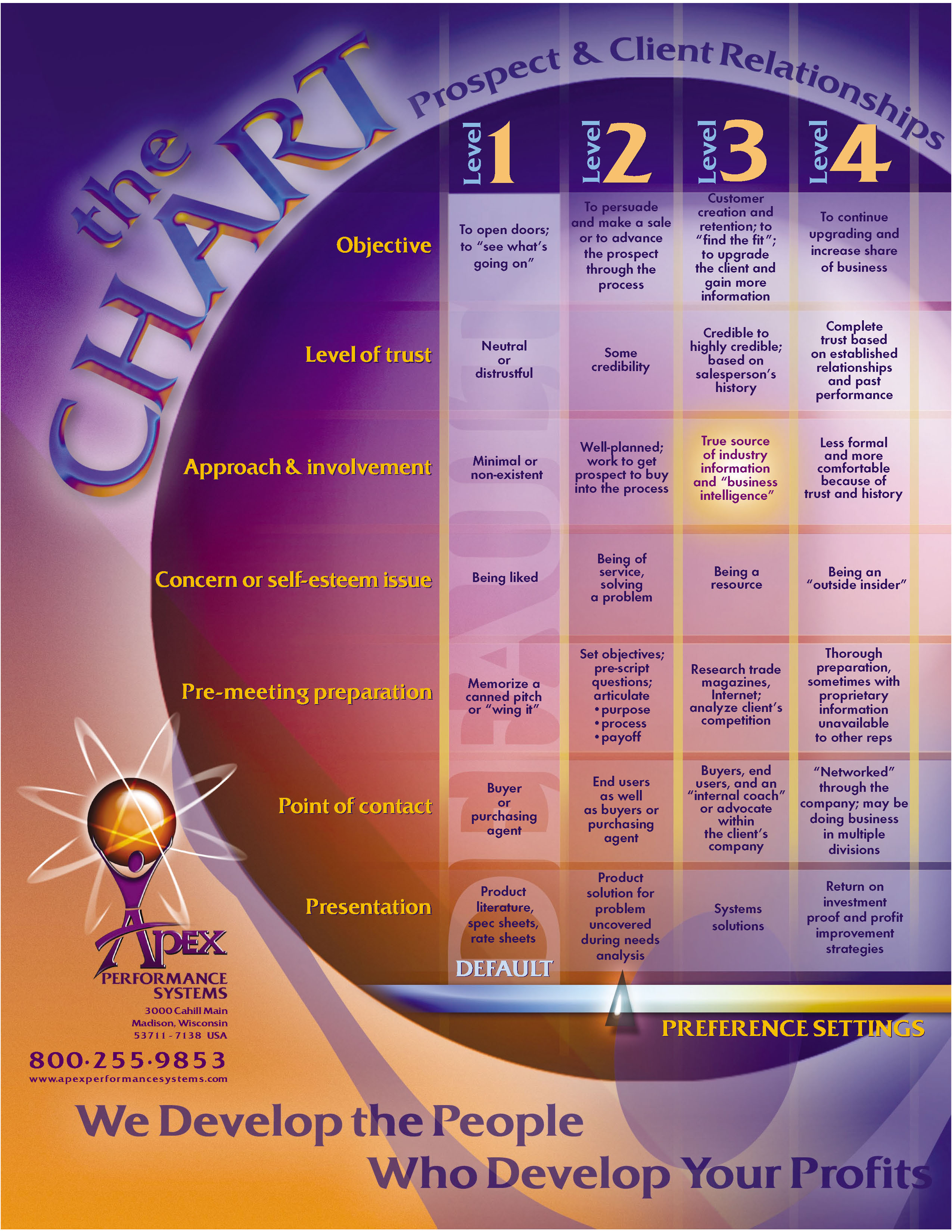
Sales have been a large part of my consulting management jobs since the mid-1990s, but it wasn’t until I owned my own company that this became a true priority. I ran across a good book, The Accidental Salesperson, by Chris Lytle. Back then, Chris Lytle had “MAX Training,” and a large part of their focus was increasing your “level” with regard to Prospect and Client relationships. The training was good and was complementary to systems like Miller Heiman.
What each of these systems do is help you prepare, plan, and execute to the best of your ability. And just like basketball, it takes practice to master. With mastery comes success and the illusion that something is easy (or you are lucky). The Seneca quote, “Luck is what happens when preparation meets opportunity,” is so true.
Regardless of the system used, what is most important is that you are trying to be the best at is to look at both positive and negative examples to see what you can learn from them. There are lessons to be learned everywhere! Understanding what makes it good or bad helps you improve as part of an ongoing improvement process.
Incorporating new tools and techniques into what has already been proven to work will help you improve your game. Returning to the sports analogy, this could be part of what made Michael Jordon so good. He would see something interesting, improve it, and then make it his own.
For example, I get many horrible sales calls and emails. The people have obviously not done any preparation, do not know anything about me or the company I work for, and often remind me of why I stopped listening to them by referring to the number of times they have tried contacting me. On the other hand, some talented sales professionals have done their homework, understand their products and the competition, and understand why what they are selling should matter to me – and can articulate that quickly and confidently. I will speak with them and occasionally buy from them. And in either case I provide my team with real-life examples of good and bad sales techniques.
So, think of the best example of whatever it is you do, and see what you can do to become more like them. This isn’t about imitation but rather about uncovering the secrets of their success and learning from them. And have some fun doing it!
Acting like an Owner – Does it matter?
One of the biggest changes to my professional perspective on business came when I started my own consulting business. Prior to that, I had worked as an employee for midsize to large companies for ten years and then as one of the first hires at a start-up technology company. I felt that doing hands-on work, managing, selling, and helping establish a start-up (where I did not have an equity stake) provided everything needed to start my own business.
Well, guess what? I was only partially correct. I was prepared for the activities of running the business but really was not prepared for the responsibility of running a business. While this seems like it should be obvious, I’ve seen many business owners whose primary focus is on growth/upside activities and not the day-to-day. That type of optimism is important for entrepreneurs – without it, they would not bother putting so much at risk.

People tend to adopt a different perspective when making decisions once they realize that every action and decision can impact the money moving into and out of their own wallets.
Even in a large business, you can usually spot the people who have taken these risks and run their own business. I was responsible for a Global Business Unit with $60+ million in annual sales and ran it like a “business within a business.” Having P&L responsibilities meant the decisions I made mattered to my success and the success of my business unit.
It’s more than just striking out on your own as a contractor or sole proprietor. I’m talking about the people who have had employees, invested in capital equipment and went all-in. These are the people thinking about the big picture and the future.
What do these people do differently than those without this type of experience?
One of the biggest things is they view business as “good business” and “bad business.” Not all business is good business, and not all customers are good customers. There needs to be a fair commercial exchange where both sides receive value, mutual respect, and open communication. You know this works when your customers treat you like a true partner (a real trusted advisor) instead of just a vendor, or at least do not try to take advantage of you (and vice-versa).
A business is in business to make money, so if your work is not profitable, you should not do it. And, if you are not delivering value to an organization, it is very likely that you would be better off spending your time elsewhere – building your reputation and reference base within an organization that was a better fit. While that may not be true for all business endeavors (think how long it took Amazon to become profitable and where they are now), it generally is true for employees at all levels.
“Bad” salespeople (who may very well regularly exceed their quotas) only care about the sale and their commission – not the fit, the customer’s satisfaction, or the effort required to support that customer. Selling products and services people don’t need, charging too little or too much, and making promises they know will not be met are typical signs of a person who does not think like an owner. Their focus is on the short-term and not on growing accounts. As an aside, their compensation plans generally only reward net new business and first-time sales, not ongoing customer satisfaction, so these actions may not be completely their fault.
How you view and treat employees is another big difference. Unfortunately, even business owners do not always get this right. I believe that employees are either viewed as Assets (to be managed for growth and long-term value) or Commodities (to be used up and replaced as needed – usually treated as fungible, as if they are easily replaceable). Your business is usually only as good as your employees, so treating them well and with respect creates loyalty and results in higher customer satisfaction.
Successful business owners usually look for the best person out there, not just the most affordable person who is “good enough” to do the job. On the flip side, you quickly need to weed out the people who are not a good fit. Making good decisions quickly and decisively is often a hallmark of a successful business owner. The saying about hiring slowly and firing quickly makes even more sense when you are running a lean operation that requires every person to contribute to the success of the company.
Successful business owners are generally more innovative. They are willing to experiment and take risks. They reward that behavior. They understand the need to find a niche where they can win and provide goods and/or services tailored to those specific needs.
Sometimes, this means specialization and customization, and sometimes, it means personalized attention and better support. Regardless of what is different, these people observe the small details, understand their target market, and are good at defining a message articulating those differences. These are the people who seem to be able to see around corners and anticipate both problems and opportunities. They do this out of necessity.
Former business owners are usually more conscientious about money, taking a “my money” perspective on sales and expenses. Every dollar in the business provides safety and opportunity for growth. These usually are not the people who routinely spend hundreds or thousands of dollars on business meals or who take unnecessary or questionable trips to nice places. Money saved on unnecessary expenses can be invested in new products, features, or marketing for the benefit of an organization.
While these are common traits of successful business owners, you can develop them even if you have never owned a business.
When selling, are you focused on delivering value, developing a positive reputation within that organization and with your customers, and profiting from long-term relationships? When delivering services, is your focus on delivering what has been contracted – and doing so on time and within budget? Are your projects used as examples of how things should be done within other organizations? Are you spending money on the right things – not wasteful or extravagant things?
These are things employees at all levels can do. They will make a difference and help you stand out. That opens the door to career growth and change. And it may get you thinking about starting the business you have always dreamed of. Awareness and understanding are the first steps towards change and improvement.
- ← Previous
- 1
- 2
- 3
 Where Ideas, Experiences, and Lessons Learned Intersect