
sales
Doing it like Mike
My son is playing basketball this year (he previously played football and soccer), and we recently went shopping for new shoes. Each store had pictures of Michael Jordan. I used to love watching MJ play with the Chicago Bulls. He was the epitome of skill and professionalism. To this day, he inspires me.
Some people are naturally talented but must still work hard to achieve their full potential. Hard work is an important aspect of being the best at anything, but it takes more than that. It takes doing things in a way that allows you to continuously improve, along with a positive mindset and a commitment to success. Once people reach that high-performance level, their jobs look easy, and they may even appear to be a “natural” – just like Mike. But that is just the tip of the iceberg.
Most of my career changes have been unplanned. For example, in 2010, our VP of Sales was fired, and the guy intended to fill the slot quit to go work for Salesforce.com. We had our sales kickoff less than five days away, and nothing was planned yet. The SVP of Sales told me that if I wanted the job, he would give me six months. But if I didn’t cut it at the end of six months, no other job would be waiting for me.
Opportunities presented themselves, the job seemed interesting, and before I knew it, I was fully immersed in something related but different. The potential reward outweighed the real risk.
Many of these things have not come naturally to me. Each time, I focused on understanding the requirements for doing the job well, then looked for examples of exceptional performance, and finally created a systematic approach that let me measure performance and identify areas for improvement on an ongoing basis. From then on, I analyzed my results, thought daily about even the smallest improvements I could make, and tried to do even better the next day.
Good enough was never good enough. Introspection can be challenging, so one thing that I have done is to take time to celebrate wins and intentionally focus on remembering how that feels. Those memories can be motivational in times of stress or frustration and help you get back on track quickly.
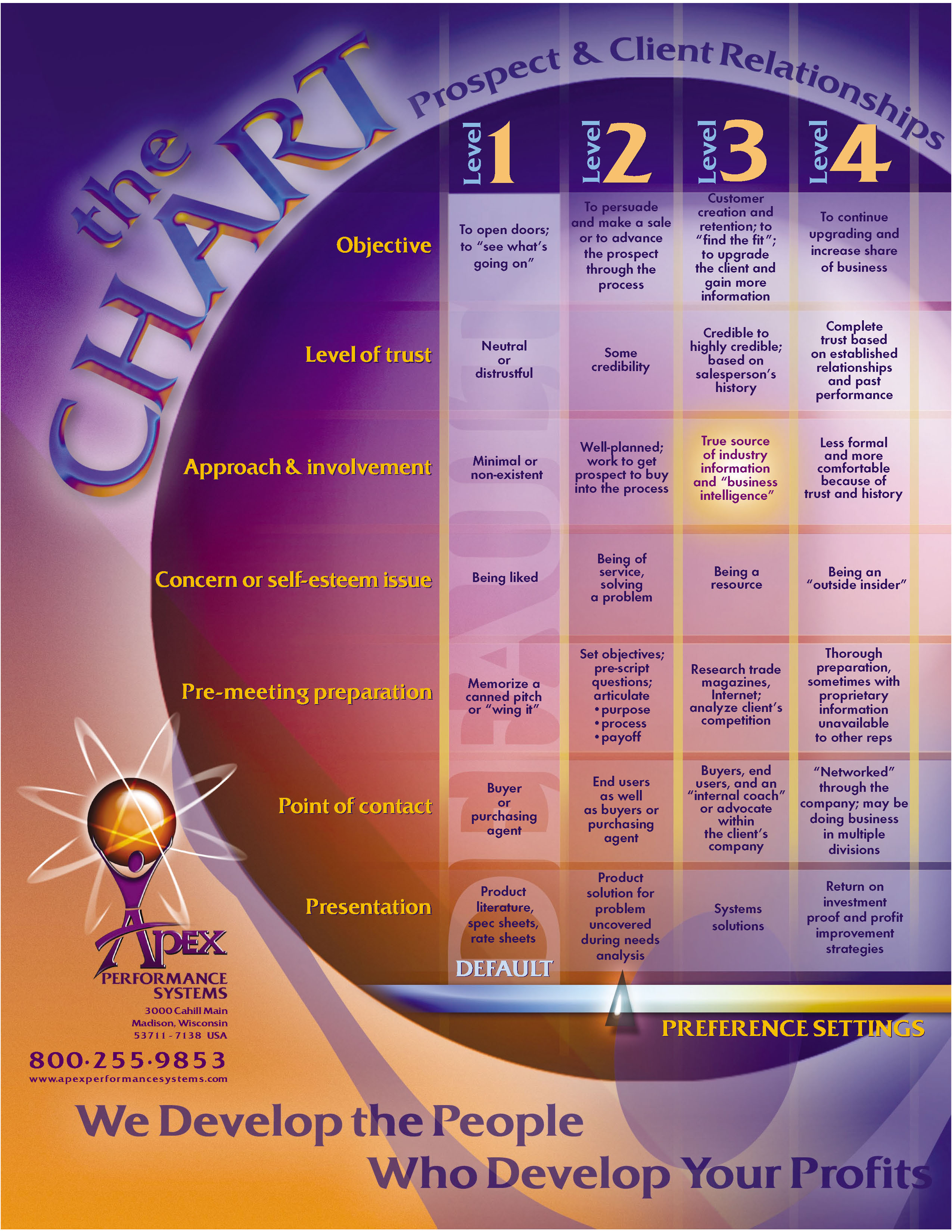
Sales has been a major part of my consulting and management jobs since the mid-1990s, but it wasn’t until I owned my own company that it became a true priority. I ran across a good book, The Accidental Salesperson, by Chris Lytle. Back then, Chris Lytle had “MAX Training,” and a large part of their focus was on increasing your “level” in prospect and client relationships. The training was good and complemented systems like Miller Heiman.
Each of these systems helps you prepare, plan, and execute to the best of your ability. And just like basketball, it takes practice to master. With mastery comes success and the illusion that something is easy (or you are lucky). The Seneca quote, “Luck is what happens when preparation meets opportunity,” is so true.
Regardless of the system you use, what matters most is that you try to be the best at examining both positive and negative examples to learn from them. There are lessons to be learned everywhere – especially when you make mistakes! Understanding what makes it good or bad helps you improve as part of an ongoing improvement process.
Incorporating new tools and techniques into what has already been proven to work will help you improve your game. Returning to the sports analogy, this could be part of what made Michael Jordon so good. He would see something interesting, improve it, and then make it his own.
For example, I get many horrible sales calls and emails. The people have obviously not done any preparation, do not know anything about the company I work for or about me, and often remind me why I stopped listening to them by citing how many times they have tried to contact me.
On the other hand, some talented sales professionals have done their homework, understand their products and the competition, and understand why what they are selling should matter to me – and can articulate that quickly and confidently. I will speak with them and occasionally buy from them. And in either case, I provide my team with real-life examples of good and bad sales techniques.
So, focus on becoming the best example of whatever it is you do, learn from others, and never stop improving. This isn’t about imitation; it’s about uncovering the secrets of their success and learning from them. And if you are lucky, you will have some fun doing it!
Acting Like an Owner – Does it matter?
One of the biggest changes to my professional perspective on business came when I started my own consulting business. Prior to that, I had worked as an employee for midsize to large companies for ten years and then as one of the first hires at a start-up technology company. I felt that doing hands-on work, managing, selling, and helping establish a start-up (where I did not have an equity stake) provided everything needed to start my own business.

Well, guess what? I was only partially correct. I was prepared for the activities of running the business but really was not prepared for the responsibility of running a business. While this seems like it should be obvious, I’ve seen many business owners whose primary focus is on growth/upside activities and not the day-to-day. That type of optimism is important for entrepreneurs – without it, they would not bother putting so much at risk.
People tend to adopt a different perspective when making decisions once they realize that every action and decision can impact the money moving into and out of their own wallets.
Even in a large business, you can usually spot the people who have taken these risks and run their own business. I was responsible for a Global Business Unit with $60+ million in annual sales and ran it like a “business within a business.” Having P&L responsibilities meant the decisions I made mattered to my success and the success of my business unit.
It’s more than just striking out on your own as a contractor or sole proprietor. I’m talking about the people who have had employees, invested in capital equipment, and gone all-in. These are the people thinking about the big picture and the future.
What do these people do differently than those without this type of experience?
One of the biggest things is they view business as “good business” and “bad business.” Not all business is good business, and not all customers are good customers.
There needs to be a fair commercial exchange where both sides receive value, mutual respect, and open communication. You know this works when your customers treat you like a true partner (a real trusted advisor) instead of just a vendor, or at least do not try to take advantage of you (and vice versa).
A business is in business to make money, so if your work is not profitable, you should not do it. And, if you are not delivering value to an organization, it is very likely that you would be better off spending your time elsewhere – building your reputation and reference base within an organization that was a better fit. While that may not be true for all business endeavors (think how long it took Amazon to become profitable and where they are now), it generally is true for employees at all levels.
For example, “bad” salespeople (who may very well regularly exceed their quotas) typically do the following:
- Only care about the sale and their commission – not profitability, fit, customer satisfaction, or the effort required to support that customer.
- Selling products and services people don’t need.
- Making promises they know will not be met is a typical sign of a person who does not think like an owner.
- Their primary focus is on personal short-term benefit, and not on growing accounts or the success of the business.
These are examples of someone who does not think or act like an owner.
How you view and treat employees is another big difference. Unfortunately, even business owners do not always get this right. I believe that employees are either viewed as Assets (to be managed for growth and long-term value) or Commodities (to be used up and replaced as needed – usually treated as fungible and easily replaceable). Your business is usually only as good as your employees, so treating them well and with respect creates loyalty and results in higher customer satisfaction.
Successful business owners usually look for the best person out there, not just the most affordable person who is “good enough” to do the job. On the flip side, you need to quickly weed out people who are not a good fit. Making good decisions quickly and decisively is often a hallmark of a successful business owner. The saying about hiring slowly and firing quickly makes even more sense when you are running a lean operation that requires every person to contribute to the company’s success.
Successful business owners are generally more innovative. They are willing to experiment and take risks. They reward that behavior. They understand the need to find a niche where they can win and provide goods and/or services tailored to those specific needs. Agility can be a significant competitive advantage. My company often contracted with Fortune 100 companies for this very reason. We could attempt something faster, for less money, and with less scrutiny than could be done internally. Those companies were outsourcing innovation.
Sometimes, this means specialization and customization, and sometimes, it means personalized attention and better support. Regardless of what is different, these people pay attention to the small details, understand their target market, and are good at defining a message articulating those differences. These are the people who seem to be able to see around corners and anticipate both problems and opportunities. This can be a learned skill, developed out of necessity.
Former business owners are usually more conscientious about money. I created a “my money” policy on expenses. If someone felt something was important enough for their success that they would spend their own money on it, then they had my blanket approal to move forward. This approach created understanding and accountability.
Every dollar in the business provides safety and the opportunity for growth. Most owners are not the people who routinely spend hundreds or thousands of dollars on business meals or who take unnecessary or questionable trips to nice places. Money saved on unnecessary expenses can be invested in new products, features, or marketing for the benefit and growth of their company.
While these are common traits of successful business owners, you can develop them even if you have never owned a business. Hence the title, Acting like an Owner.
When selling, are you focused on delivering value, developing a positive reputation within that organization and with your customers, and profiting from long-term relationships? When delivering services, is your focus on delivering what has been contracted – and doing so on time and within budget? Are your projects used as examples of how things should be done within other organizations? When leading, are you being fair and transparent with your team? Are you spending money on the right things – not wasteful or extravagant things?
These are things employees at all levels can do. They will make a difference and help you stand out. That opens the door to career growth and change. And it may get you thinking about starting the business you have always dreamed of.
Awareness and understanding are the first steps towards change and improvement.
- ← Previous
- 1
- …
- 3
- 4

