Customer Success
What is Customer Success?
In most companies, it is a department or a team. I would argue that it should be foundational in a company’s culture. Companies need to focus on providing products and services that solve critical business problems for their clientele. Failing to do that will ultimately lead to the death of products and ultimately corporate decline.
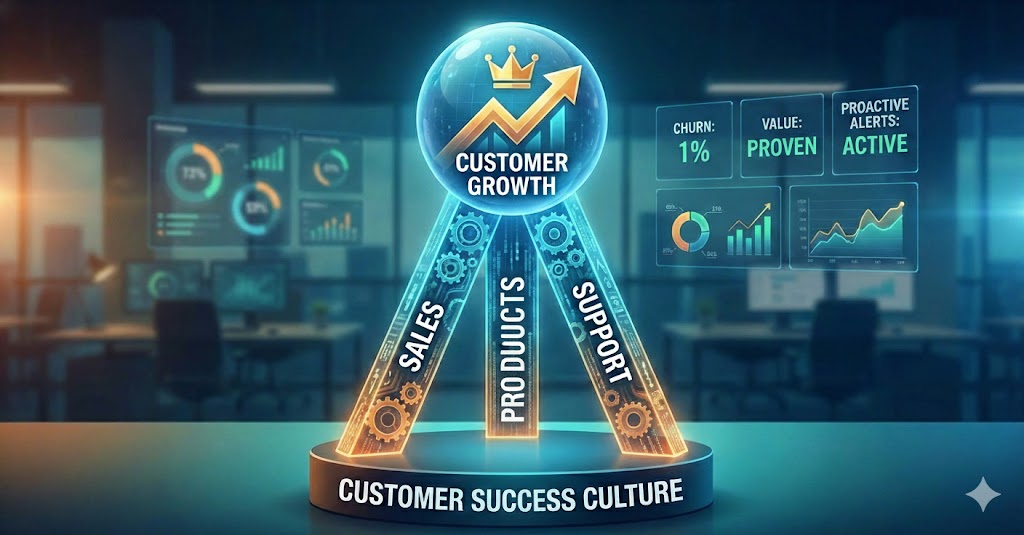
In a quarterly executive meeting a decade or so ago, the head of the Support organization stated this team was the most important. The head of Engineering then stated that her team was the most important. I chimed in and stated, “Without Sales, nothing happens, but ultimately, if all teams are not focused on the same objective, like a tripod, then all teams will ultimately fail.” Our CEO agreed with me, and that was the end of the discussion.
You could also argue that Marketing and Services should be included, and I would agree, since it goes back to all teams being focused on a singular, overarching goal.
In a previous post about creating Customers for Life, I wrote about a tactical implementation to address customer churn, which is the byproduct of failure in one or more areas. This was a wakeup call for me, as we were very focused on the success of our largest accounts and most productive channel partners – totaling 70% of our revenue, but we took the other “less valuable” accounts for granted. The lesson learned was that 30% of $62M is a large number, and by applying the same techniques to those accounts, we increased organic growth while minimizing churn.
Why Customer Success Teams Struggle
- Lack of Ownership: They do not own the accounts and often lack the motivation and accountability for the health and success of each customer.
- Stay Reactive: They are reactive rather than proactive advocates for customers.
- Lack of Resources: They are spread too thin and lack the capacity to actively engage with all but a few customers.
- Enter Too Late: They are not introduced early in the sales process, which is a great way to demonstrate commitment to the prospect’s success if they select you as a vendor.
- Stay Low in the Org Chart: They do not develop relationships beyond a small operational team, limiting executive visibility and expansion potential.
- Ad Hoc in Nature: They lack formal processes, including detailed documentation, that help ensure consistency and continuity over time.
How to Position Your Team for the Win
- SWOT: Review your strengths and weaknesses. Why do companies buy from you? (or, what are you really selling?) What are you known for? What do people like and appreciate? Where do you fall short? (opportunities for others) Accentuate the positive and focus on improvements where needed.
- We often received feedback from customers that when they called our support team, their problem was often solved on the initial call. With other vendors, it often required going through 2-3 people to get to someone knowledgeable who could help. We promoted this when selling and reinforced the importance of maintaining this positive image to our internal teams.
- We also received feedback that some of our technical features were lagging behind the competition, so my team and I helped identify the most critical features, then worked with Engineering to prioritize them and focus on bringing in new customers who needed them. It was a win-win.
- Be Proactive: It is often possible to anticipate problems or make improvements based on your understanding of the customer and their history. Being part of the solution means that you don’t wait for the next problem to engage.
- When I had my consulting company, we provided managed services for several large companies. We had proprietary monitoring tools that would report conditions that often led to outages if unchecked. We would address the issue and inform the customer once it was resolved. Our monthly summary report listed the likely outages avoided, the average duration of similar outages, and the cost avoided (based on the hourly cost of downtime). Key people saw our value at least monthly, so when it came time to renew our service, the process was fast and painless.
- Become the Internal Liaison: The customer success team should serve as the main conduit for information. Introduce your Services or Engineering teams to the customer early. This doesn’t just solve problems; it uncovers new opportunities to provide value (and sell additional services) that position the customer for even greater success. Engagement and a sense of partnership go a long way.
- I will often introduce the Services team when problems or needs arise. Their expertise and insights can be very valuable, often leading to services that position the customer for even greater success.
- Go Above and Beyond: People remember that. Teams begin to rely on you. And Executives begin to see your company and products as critical to their success. This creates long-term value for your company.
- Focus on the Future: Ask your customers, “How can we help with your upcoming initiatives and projects?” This is a great way to learn what they will be working on, to show your interest in their success, and to identify how your company and products can help them achieve it.
These are things that have been very successful for me when I was leading two large global regions, when I was a top Account Executive at a company with a small customer success team, and as a Consultant. I set expectations, led by example, and they began doing much more of what I expected from the customer success team. We started seeing improvements in the first 30 days.
While leadership doesn’t have to come from designated leaders, cultural changes usually require the commitment, involvement, and support of the organization’s top executives. Every person has the potential to make a positive impact on a company’s direction and success.
When the customer wins and views you as a key partner, you don’t have to worry about churn.
Beyond the Hunt: Fueling Sustainable Enterprise Sales Growth
The software start-up world is obsessed with “Hunters” – salespeople laser-focused on landing new customers. Job boards are overflowing with companies in “growth phases,” desperate for new logos. Understandably, the revenue from each new customer can mean a 10-20x multiple in company valuation in the VC-fueled race toward an exit. But what happens after the deal closes? Is that frenzied growth sustainable?
The Long Game: Profitability and Sustainability

My experience leading a large business unit and running my own company has taught me that sustainable growth requires more than just a flood of new logos. Here’s why:
- Cash flow is King: Lines of credit can vanish overnight (remember Silicon Valley Bank?). Relying solely on external funding is a risky approach.
- Not All New Business is Good Business: Unprofitable accounts, high-churn risks, and customers with limited growth potential can drain your resources faster than you can acquire them. Efficiency matters for scalability.
- Profits Drive Long-Term Growth: Organic, profit-fueled growth, especially when driven by innovation, creates a much more resilient and valuable business.
The Power of the Hybrid Sales Model
To achieve sustainable growth, you either need an extensive and fully integrated organization that seamlessly transitions from the sale to implementation (not many companies are able to accomplish this), or a hybrid sales team that excels at both hunting (50-70%) and farming (30-50%). Landing a new customer is hard work, but retaining and growing them is just as challenging and crucial. Customer acquisition costs are often too high to justify losing a customer only a year or two after the initial win. Treating new customers like assets (instead of commodities) is essential to long-term success.
Mastering Strategic Accounts: Turnarounds and Growth
Large, strategic accounts—Tier 1 companies with strong brand recognition and significant revenue potential—present unique challenges. In my experience, these accounts often fall into two categories: those I initially closed and then grew (ideal, as you have already laid the foundation for success), and those I inherited in a neglected state and had to turn around.
Turnarounds require a unique skill set. They demand as much time and sometimes even more effort than landing a new logo, blending aspects of both hunting and farming. It takes commitment, skill, patience, and effort to understand an organization and find new ways to deliver value. Relationships and trust take time to develop, and in this situation they are in question (or worse).
Case Study: From Churn Risk to Multi-Million Dollar Expansion
Take, for example, a large Financial Services company I inherited when their Strategic Account Manager left. The account had been neglected for two years and was riddled with problems. We lacked executive relationships and higher-level visibility within the organization. They were evaluating competitors, and we knew nothing about it! Even though they were an existing customer, we were the underdog.
I organized a day-long on-site meeting to understand their pain points. We identified immediate issues, shared our vision for the future, began building trust, and demonstrated our commitment to their success. Following this, we spent a few hours getting to know the team over dinner. It was an eye-opener for me, with them providing more information about their needs and how best to approach them.
The result? Within three months, I closed a $500K expansion deal, followed by a $500K consulting engagement and then a $3.25M two-year cloud expansion and upgrade prepay deal. My team and I rebuilt the relationship, solved critical problems (even going beyond our product scope), and provided a clear path forward with our AI-powered platform. I became a trusted advisor who was valued by their executive team. It was a true win-win.
The Bottom Line: Building a Sustainable Sales Engine
Install base growth and customer retention is critical for long-term success, especially with larger customers. The approach has to be multi-dimensional. It is a team effort, and the Account Executive is the quarterback. Relationship management, customer success teams, support, and services all play a role. Effective communication is bi-directional, where the customer has insight into what is coming down the road and input into the direction of products they rely on. This becomes a true partnership that adds significant value to both organizations.
Does this hybrid approach apply to every company? If you’re IBM or Oracle, your offerings are broad and deep, and your customers are largely locked-in. “Land and expand” is part of their DNA. And if you’re selling end-of-life products, your focus might shift towards maximizing the “long tail” through customer success and services to minimize costs and maximize profitability.
However, for most growth-stage Cloud and SaaS companies, the hybrid sales model is an essential part of their success.
Call to Action:
- Evaluate your sales team structure and compensation plans. Do they incentivize both new customer acquisition and ongoing account growth?
- Invest in training and development for your sales team. Equip them with the skills needed to excel at both hunting and farming. It can be a difficult transition, but is worth it in the long run.
- Need help building a high-performing hybrid sales team or turning around strategic accounts? Let’s connect!
What are you doing to improve CX today?
In challenging times, minor frustrations can lead to harmful, long-term negative sentiment. Your approach to Customer Experience (CX) matters more than ever during this pandemic crisis. Your business needs to protect relationship capital and see this as an opportunity to appeal to your next generation of loyal customers.

Recently, I sold a few gold coins on an auction website. The transactions were great and concluded quickly. However, the payment arm of this organization appears to have a bug in its tracking system for USPS Registered Mail. The transaction status displayed “shipped,” but when you clicked the “Tracking” button, it was clear the package had been delivered a few weeks earlier. Still, they were holding a significant amount of money without a clear release date.
While that was a little frustrating, what happened next changed my feelings about this company. I sent several emails to Support and received canned responses. I used their chat option and spoke to a couple of “people” who were either chatbots or should be replaced by chatbots, because no matter what information I provided, the response was always the same and not helpful. Positive, consistent interactions matter!
Now, think about tens, hundreds, or even thousands of customers or prospects having problems getting information about your products and services, getting assistance with questions or support for problems, and working with your company in general. In this time of increased stress and uncertainty, the customer experience for each anticipated archetype must be as ideal as possible in order to increase engagement and loyalty. BTW, those things lead to increases in lifetime customer value, repeat business, and overall business growth.
I’ve always told my teams that “People buy easy,” so, as a group or organization, we aim to make it as efficient and frictionless as possible to conduct business with us. By doing that, being fair, and acting with integrity, we are rewarded with loyal customers who help our business grow.
Relationships develop over time, and each interaction helps determine the eventual outcome. Understanding what differentiates your company and products in your customers’ and prospects’ eyes can help you create more meaningful, consistent, and valuable interactions. People appreciate a positive customer experience, so those efforts may ultimately lead to developing Customers for Life.
Now is the time to evaluate your processes, procedures, guidelines, and interfaces. Be extremely critical as you ask yourself, “Is this how I would like to be treated as a customer?” By setting CX as a strategic priority, your business or organization will focus on eliminating friction and ensuring that your customers are treated well. Moreover, you are building a more loyal install base by supporting the activities that comprise the customer’s journey.
Investments in CX today can deliver an immediate payback and increase long-term growth.
What are you Really Selling? (hint – solutions)
It is interesting to see Sales and Marketing people still focusing on features, performance, cost, and even value without creating a linkage to what that means to a company from a business perspective. Once you understand what your prospect is buying and why they need it, you can connect with them meaningfully to increase your win rate.

A sales adage from the 1940s (source) asserts, “No one wants a drill. What they want is the hole.” Today, that basic understanding of why people and companies buy is often lost in sales and marketing messages. Sales success is all about solving problems and satisfying needs.
Several years ago, my team and I were selling a new Analytics Database that was genuinely different. Still, our message was identical to every other database vendor – “70% – 100% faster than every other product.” It is nearly impossible to differentiate your product using a non-differentiated message. Don’t treat your product or service as a commodity if it is not one.
I flipped the messaging to focus on business needs. We created a weekly webinar focused on Why Fast Matters. Query response time is important, but responsiveness to customer needs and requests is essential. What if they did not need to wait a week or two to have new indexes created or a month to have a Star Schema updated? They could just run queries as-is, maybe wait a minute instead of a second or two, and have what they need then and there. That message resonated; we sold the first 50% of that product globally. When the Australian team began using our messaging, their sales also increased. Funny how that works.
Effectiveness is all about results and intended outcomes. Efficiency is about achieving those results with the least time and effort invested. It doesn’t mean that we are looking for a lazy approach to find a win. Instead, it is about identifying repeatable patterns that circumvent unnecessary activities, accelerate the sales cycle, and minimize related costs.
The way to help yourself understand what you are selling is to view things from your prospect’s perspective. What struggles are they likely facing? Where are the greatest opportunities to help their type of business? Are you analyzing data to attempt to assess their unmet needs? Your insight can become a huge differentiator, especially if you can teach them different and better ways to do something (ala the Challenger Sales Model).
What is the difference between your prospect company and its main competition? This analysis requires a general understanding of the problem space and a more specific understanding of the prospect company, its history, and 2-3 main competitors. It also requires an honest account of how your company and products compare to the competition so that you can play up your strengths and limit your investment in areas where the fit is not as good.
The next item to focus on is messaging. Below are a few examples from my career –
- Analytics & Big Data – The focus here is often on data volume, the currency of the data, speed of queries, cost, maintenance, and downtime. Those things become essential later in the sales discussion, but initially, companies want to know what problems their product or solution will solve.
- Some of my fastest deals sold because I demonstrated ways to make better decisions faster and/or identify minor problems before they had the chance to become major problems. Avoiding problems and unplanned outages were critical elements of the messaging.
- In one case, I closed a significant deal in less than three months by focusing on how a company could provide customers with five years of transactional data. Those customers could use the data to make better purchasing decisions in less time than it took the current system to analyze six months of data. Their sales increased after implementing this modernized system. Helping their customers make better buying decisions faster was the winning message.
- Embedded Products – While many companies focus on APIs, features, or cost per unit, I would focus on how the product I was selling made things better and easier to manage for improved Customer Support and Customer Satisfaction.
- I closed a $1.1 million deal in less than two months to a medical device company by focusing on the life cycle of those devices (often 10-15 years) and how their customers needed consistency from machine to machine. Consistency over time was the winning message here.
- After being approached by a Defense Contractor for a relational database product for a new Flight Simulator system, I changed the discussion to the complexity of flight control systems, the need to correlate 30+ operational systems in real-time, and the importance of taking a verbal command and translating it to specific commands for each related system. That led to selling a NoSQL product ideally suited for this complex environment. Letting our software handle the highly complex workload helped us win this deal.
- Consulting Services – These were not contracting or body shop services (commodities) but actual Business and Technical Consulting services with high visibility and impact. In these cases, expertise, experience, and having a track record of success in different but demanding scenarios provided confidence. These were often multi-phase engagements to prove our value before making a significant commitment.
- In a bid against two well-established competitors, we won a deal with a large Petroleum company worth nearly $500K. The proposal included information we uncovered about the system and use case and later verified with the prospect, a section on our people and past projects, and a high-level project plan with firm-fixed pricing. We won the bid, and I later discovered that our cost was $50K higher than the largest competitor and $100K more than the other competitor. The customer told me, “Your proposal demonstrated the understanding of who we are and what we need, and that confidence provided the justification to select your company and pay a premium to have the job done right the first time.”
- My first million-dollar deal was with a company where we demonstrated our ability to solve problems. They knew they needed assistance but were not exactly sure where. I created a “Pool of Days” concept that provided flexibility in the work performed (task, deliverables, and scheduling) but had minimum monthly burn rates and an expiration date to protect my company. The winning messaging this time was that flexibility and the ability to accommodate changing needs without introducing significant risk or additional cost were better ways to buy consulting services. This approach led to many other deals of a similar nature with other companies.
The common theme is helping companies solve their specific business problems from these examples. Even when technology was central to the message, focusing on better outcomes for that prospect and their customers was essential. Value matters, but positive results and better outcomes matter even more for purchasing decisions.
Nobody wants to be responsible for taking a chance on a new vendor and be responsible for a high-profile failure. Helping instill confidence early on makes a huge difference, and following through to successful implementation results in happy customers who become loyal customers who provide references and referrals.
Success starts with selling what you can do from a business perspective for your Prospects. You are solving their problems with solutions they need and avoid getting lost in the noise of the unfocused messaging from most of your competition.
Good Selling!
Creating Customers for Life (4 minute read)
The goal for any business, regardless of the products you sell or the services you provide, should be maintaining a satisfied customer base that is loyal to your business. The idea is to create a mutually beneficial relationship that motivates people to want to continue working with you despite the availability of competitive products or motivations (e.g., those pushing for a “Corporate Standard” involving another product.)
The best part is that this concept applies to all companies and all Product Life Cycle stages. Whether your company is on a rapid growth trajectory towards ‘Unicorn status,’ your offerings are mature and viewed as ‘less exciting.’ The approach will also help if your products decline and you seek the ‘longest tail’ possible. At each phase, there are credible threats from competitors that seek to grow through the erosion of your business.

Several years ago, I was responsible for two product lines in two major geographic regions (Americas and APAC/Japan). Our attrition rate (“churn”) was traditionally slightly below the industry average. We began seeing an increase in churn and a corresponding decrease in organic growth. Both were indicators that something needed to change.
After discussing tactical approaches to address this, our small leadership team agreed that this was a strategic issue we needed to address. The result was an understanding that we needed to create ‘Customers for Life.’ Everyone agreed with the concept, but due to various differences (culture, who our customer was – end customer vs. channel partner, buying patterns, etc.), we agreed to try what was best for each of our regional businesses and share the results and lessons learned.
My approach focused on developing strong relationships that fostered collaboration and ultimately led to growth and success for both parties. The basic premise was simple:
- People tend to buy from people they like, respect, and trust. Become one of those people for your customers.
- Helping companies achieve better business outcomes leads to greater success for our customers and us.
How did we do it? It was a systematic process that my team used that included the following:
- Develop simple profiles for each customer (e.g., products used, date of first purchase, size of footprint, usage and payment trends, industry).
- An optimal size – based on the size of the product footprint, annual amount spent with us, or size of the company- was used to prioritize companies and organizations with the most significant potential impact.
- Make contact multiple times yearly, not just when you want money.
- These “out of cycle” contacts became very important.
- Ask questions about key initiatives, milestones, and concerns.
- We documented the responses, which helped seed following conversations and demonstrate a genuine interest in what they were doing.
- Follow-up!
- Request meetings to understand how they use our products and get a brief update on what our company has been doing.
- Meeting people face-to-face is always good.
- Learning more about their business, systems, goals, and challenges created opportunities to add value and become more of a partner in success with that customer.
- Look at what they were doing with our products and offer suggestions to do more, do something better or more efficiently, call out potential problems and offer suggestions, and discuss best practices. Often, we would have a technical expert follow up and provide an hour or two of free assistance relating to those findings.
- Look for opportunities to congratulate them.
- It demonstrates that they are important enough that you are paying attention. Google Alerts made this easy.
- Regularly ask our customers if there is anything that we could do to help them.
- They would often reciprocate, leading to increased references and referrals.
- Continuous Improvement – Analyze the results and refine the process as needed on an ongoing basis.
Before the meeting, we would spend an hour or two researching the company, its history, and significant events for it and within its industry, and identify its top 2-3 competitors. My consulting background came in handy as I “looked between the lines” to better understand the situation as we planned the meeting, focusing on what we wanted to walk away with and what we wanted the customer to walk away with from that meeting.
As we met with our Customers and Channel Partners, we would explain what ‘Customer for Life’ meant to us and the potential benefits to them. Before the meeting, we would check to see if we had (or they wanted) an NDA so they could speak freely and with confidence. Trust was important. The information disclosed would help us understand their situation, and we would map this against other customers in search of actionable trends. Showing interest and understanding created credibility. Asking relevant questions allowed conversations to progress to substantive issues in less time. From there, we focused on specific points that would positively impact that customer.
Over the course of two years, my team and I helped our customers innovate by providing different perspectives and ideas, modernizing (e.g., moving to spatial analytics to get a more granular understanding of their own business, cloud-enable their systems to increase responsiveness to their business and often control costs), improve their systems and grow their businesses, and more. We also received feedback that helped us improve our products and a variety of processes – something that benefitted all customers. Occasionally, we learned about problems they were having. We took ownership of the issue, brought in the right people, and helped the customer find a resolution. Collaboration and success created strong relationships with many customers – especially in the segment with the largest customers and companies.
From a business perspective, our customer churn decreased by 50% over the same period, and organic growth increased slightly more than 20%. We had achieved our objectives and improved our bottom line. The concepts behind Strategic Account Management, Voice of the Customer, Customer Experience, Customer Loyalty, and Customer Success had blended into a manageable practical approach and provided a great ROI.
One of my biggest lessons learned was that adopting this mindset and creating a repeatable process should be started sooner rather than later.
Every day you are not creating your own ‘Customers for Life,’ there is a good chance that your competition is. Don’t let that happen to your business.
 Where Ideas, Experiences, and Lessons Learned Intersect