high performance culture
What is Customer Success?
In most companies, it is a department or a team. I would argue that it should be foundational in a company’s culture. Companies need to focus on providing products and services that solve critical business problems for their clientele. Failing to do that will ultimately lead to the death of products and ultimately corporate decline.
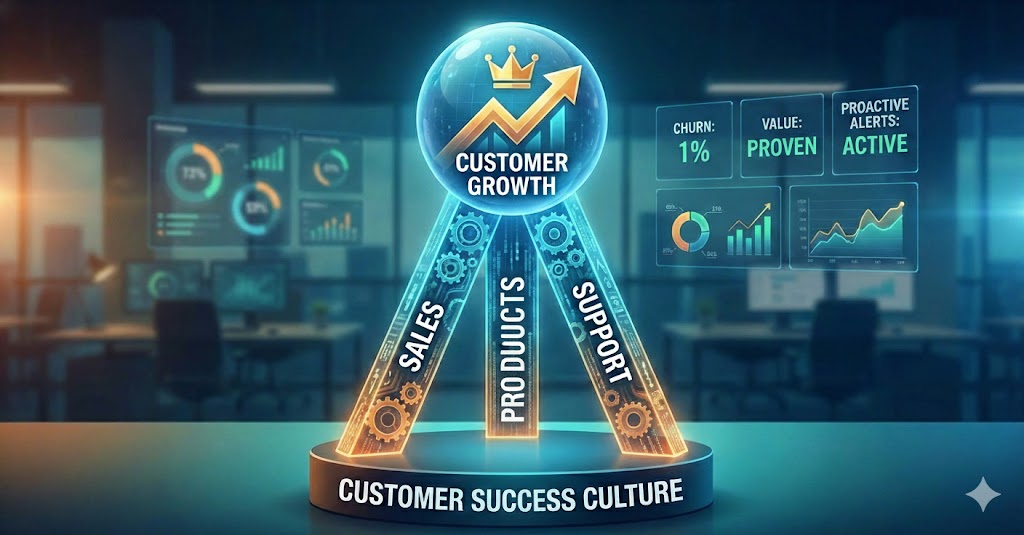
In a quarterly executive meeting a decade or so ago, the head of the Support organization stated this team was the most important. The head of Engineering then stated that her team was the most important. I chimed in and stated, “Without Sales, nothing happens, but ultimately, if all teams are not focused on the same objective, like a tripod, then all teams will ultimately fail.” Our CEO agreed with me, and that was the end of the discussion.
You could also argue that Marketing and Services should be included, and I would agree, since it goes back to all teams being focused on a singular, overarching goal.
In a previous post about creating Customers for Life, I wrote about a tactical implementation to address customer churn, which is the byproduct of failure in one or more areas. This was a wakeup call for me, as we were very focused on the success of our largest accounts and most productive channel partners – totaling 70% of our revenue, but we took the other “less valuable” accounts for granted. The lesson learned was that 30% of $62M is a large number, and by applying the same techniques to those accounts, we increased organic growth while minimizing churn.
Why Customer Success Teams Struggle
- Lack of Ownership: They do not own the accounts and often lack the motivation and accountability for the health and success of each customer.
- Stay Reactive: They are reactive rather than proactive advocates for customers.
- Lack of Resources: They are spread too thin and lack the capacity to actively engage with all but a few customers.
- Enter Too Late: They are not introduced early in the sales process, which is a great way to demonstrate commitment to the prospect’s success if they select you as a vendor.
- Stay Low in the Org Chart: They do not develop relationships beyond a small operational team, limiting executive visibility and expansion potential.
- Ad Hoc in Nature: They lack formal processes, including detailed documentation, that help ensure consistency and continuity over time.
How to Position Your Team for the Win
- SWOT: Review your strengths and weaknesses. Why do companies buy from you? (or, what are you really selling?) What are you known for? What do people like and appreciate? Where do you fall short? (opportunities for others) Accentuate the positive and focus on improvements where needed.
- We often received feedback from customers that when they called our support team, their problem was often solved on the initial call. With other vendors, it often required going through 2-3 people to get to someone knowledgeable who could help. We promoted this when selling and reinforced the importance of maintaining this positive image to our internal teams.
- We also received feedback that some of our technical features were lagging behind the competition, so my team and I helped identify the most critical features, then worked with Engineering to prioritize them and focus on bringing in new customers who needed them. It was a win-win.
- Be Proactive: It is often possible to anticipate problems or make improvements based on your understanding of the customer and their history. Being part of the solution means that you don’t wait for the next problem to engage.
- When I had my consulting company, we provided managed services for several large companies. We had proprietary monitoring tools that would report conditions that often led to outages if unchecked. We would address the issue and inform the customer once it was resolved. Our monthly summary report listed the likely outages avoided, the average duration of similar outages, and the cost avoided (based on the hourly cost of downtime). Key people saw our value at least monthly, so when it came time to renew our service, the process was fast and painless.
- Become the Internal Liaison: The customer success team should serve as the main conduit for information. Introduce your Services or Engineering teams to the customer early. This doesn’t just solve problems; it uncovers new opportunities to provide value (and sell additional services) that position the customer for even greater success. Engagement and a sense of partnership go a long way.
- I will often introduce the Services team when problems or needs arise. Their expertise and insights can be very valuable, often leading to services that position the customer for even greater success.
- Go Above and Beyond: People remember that. Teams begin to rely on you. And Executives begin to see your company and products as critical to their success. This creates long-term value for your company.
- Focus on the Future: Ask your customers, “How can we help with your upcoming initiatives and projects?” This is a great way to learn what they will be working on, to show your interest in their success, and to identify how your company and products can help them achieve it.
These are things that have been very successful for me when I was leading two large global regions, when I was a top Account Executive at a company with a small customer success team, and as a Consultant. I set expectations, led by example, and they began doing much more of what I expected from the customer success team. We started seeing improvements in the first 30 days.
While leadership doesn’t have to come from designated leaders, cultural changes usually require the commitment, involvement, and support of the organization’s top executives. Every person has the potential to make a positive impact on a company’s direction and success.
When the customer wins and views you as a key partner, you don’t have to worry about churn.
Leading Next-Generation Sales Teams: The Mandate for Predictable Revenue

The sales landscape has fundamentally shifted. I keep reading posts and stories about AI replacing sales teams, and it may be for more commodity-type sales, but it will be some time before it replaces Enterprise sales teams. Building relationships and trust is the foundation for an executive to take a risk on your product, especially when it is critical to their success. AI is currently not at that level, and with behavior changing with every key release, building trust with an AI will be challenging for many years to come. But today, AI can be a powerful enablement tool for your team when leveraged correctly.
Your prospects no longer need salespeople for information; they need us for Insight. They have done their research. They expect their time to be an investment, not a discovery exercise. Does your presence and knowledge project confidence and inspire trust? Does the prospect view you as someone interested in helping their business, or just someone trying to close a deal? Impress them, and you could earn the opportunity to dig deeper. Disappoint them, and good luck trying to recover.
Two years ago, I was selling to a Fortune 100 Financial Services company. I understood their business needs, which we easily achieved. We demonstrated that we could take a key manual process that typically took 7 weeks to complete, automate it and maintain full compliance, and complete the task within 10 minutes. The SVP told me his priorities for selecting any new vendor were: 1 – Company Stability; 2 – Relationship with the Vendor; 3 – Product Quality; 4 – Product Value to their business; and 5 – Total Solution cost. Prior to selling their IP, the company fired the sales team, and the remaining execs went in and offered the deal at an even greater discount. It never sold because the executive team did not understand what was important to this buyer. The company had a high-level relationship with the stakeholders, but lacked the trust and credibility that I had built over several months. This is one of the main reasons why I believe AI won’t take over Enterprise Sales anytime soon.
So, how do you get it right?
The question for every CRO or VP of Sales isn’t whether their team is busy, but whether their activity is revenue-focused and leads to predictable and scalable results. There is much money to be made by everyone, but following the same old tired formulas seldom works.
For leaders aiming to build next-generation teams that deliver zero surprises in the forecast, the approach must be recalibrated around three core pillars: Strategic Preparation, High-Agency Coaching, and Outcome Focused Messaging (“context.”) It is much more than cold calling for two hours a day or having 5-10 meetings per week. Things like that are important, but they are just activities if you are not targeting the right companies and people, or if your team blows it once you have found those people. This will be a significant cultural shift for many companies.
Strategic Preparation: From “Discovery” to “Insight”
When a prospect books a meeting, they are giving us one of their most precious assets: time. If we treat that time as a standard discovery call, we set negative expectations, which signals the lack of perspective (the ‘P’ in PIE) and perceived value. This isn’t theory—it’s the PIE framework (Perspective, Insight, Experience) I’ve used to sell large deals, turn around at-risk customers, and scale teams for many years.
The C-Suite Mandate: Accelerate deal velocity by focusing on specific quantifiable impact for your prospects, and increase win rates by targeting identifiable business pain.
- Come with an Understanding of their Market, Changes, and Competition. Before the first call, we must demonstrate that we’ve already invested time in understanding their operational constraints, their competitive pressures, and their budget priorities. The goal is to move the conversation immediately from the tired, “What keeps you up at night?” to “We have seen [problem] with companies in your industry. Is that something you have experienced or have concerns about?”
- Long Discovery Calls or Presentations Typically Won’t Work. Customers are fatigued by generic questions. Every interaction must be purpose-driven and meaningful. If the call runs longer than planned, it must be because the conversation has become mutually valuable, not because we were ill-prepared and just keep talking.
- Discussions Must Be Targeted to the Problems They Are Most Likely Experiencing. This is where we leverage Insight (the ‘I’ in PIE). Use your background and AI to hypothesize the top three pain points before you dial. Our role is to validate these points, quantify the impact, and then introduce a Shared Vision of Success (our solution) anchored by measurable business outcomes.
Player-Coach: Enhancing Team Capabilities, Not Just Motivating Activity
If you are a sales leader who only focuses on closing your team’s most challenging deals, you are creating a dependency, not a capability. A Player-Coach must be accountable for the team’s numbers and its health.
The C-Suite Mandate: Drive organic growth by building repeatable processes and cultivating high-agency talent.
- Not a One Size Fits All Proposition. True coaching is not a template. It requires a methodical but human approach to diagnostics. That takes time, effort, and a genuine desire to help people grow.
- Identify Skills Gaps and Tailor Efforts. Test skills, identify gaps, and then create targeted efforts around building skills that address someone’s specific deficiencies. This personalized attention is how we build the high-performance culture and accountability required to sustain long-term success.
- Leverage the Team – Role Playing and Team Reviews. We must create a culture where knowledge sharing and feedback loops are the norm. Leverage team reviews and structured role-playing to sharpen execution. This is how we transform luck into a predictable process.
Give teams the latitude to adjust their messaging and test approaches. Adapt messaging to business trends, changes in the competitive landscape, and changing terminology. Then, have your team share their experiences and findings (good and bad) with the team to review, provide feedback, and refine. Structured agility helps your team maintain its competitive edge.
The Leadership Mandate: Context Over Content
We are past the hype cycle of AI. The C-Suite doesn’t care about the tool; they care about the ROI and the risk of poor execution. As leaders, we cannot just hand our teams a login and say, “Go use AI.” That’s a recipe for chaos and a quick erosion of professional credibility. We must lead by example.
We need to teach our teams that AI generates content, but humans generate context.
- Do use AI to deepen your understanding of the prospect’s industry so you can become a true consultant. Use the technology to gain understanding and market intelligence and tie it to your Experience (the ‘E’ in PIE) as preparation before any call.
- Don’t use AI to automate a thousand bad emails. Mass communication is cheap; individualized insight is priceless.
- Do use AI to research the one hundred prospects that actually matter. Focused efforts yield significantly better results.
- Don’t use AI to fake expertise. This leads to the quick death of credibility, as any good consultant will tell you.
The “Million Dollar Deal“ isn’t won by a bot. It’s won by a human who understands the nuances of the prospect’s business, builds trust, and navigates the internal structure and politics. AI is simply the tool that clears the path so you can do that work faster and with better data. AI is leverage, not a crutch.
Call to Action: Are You Building a Team or a Capability?
The next-generation sales leader understands that customer success is at the heart of everything we do. We win when they succeed. Your most valuable asset isn’t your pipeline—it’s the predictable capability of the individuals on your team. Consistently doing the right things is critical to success.
The challenge for every business leader today is this: Are you enabling your teams to sell like consultants, or are you still measuring them (and driving their behavior) on activity-based metrics? Focus on building intelligent and creative teams that deliver consistent results with zero surprises. It doesn’t happen overnight, but it is an investment in your future success.
Let’s discuss how we can implement the PIE framework and position your team to deliver scalable, organic growth in your organization.
Lessons Learned from GTM Consulting
For the past two years, I have performed part-time, contract go-to-market consulting. My wife had a surgery that had gone wrong 18 months ago, so I needed something that would allow me to take care of her, stay sharp, earn money, and help companies grow.

Most of the work was with small to midsize companies, but the problems and needs mirrored what I have encountered at larger companies. The main difference is that large companies tend to look to software to address problems. In contrast, smaller companies lack the budget for what they view as an unproven solution that increases complexity.
Here are my Top 5 findings:
- GTM plans are often developed at the highest levels, often in isolation, without market testing and validation.
- Sales teams are pitted against one another, rather than working together to help everyone achieve more (i.e., “A rising tide lifts all boats.”)
- Sales teams are focused on selling features rather than solving business problems.
- CRMs are not consistently used and often reflect idealized fiction rather than reality.
- Sales management and teams are not leveraging AI to help focus their efforts.
Here are the related Lessons Learned:
- Identifying common business problems and describing how your product or service solves them should be the foundation of the plan. Perform market analysis. How do companies describe those problems? Their terminology, often found in job ads, can help create effective messaging that resonates. Work to become the natural fit for what your prospects are seeking.
- Individual contributors get paid to win, but sales management needs to create incentives for collaborative efforts that lead to wins.
- For one company, I convinced them to implement a 2% SPIV (like a SPIFF, but team-focused) for every team member who actively contributed to team improvement. SPIV payments were quarterly, and there was a running total so the team could see the fund growth. Initial indications of a positive impact are good.
- Another benefit of collaboration is that it helps teams focus on approaches that work due to ongoing testing and refinement. Collaboration also helps teams focus on a more accurate ICP (ideal customer profile). Sales management can then feed their findings back to Marketing to improve and tailor their efforts.
- Selling is a byproduct of problem-solving. You can’t solve problems if you don’t know what they are. Every interaction with a prospect should focus on gathering information, building trust and relationships, and leveraging prior interactions to demonstrate that your solution will solve their problem and ease their pain.
- CRMs often either lack information or are full of wishful thinking. They focus on activities, and not progress and next steps. Using MEDDIC/MEDPICC as a foundation for reporting is a much better start. Sales managers need to independently validate the information to ensure their teams are being upfront and honest. Trust, coaching, and collaboration work together for the win.
- AI is not a panacea, but it is very effective for research, market validation, prospecting, and meeting preparation. Going in prepared builds respect and credibility, saves time, and lets you quickly qualify prospects in or out. There may be a nurturing program for some of the prospects qualified out for immediate deals, but your time is valuable, and you will go hungry chasing deals you can’t close.
So, what are your thoughts? Have you seen some of these problems yourself? How did you handle them? Let me know in the comments below.
And if you are looking for a Consultant to help your business grow or someone who can add immediate value to your team, then contact me.
The Value Created by a Strong Team
I participated in an amazing team-building exercise as a Board Member for the Children’s Hospital Foundation of Wisconsin. We were going down a path that led to a decision on whether or not to invest $150M in a new addition. The CEO at the time, Jon Vice, wisely determined that strong teams were needed for each committee in order to thoroughly vet the idea from every possible perspective.

The process started with being given a book to read (“Now, Discover Your Strengths” by Marcus Buckingham & Donald O. Clifton, Ph.D.) and then completing the “Strengthsfinder” assessment using a code provided in the book. The goal was to understand gaps in perception (how you view yourself vs. how others view you) so that you could truly understand your own strengths and weaknesses. Then, teams were created with people having complementary skills to help eliminate weaknesses from the overall team perspective. The results were impressive.
Over my career, I have been involved in many team-building exercises and events – some of which provided useful insights. However, most failed to combine the findings meaningfully, provide useful context, or offer actionable recommendations. Key areas that were consistently omitted were Organizational Culture, Organizational Politics, and Leadership. Those three areas significantly impact value creation vis-à-vis team effectiveness and commitment.
When I had my consulting company, we had a small core team of business and technology consultants and would leverage subcontractors and an outsourcing company to allow us to take on more concurrent projects as well as larger, more complex projects. This approach worked for three reasons:
- We had developed a High-Performance Culture that was based on:
- Purpose: A common vision of success, understanding why that mattered, and understanding how that was defined and measured.
- Ownership: Taking responsibility for something and being accountable for the outcome. This included responsibility for the extended team of contractors. Standardized procedures helped ensure consistency and make it easier for each person to accept responsibility for “their team.”
- Trust: Everyone understood that they not only needed to trust and support each other, but in order to be effective and responsive, the others would need to trust their judgment. If there was a concern, we would focus on the context and process improvements to understand what happened and implement changes based on lessons learned. Personal attacks were avoided for the good of the entire team.
- Empowerment: Everyone understood that there was risk associated with decision-making while at the same time realizing that delaying an important decision could be costly and create more risk. Therefore, it was incumbent upon each member to make good decisions as needed and then communicate changes to the rest of the team.
- Clear and Open Communication: The people on the team were very transparent and honest. When there was an issue, they would attempt to resolve it first with that person and then escalate if they could not reach an agreement and decided to seek the team’s consensus. Everything was out in the open and done in the spirit of being constructive and collaborating. Divisiveness is the antithesis of this tenet.
People who were not a good fit would quickly wash out, so our core team consisted of trusted experts. A friendly competition helped raise the bar for the entire team, but when needed, the other team members became a safety net for each other.
We were all focused on the same goal, and everyone realized that the only way to be successful was to work together for the team’s success. Win or lose, we did it together. The strength of our team created tremendous value – internally and for our customers that we sustained for several years. That value included innovation, higher levels of productivity and profitability, and an extremely high success rate.
This approach can work at any level but is most effective when it starts at the top. When employees see their company leaders behaving in this manner, it provides the model and sets expectations for everyone under them. If there is dysfunction within an organization, it often starts at the top – by promoting or accepting behaviors that do not benefit the whole of the organization. But, with a strong and positive organizational culture, the value of strong teams is multiplied and becomes an incredible competitive advantage.
One Successful Approach to Innovation that worked for an SMB
When I owned a consulting company, we viewed innovation as an imperative. It was the main thing that created differentiation, credibility, and opportunity. We had an innovation budget, solicited ideas from the team, and evaluated those ideas quarterly.
Almost as important to me was that this was fun. It allowed everyone on the team to suggest ideas and participate in the process. That was meaningful and supported the collaborative, high-performance culture that had developed. The team was inspired and empowered to make a difference, and that led to an ever-increasing sense of ownership for each employee.
The team also had a vested interest in having the process work, as quarterly bonuses were paid based on their contributions to the company’s profitability. There was a direct cause-and-effect correlation with tangible benefits for every member of the team.
We developed the following 10 questions to qualify & quantify the potential of new ideas:
- What will this new thing do?
- It is important to be very detailed as this was used to create a common vision of success based on the presented idea.
- What problem(s) does this solve, and how so?
- This seems obvious, but selling this new product will be an uphill challenge if you are not solving a problem (which could be something like “lack of organic expansion”) or addressing a pain point.
- What type of organizations have those problems and why?
- This was fundamental to understanding if a fix was possible from a practical perspective, what the value of that fix might be for the target buyer, and how much market potential existed to scale this new offering.
- What other companies have created solutions or are working on solutions to this problem?
- The lack of competition today does not mean you are the first to attack this problem. Due diligence can help avoid repeating the failure of others, potentially providing lessons learned by others and helping you avoid similar pitfalls.
- Will this expand our existing business, or does it have the potential to open up a new market for us?
- Each answer has upsides and downsides, but breaking into a new market can take more time and be more difficult, time-consuming, and expensive to achieve.
- Is this Strategic, Tactical, or Opportunistic?

- An idea may fall into multiple categories. When the Sarbanes-Oxley (SOX) Act became law, we viewed a new service offering as a tactical means to protect our managed services business and an opportunistic means to acquire new customers and grow the business. While this is not true innovation, IMO, it was an offering that flowed from this defined process.
- What are the Cost, Time, and Skill estimates for developing a Minimally Viable Product (MVP) or Service?
- What are the Financial Projections for the first year?
- Cost to develop and go to market.
- Target selling price, factoring in early adopter discounts.
- Estimated Contribution Margin Ratio (for comparison with other ideas being considered).
- Break-even point.
- Would we be able to get an existing customer to pre-purchase this?
- A company willing to provide a PO that commits to purchasing that MVP within a specific timeframe increased our confidence in the viability of the idea.
- What are the specific Critical Success Factors to be used for evaluation purposes?
- This important lesson learned over time helped minimize emotional attachment to the idea or project and provided objective milestones for critical go / no-go decision-making.
This process was purposeful, agile, lean, and somewhat aggressive. We believed it gave our company a competitive advantage over larger companies that tended to respond slower to new opportunities and smaller competitors that did not want to venture outside their wheelhouse.
With each project, we learned and became more efficient and effective and made better investment decisions that positively impacted our success. We monitored progress on an ongoing basis relative to our defined success criteria and adjusted or sunset an offering if it stopped providing the required value.
The process was not perfect…
For example, we passed on some leading-edge ideas, such as a “Support Robot” in 2003, an interactive program that used a machine-learning algorithm. It was to be trained using historical log files, could quickly and safely be tested in a production environment, refined as needed, and ultimately validated.
This automation could have been used with our existing managed services and Remote DBA customers to further mitigate the risk of unplanned outages. Most importantly, it would have provided leverage to take on new business without jeopardizing quality or adding staff – thereby increasing revenue and profit margin.
At the time, we believed this would be too difficult to sell to prospective customers (“pipe dream” and “snake oil” were some of the adjectives we envisioned), so it appeared to lack a few items required by the process. Live and learn.
In summary, having a defined approach for something as important as business needs innovation to grow and prosper, as best demonstrated by market leaders like Amazon and Google (read the 10-K Annual Reports to gain a better understanding of their competitive growth strategies that are largely based on innovation).
Implementing this type of approach within a larger organization requires additional steps, such as getting the buy-in from a variety of stakeholders and aligning with existing product roadmaps, but it is still the key to scalable growth for most businesses.
 Where Ideas, Experiences, and Lessons Learned Intersect