
selling
Success is a Mental Game
This assertion is as true in business as in sports, individually and in teams. So, let’s break it down.

When I watch my local football team, I occasionally see a shift in facial expressions from excitement to frustration – often right before the end of the first half. Sometimes, they recover during halftime and come out renewed and ready to win, but the “gloom and doom” expressions usually translate into suboptimal performance and mistakes. It is frustrating because you know they have the talent to win.
The same thing happens in business – especially in Sales. Sometimes it occurs in the middle of a sales cycle, similar to the example above. Unfortunately, too many people allow a few data points to determine their future trajectory. Why is that?
Whether you own a company or manage a group of people, good leaders aim to optimize their workforce by balancing factors that lead to happy, loyal employees doing their best for themselves, their customers, and their company. Many motivational theories exist, such as Expectancy Theory, Reinforcement Theory, the Role of Instrumentality, Intrinsic vs. Extrinsic Motivation, and more. Since one size rarely fits all, the challenge becomes reward-focused personalization, which can be a lot of work.
People will often win or lose before they even start. Their negativity, self-doubt, and anticipation of failure become a self-fulfilling prophecy. This post focuses on self-motivation, attitude, mindset, and creating the habits that lead to better success.
Below are four simple questions that someone should ask themselves when they question their ability to succeed in a position, company, or industry. There are always many ways to point the finger of blame elsewhere, but the first step should be to look in the mirror.
- Do you believe that you can win where you are today? If not, why are you still there? Customers and prospects can sense insincerity, so if you don’t believe in yourself, you shouldn’t expect them to believe in you. Maybe the company is terrible, and everyone is failing. If that is true, then it is probably time to look elsewhere.
- What have you learned from past successes and failures, and how have you adapted based on those lessons learned?
- What are some early indicators of success or failure that you have identified? Are you adapting to the situation if you run into those indicators now? The best approach may be to cut your losses on this attempt and move to the next sooner rather than later (i.e., qualify out quickly).
- What are you doing to improve your skills? It is funny how small, continuous improvement efforts lead to a greater sense of confidence. Greater confidence often translates to increased success.
I have found that consistently doing the right things is the best way to maximize my success. Start developing habits and routines that have led to winning in the past, but don’t expect them to work forever. Everything changes, and you should change, too. Look for what’s working for others, try it out, and if it works, incorporate it into your routines.
Success truly is a mental game, and everyone can win. The person who keeps winning over time is the one who doesn’t get stuck in time. Be curious, get excited, and adapt. And once you get there, start helping others. Having mentors is nice, but it is also great to become one.
As the saying goes, the rising tide lifts all boats. Winning can be a team sport, but it begins with individual contributors having winning attitudes. Unfortunately, the same is true of losing, so decide now what you want and move forward with energy and confidence.
Sales Success for the Individual Contributor
Let’s start with two of my favorite personal quotes:
“Luck is what happens when Preparation meets Opportunity.” – Seneca, Roman Philosopher.
“Become the person who would attract the results you seek.” – Jim Cathcart, Author of “Relationship Selling”
Why are those quotes important? Because they point out that you are responsible for your own success.

Great companies with great products or services and great management teams make it much easier to be successful, but anyone who is prepared, curious, focused, motivated, and has a system they follow can succeed anywhere.
My experience has shown the following to be true:
- You are unlikely to succeed without preparation and understanding of your prospects, their customers, and their competition. This understanding provides the foundation for asking relevant questions to understand the real need and effectively qualify a deal in or out.
- Most sales occur because a Product or Service solves real and immediate business problems or ties into strategic business initiatives.
- Your early goals should be to get the meeting, have real discussions, understand problems from your prospect’s perspective (including the terminology they use to describe those problems), and help them describe what success “looks like to them” and why that matters (logically and emotionally). At this stage, you are learning and positioning, not selling.
- Deal qualification is an essential skill that lets you focus your time and effort where you are most likely to succeed. The faster you can “qualify out” a prospect that is not a good fit, the better it is for you and that prospect. Eternal optimism is not a plan for filling your pipeline.
- If you have a supporting team, ensure that everyone understands the situation, their role and contribution to success, and what you want them to focus on. Never assume that things will just fall into place on their own.
- Have a repeatable process to track activities, measure progress, and identify the best next steps. Remember, “To measure is to know.” (Lord Kelvin)
- The sale is not over until your new Customer is happy. Become their internal advocate within your organization, and you will earn the customer’s trust, loyalty, and repeat business.
Ideally, your Sales Leadership Team has defined a Sales Strategy and created a couple of repeatable Sales Plays and compelling supporting materials such as Success Stories, Case Studies, ROI and TCO charts, brief but targeted Demos, and realistic Product Comparison information for internal use. These become the foundation for repeatable and scalable success.
But if that is missing, collaborate with your peers, seek guidance from your leadership, and get creative. Remember, you are ultimately responsible for your success, so don’t allow things to become excuses or a crutch. In the words of the Buddha, “There are three solutions to every problem: Accept it, Change it, or Leave it.”
To help ensure success, you will need to follow a Sales Methodology. Here is a link to a good high-level overview from Spotio.com. I’ve used several, and each has pros and cons. None of them effectively addresses the successful progression from:
- Initiation, Understanding, and Qualification.
- Defining a compelling Solution and successfully positioning it against the competition.
- Closing the Sale is an area in which many salespeople fall short.
The sales methodology that I personally believe is one of the easiest to use and most effective is MEDDIC. It is a Deal Qualification process, which is more encompassing than a simple Lead Qualification approach. The biggest blind spot is that it fails to address these four key areas:
- Influencers within a buyer’s organization. Knowing who these people are and what their biases are will let you direct resources to each and, ideally, take a multi-threaded approach for each deal.
- Incumbents and the sentiment towards those vendors and their products. This is key to avoiding wasted time on an opportunity you’re unlikely to win.
- Related/Adjacent needs. Tying success to multiple areas provides leverage and increases the value of your solution.
- Timeline/Urgency. This allows you to work backward from milestone dates for efforts like typical lead times for Legal and Purchasing, Integration Testing, QA/QC, Training and Documentation, etc.
Being prepared, creating a common vision of success based on the outcome rather than the approach, being responsive, and developing relationships and trust based on knowledge and a desire to help are easy ways to differentiate yourself from many lesser salespeople. Invest in your skills, set aggressive goals, and always hold yourself accountable for success.
Do this, and you will become part of the 20% of any sales team that ‘moves the dial.’
What are you Really Selling? (Hint: Solutions)
Understanding pain and need comes from asking good, targeted questions, listening to the response, and confirming or drilling down to make sure you understand the problems, their impact, and what would be better if those problems were resolved. This is the foundation of solution selling.

Once you understand what your prospect needs and why they need it, you can connect with them meaningfully to increase your win rate by providing a solution to their problem.
It is interesting to see Sales and Marketing people focus on features, performance, cost, and even value without linking them to a company’s specific business impact. That often goes hand in hand with showing 20 slides and focusing on every major feature, which is a great way to alienate your prospect.
A sales adage from the 1940s (source) asserts, “No one wants a drill. What they want is the hole.” Today, that basic understanding of why people and companies buy is often lost in sales and marketing messages. Sales success is all about solving problems and satisfying needs.
Several years ago, my team and I were selling a new Analytics Database that was genuinely different. Still, our message matched every other database vendor: “70% – 100% faster than every other product.” It is nearly impossible to differentiate your product using a non-differentiated message. Don’t treat your product or service as a commodity if it isn’t one.
I flipped the messaging to focus on business needs. We created a weekly webinar focused on Why Fast Matters. Query response time is important, but responsiveness to customer needs and requests is essential. What if they didn’t have to wait a week or two to create new indexes or a month to update a Star Schema? They could just run queries as-is, maybe wait a minute instead of a second or two, and have what they need then and there. That message resonated; we sold the first 50% of that product globally. When the Australian team began using our messaging, their sales also increased. Funny how that works.
Effectiveness is all about results and intended outcomes. Efficiency is about achieving those results with the least time and effort invested. It doesn’t mean that we are looking for a lazy approach to find a win. Instead, it is about identifying repeatable patterns that cut out unnecessary activities, speed up the sales cycle, minimize related costs, and maximize wins.
To better understand what you are selling, view it from your prospect’s perspective. What struggles are they likely facing? Where are the greatest opportunities to help their type of business? Are you analyzing data to attempt to assess their unmet needs? Your insight can become a huge differentiator, especially if you can teach them different and better ways to do something (à la the Challenger Sales Model).
What is the difference between your prospect company and its main competition? This analysis requires a general understanding of the problem space and a more specific understanding of the prospect company, its history, and 2-3 main competitors. It also requires an honest account of how your company and products compare to the competition so you can play up your strengths and limit investment in areas where the fit is weaker.
The next item to focus on is messaging. Below are a few examples from my career –
- Analytics & Big Data – The focus here is often on data volume, data currency, query speed, cost, maintenance, and downtime. Those things become essential later in the sales discussion, but initially, companies want to know what problems their product or solution will solve.
- Some of my fastest deals sold because I showed them how to make better decisions faster and/or identify minor problems before they became major problems. Avoiding problems and unplanned outages were critical elements of the messaging.
- In one case, I closed a significant deal in less than three months by focusing on how a company could provide customers with five years of transactional data. Those customers could use the data to make better purchasing decisions in less time than the current system took to analyze six months of data. Their sales increased after implementing this modernized system. The winning message was that it helped customers make better buying decisions faster.
- Embedded Products – While many companies focus on APIs, features, or cost per unit, I focused on how the product made things better and easier to manage, improving customer support and Customer Satisfaction.
- I closed a $1.1 million deal in less than two months to a medical device company by focusing on the life cycle of those devices (often 10-15 years) and how their customers needed consistency from machine to machine. Consistency over time was the winning message here.
- After being approached by a Defense Contractor for a relational database product for a new Flight Simulator system, I changed the discussion to the complexity of flight control systems, the need to correlate 30+ operational systems in real-time, and the importance of taking a verbal command and translating it to specific commands for each related system. That led to selling a NoSQL product ideally suited for this complex environment. Letting our software handle the highly complex workload helped us win this deal.
- Consulting Services – These were not contracting or body shop services (commodities) but actual Business and Technical Consulting services with high visibility and impact. In these cases, our expertise, experience, and track record of success in different but demanding scenarios provided confidence. These were often multi-phase engagements to prove our value before making a significant commitment.
- In a bid against two well-established competitors, we won a deal with a large Petroleum company worth nearly $500K. The proposal included information we uncovered about the system and use case and later verified with the prospect, a section on our people and past projects, and a high-level project plan with firm-fixed pricing. We won the bid, and I later discovered that our cost was $50K higher than the largest competitor and $100K more than the other competitor. The customer told me, “Your proposal demonstrated the understanding of who we are and what we need, and that confidence provided the justification to select your company and pay a premium to have the job done right the first time.”
- My first million-dollar deal was with a company where we demonstrated our ability to solve problems. They knew they needed help but weren’t sure where. I created a “Pool of Days” concept that provided flexibility in the work performed (tasks, deliverables, and scheduling) but had minimum monthly burn rates and an expiration date to protect my company. The winning messaging this time was that flexibility and the ability to accommodate changing needs without introducing significant risk or additional cost were better ways to buy consulting services. This approach led to many other similar deals with other companies.
The common theme across these examples is helping companies solve their specific business problems. Even when technology was central to the message, focusing on better outcomes for that prospect and their customers was essential. Value matters, but positive results and better outcomes matter even more for purchasing decisions.
Nobody wants to take a chance on a new vendor and be responsible for a high-profile failure. Building confidence early makes a huge difference, and following through to successful implementation creates happy customers who become loyal customers who provide references and referrals.
Success starts with selling what you can do for your prospects from a business perspective. You solve their problems with the solutions they need and avoid getting lost in the noise of unfocused messaging from most of your competition.
Good Selling!
Doing it like Mike
My son is playing basketball this year (he previously played football and soccer), and we recently went shopping for new shoes. Each store had pictures of Michael Jordan. I used to love watching MJ play with the Chicago Bulls. He was the epitome of skill and professionalism. To this day, he inspires me.
Some people are naturally talented but must still work hard to achieve their full potential. Hard work is an important aspect of being the best at anything, but it takes more than that. It takes doing things in a way that allows you to continuously improve, along with a positive mindset and a commitment to success. Once people reach that high-performance level, their jobs look easy, and they may even appear to be a “natural” – just like Mike. But that is just the tip of the iceberg.
Most of my career changes have been unplanned. For example, in 2010, our VP of Sales was fired, and the guy intended to fill the slot quit to go work for Salesforce.com. We had our sales kickoff less than five days away, and nothing was planned yet. The SVP of Sales told me that if I wanted the job, he would give me six months. But if I didn’t cut it at the end of six months, no other job would be waiting for me.
Opportunities presented themselves, the job seemed interesting, and before I knew it, I was fully immersed in something related but different. The potential reward outweighed the real risk.
Many of these things have not come naturally to me. Each time, I focused on understanding the requirements for doing the job well, then looked for examples of exceptional performance, and finally created a systematic approach that let me measure performance and identify areas for improvement on an ongoing basis. From then on, I analyzed my results, thought daily about even the smallest improvements I could make, and tried to do even better the next day.
Good enough was never good enough. Introspection can be challenging, so one thing that I have done is to take time to celebrate wins and intentionally focus on remembering how that feels. Those memories can be motivational in times of stress or frustration and help you get back on track quickly.
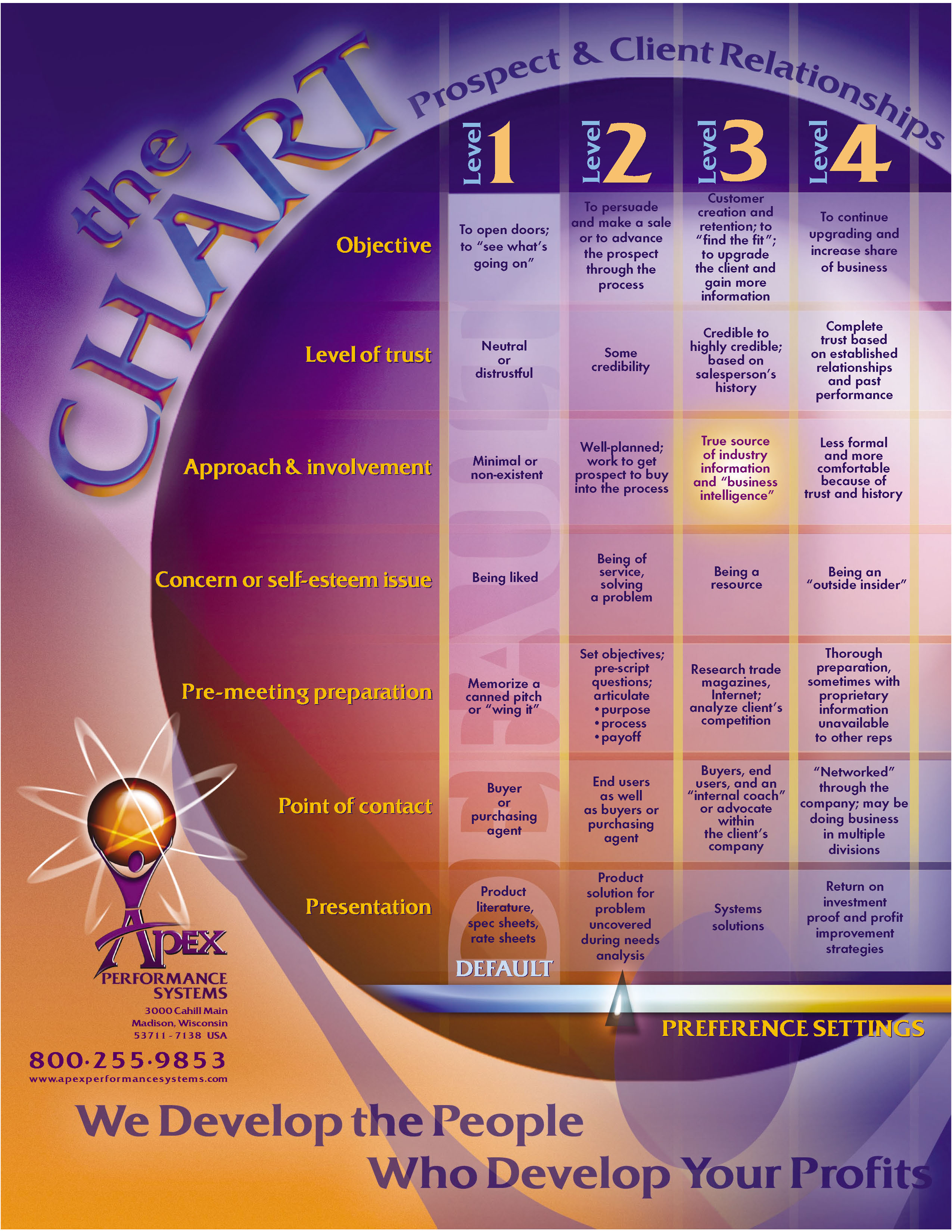
Sales has been a major part of my consulting and management jobs since the mid-1990s, but it wasn’t until I owned my own company that it became a true priority. I ran across a good book, The Accidental Salesperson, by Chris Lytle. Back then, Chris Lytle had “MAX Training,” and a large part of their focus was on increasing your “level” in prospect and client relationships. The training was good and complemented systems like Miller Heiman.
Each of these systems helps you prepare, plan, and execute to the best of your ability. And just like basketball, it takes practice to master. With mastery comes success and the illusion that something is easy (or you are lucky). The Seneca quote, “Luck is what happens when preparation meets opportunity,” is so true.
Regardless of the system you use, what matters most is that you try to be the best at examining both positive and negative examples to learn from them. There are lessons to be learned everywhere – especially when you make mistakes! Understanding what makes it good or bad helps you improve as part of an ongoing improvement process.
Incorporating new tools and techniques into what has already been proven to work will help you improve your game. Returning to the sports analogy, this could be part of what made Michael Jordon so good. He would see something interesting, improve it, and then make it his own.
For example, I get many horrible sales calls and emails. The people have obviously not done any preparation, do not know anything about the company I work for or about me, and often remind me why I stopped listening to them by citing how many times they have tried to contact me.
On the other hand, some talented sales professionals have done their homework, understand their products and the competition, and understand why what they are selling should matter to me – and can articulate that quickly and confidently. I will speak with them and occasionally buy from them. And in either case, I provide my team with real-life examples of good and bad sales techniques.
So, focus on becoming the best example of whatever it is you do, learn from others, and never stop improving. This isn’t about imitation; it’s about uncovering the secrets of their success and learning from them. And if you are lucky, you will have some fun doing it!
Acting Like an Owner – Does it matter?
One of the biggest changes to my professional perspective on business came when I started my own consulting business. Prior to that, I had worked as an employee for midsize to large companies for ten years and then as one of the first hires at a start-up technology company. I felt that doing hands-on work, managing, selling, and helping establish a start-up (where I did not have an equity stake) provided everything needed to start my own business.

Well, guess what? I was only partially correct. I was prepared for the activities of running the business but really was not prepared for the responsibility of running a business. While this seems like it should be obvious, I’ve seen many business owners whose primary focus is on growth/upside activities and not the day-to-day. That type of optimism is important for entrepreneurs – without it, they would not bother putting so much at risk.
People tend to adopt a different perspective when making decisions once they realize that every action and decision can impact the money moving into and out of their own wallets.
Even in a large business, you can usually spot the people who have taken these risks and run their own business. I was responsible for a Global Business Unit with $60+ million in annual sales and ran it like a “business within a business.” Having P&L responsibilities meant the decisions I made mattered to my success and the success of my business unit.
It’s more than just striking out on your own as a contractor or sole proprietor. I’m talking about the people who have had employees, invested in capital equipment, and gone all-in. These are the people thinking about the big picture and the future.
What do these people do differently than those without this type of experience?
One of the biggest things is they view business as “good business” and “bad business.” Not all business is good business, and not all customers are good customers.
There needs to be a fair commercial exchange where both sides receive value, mutual respect, and open communication. You know this works when your customers treat you like a true partner (a real trusted advisor) instead of just a vendor, or at least do not try to take advantage of you (and vice versa).
A business is in business to make money, so if your work is not profitable, you should not do it. And, if you are not delivering value to an organization, it is very likely that you would be better off spending your time elsewhere – building your reputation and reference base within an organization that was a better fit. While that may not be true for all business endeavors (think how long it took Amazon to become profitable and where they are now), it generally is true for employees at all levels.
For example, “bad” salespeople (who may very well regularly exceed their quotas) typically do the following:
- Only care about the sale and their commission – not profitability, fit, customer satisfaction, or the effort required to support that customer.
- Selling products and services people don’t need.
- Making promises they know will not be met is a typical sign of a person who does not think like an owner.
- Their primary focus is on personal short-term benefit, and not on growing accounts or the success of the business.
These are examples of someone who does not think or act like an owner.
How you view and treat employees is another big difference. Unfortunately, even business owners do not always get this right. I believe that employees are either viewed as Assets (to be managed for growth and long-term value) or Commodities (to be used up and replaced as needed – usually treated as fungible and easily replaceable). Your business is usually only as good as your employees, so treating them well and with respect creates loyalty and results in higher customer satisfaction.
Successful business owners usually look for the best person out there, not just the most affordable person who is “good enough” to do the job. On the flip side, you need to quickly weed out people who are not a good fit. Making good decisions quickly and decisively is often a hallmark of a successful business owner. The saying about hiring slowly and firing quickly makes even more sense when you are running a lean operation that requires every person to contribute to the company’s success.
Successful business owners are generally more innovative. They are willing to experiment and take risks. They reward that behavior. They understand the need to find a niche where they can win and provide goods and/or services tailored to those specific needs. Agility can be a significant competitive advantage. My company often contracted with Fortune 100 companies for this very reason. We could attempt something faster, for less money, and with less scrutiny than could be done internally. Those companies were outsourcing innovation.
Sometimes, this means specialization and customization, and sometimes, it means personalized attention and better support. Regardless of what is different, these people pay attention to the small details, understand their target market, and are good at defining a message articulating those differences. These are the people who seem to be able to see around corners and anticipate both problems and opportunities. This can be a learned skill, developed out of necessity.
Former business owners are usually more conscientious about money. I created a “my money” policy on expenses. If someone felt something was important enough for their success that they would spend their own money on it, then they had my blanket approal to move forward. This approach created understanding and accountability.
Every dollar in the business provides safety and the opportunity for growth. Most owners are not the people who routinely spend hundreds or thousands of dollars on business meals or who take unnecessary or questionable trips to nice places. Money saved on unnecessary expenses can be invested in new products, features, or marketing for the benefit and growth of their company.
While these are common traits of successful business owners, you can develop them even if you have never owned a business. Hence the title, Acting like an Owner.
When selling, are you focused on delivering value, developing a positive reputation within that organization and with your customers, and profiting from long-term relationships? When delivering services, is your focus on delivering what has been contracted – and doing so on time and within budget? Are your projects used as examples of how things should be done within other organizations? When leading, are you being fair and transparent with your team? Are you spending money on the right things – not wasteful or extravagant things?
These are things employees at all levels can do. They will make a difference and help you stand out. That opens the door to career growth and change. And it may get you thinking about starting the business you have always dreamed of.
Awareness and understanding are the first steps towards change and improvement.
- ← Previous
- 1
- 2
- 3
- Next →

