
Latest Event Updates
IoT and Vendor Lock-in
I was researching an idea last weekend and stumbled across something unexpected. My view on IoT has been that it provides a framework for a rich ecosystem of hardware and software products and their use. That flexibility and extensibility foster innovation, which in turn leads to greater use and adoption of the best products. It was quite a surprise to discover that IoT was being used to do just the opposite.
My initial find was a YouTube video about “Tractor Hacking” that lets farmers make their own repairs. That seemed like an odd video to appear in my search results, but it made sense about halfway through. The video discusses not having access to software, replacement components not working because they aren’t registered to that tractor’s serial number, and the only alternative being costly transportation of the equipment to a Dealership to have a costly component installed.

I initially thought there had to be more to the story, as I found it hard to believe that a major vendor in any industry would intentionally do something like this. That led me to an article from nearly two years earlier that contained the following:
“IoT to completely transform their business model” and
“John Deere was looking for ways to change their business model and extend their products and service offering, allowing for a more constant flow of revenue from a single customer. The IoT allows them to do just that.”
That article closed with the assertion:
“Moreover, only allowing John Deere products access to the ecosystem creates a buyer lock-in for the farmers. Once they own John Deere equipment and make use of their services, it will be very expensive to switch to another supplier, thus strengthening John Deere’s strategic position.”
While any technology – especially platforms – has the potential for vendor lock-in, the majority of vendors offer some form of openness, such as:
- Supporting open standards, APIs, and processes that support some degree of portability and third-party product access.
- Providing simple ways to unload your data in at least one of several commonly used non-proprietary formats.
Some buyers may deliberately implement systems that support non-standard technology and extensions because they believe the long-term benefits of a tightly coupled system outweigh the risks of being locked into a vendor’s proprietary stack. But there are almost always several competitive options available; always consider all viable alternatives.
Less technology-savvy buyers may never even consider asking questions like this when purchasing. Even technologically savvy people may fail to consider IoT as a key component of everyday tools and services – thus failing to recognize the implications of a closed system relative to their purchase.
It will be interesting to see whether deliberate business strategies like these change because of competitive pressure, social pressure, or legislation over the coming years. In the meantime, the principle of caveat emptor may be truer than ever in this age of connected everything and the Internet of Things.
The Value Created by a Strong Team
I participated in an amazing team-building exercise as a Board Member for the Children’s Hospital Foundation of Wisconsin. We were heading down a path that would lead to a decision on whether to invest $150M in a new addition. The CEO at the time, Jon Vice, wisely determined that each committee needed strong teams to thoroughly vet the idea from every possible perspective.

The process started with being given a book to read (“Now, Discover Your Strengths” by Marcus Buckingham & Donald O. Clifton, Ph.D.) and then completing the “StrengthsFinder” assessment using a code provided in the book. The goal was to understand gaps in perception (how you view yourself vs. how others view you) so you could better understand your strengths and weaknesses. Then, teams were created with people having complementary skills to help eliminate weaknesses from the overall team perspective. The results were impressive.
Over my career, I have been involved in many team-building exercises and events – some of which provided useful insights. However, most failed to combine the findings meaningfully, provide useful context, or offer actionable recommendations. Key areas that were consistently omitted were Organizational Culture, Organizational Politics, and Leadership. Those three areas significantly impact value creation vis-à-vis team effectiveness and commitment.
When I ran my consulting company, we had a small core team of business and technology consultants and leveraged subcontractors and an outsourcing company to take on more concurrent projects, as well as larger, more complex ones. This approach worked for three reasons:
- We had developed a High-Performance Culture that was based on:
- Purpose: A common vision of success, understanding why that mattered, and understanding how that was defined and measured.
- Ownership: Taking responsibility for something and being accountable for the outcome. This included responsibility for the extended team of contractors. Standardized procedures helped ensure consistency and make it easier for each person to accept responsibility for “their team.”
- Trust: Everyone understood that to be effective and responsive, they needed to trust and support each other and trust each other’s judgment. If there was a concern, we focused on context and process improvements to understand what happened and implement changes based on lessons learned. We avoided personal attacks for the good of the entire team.
- Empowerment: Everyone understood that decision-making involves risk, while also recognizing that delaying an important decision could be costly and create more risk. Therefore, each member was responsible for making good decisions as needed and communicating changes to the rest of the team.
- Clear and Open Communication: The team was very transparent and honest. When an issue came up, they tried to resolve it with that person first, then escalated if they couldn’t reach an agreement and decided to seek the team’s consensus. Everything was out in the open and done in a constructive, collaborative spirit.
People who were not a good fit would quickly wash out, so our core team consisted of trusted experts. A friendly competition helped raise the bar for the entire team, but when needed, the other team members became a safety net for each other.
We were all focused on the same goal, and everyone realized the only way to succeed was to work together. Win or lose, we did it together. The strength of our team created tremendous value – internally and for our customers that we sustained for several years. That value included innovation, higher levels of productivity and profitability, and an extremely high success rate.
This approach can work at any level but is most effective when it starts at the top. When employees see their company leaders behaving this way, it provides a model and sets expectations for everyone under them. If there is dysfunction within an organization, it often starts at the top – by promoting or accepting behaviors that do not benefit the whole of the organization. With a strong and positive organizational culture, the value of strong teams is multiplied and becomes an incredible competitive advantage.
Good Article on Why AI Projects Fail

Today I came across this very good article focused on lessons learned, which could help anyone interested in these topics. It included a good mix of non-technical problems.
This is the link to the article, along with my commentary on the Top 3 items listed: https://www.cio.com/article/3429177/6-reasons-why-ai-projects-fail.html
Item #1:
The article discusses how the “problem” being evaluated was misstated using technical terms. At least some of these efforts are conducted “in a vacuum.” Given the cost and strategic importance of getting these early-adopter AI projects right, that surprised me.
In Sales and Marketing, you start the question, “What problem are we trying to solve?” and evolve that to, “How would customers or prospects describe this problem in their own words?” Without that understanding, you can neither vet the solution initially nor quickly qualify the need for it when speaking with customers or prospects. That leaves room for error when transitioning from strategy to execution.
More collaboration with Business likely would have helped. This was touched on at the end of the article under “Cultural challenges,” but the importance seemed to be downplayed. Lessons learned are valuable – especially when you are able to learn from the mistakes of others. This should have been called out early as a major lesson learned.
Item #2:
This second area had to do with the perspective of the data, whether that was the angle of the subject in photographs (overhead from a drone vs horizontal from the shoreline) or the type of customer data evaluated (such as from a single source) used to train the ML algorithm.
That was interesting because assumptions may have played a role in overlooking other aspects of the problem, or the teams may have been overly confident they could get the right results with the data available. In the examples cited, those teams identified the problems and took corrective action. A follow-up article describing the process used to determine the root cause in each case would be very interesting.
As an aside, from my perspective, this is why Explainable AI is so important. Sometimes, you just don’t know what you don’t know (the unknown unknowns). Understanding why and on what the AI is basing its decisions should help provide better-quality curated data up front, as well as identify potential drifts in the wrong direction while it is still early enough to make corrections without impacting deadlines or deliverables.
Item #3:
This didn’t surprise me, but it should be a cause for concern as advances are made at faster rates and organizations race to be first to market with an AI-based competitive advantage, potentially with less validation than ideal. The last paragraph under ‘Training data bias’ stated that based on a PWC survey, “only 25 percent of respondents said they would prioritize the ethical implications of an AI solution before implementing it.“
Bonus Item:
The discussion about the value of unstructured data was very interesting, especially when you consider:
- The potential for NLU (natural language understanding) products in conjunction with ML and AI.
- This is a great NLU-pipeline diagram from North Side Inc. in Canada, one of the pioneers in this space.
- The importance of semantic data analysis relative to any ML effort.
- The incredible value that products like MarkLogic’s database or Franz’s AllegroGraph provide over standard Analytics Database products.
- I personally believe the biggest exception to this assertion will be GPU databases (like OmniSci) that easily handle streaming data, can accomplish extreme computational feats well beyond traditional CPU-based products, and have geospatial capabilities that add an extra dimension of insight to the problem being solved.
Update: This is a link to a related article that discusses trends in areas of implementation, important considerations, and the potential ROI of AI projects: https://www.fastcompany.com/90387050/reduce-the-hype-and-find-a-plan-how-to-adopt-an-ai-strategy
This is an exciting space that will grow significantly over the next 3-5 years. The more information, experiences, and lessons learned are shared, the better it will be for everyone.
Apollo 11 50th Anniversary – Interesting photos & article link
I still remember my parents letting me stay up late to watch the first moonwalk. It was 9:30 pm, I was 5 years old, and we were huddled around an old “black and white” television with a circular viewing area. My parents tried to convey how important and monumental that moment was – telling me I would tell my children this story someday.
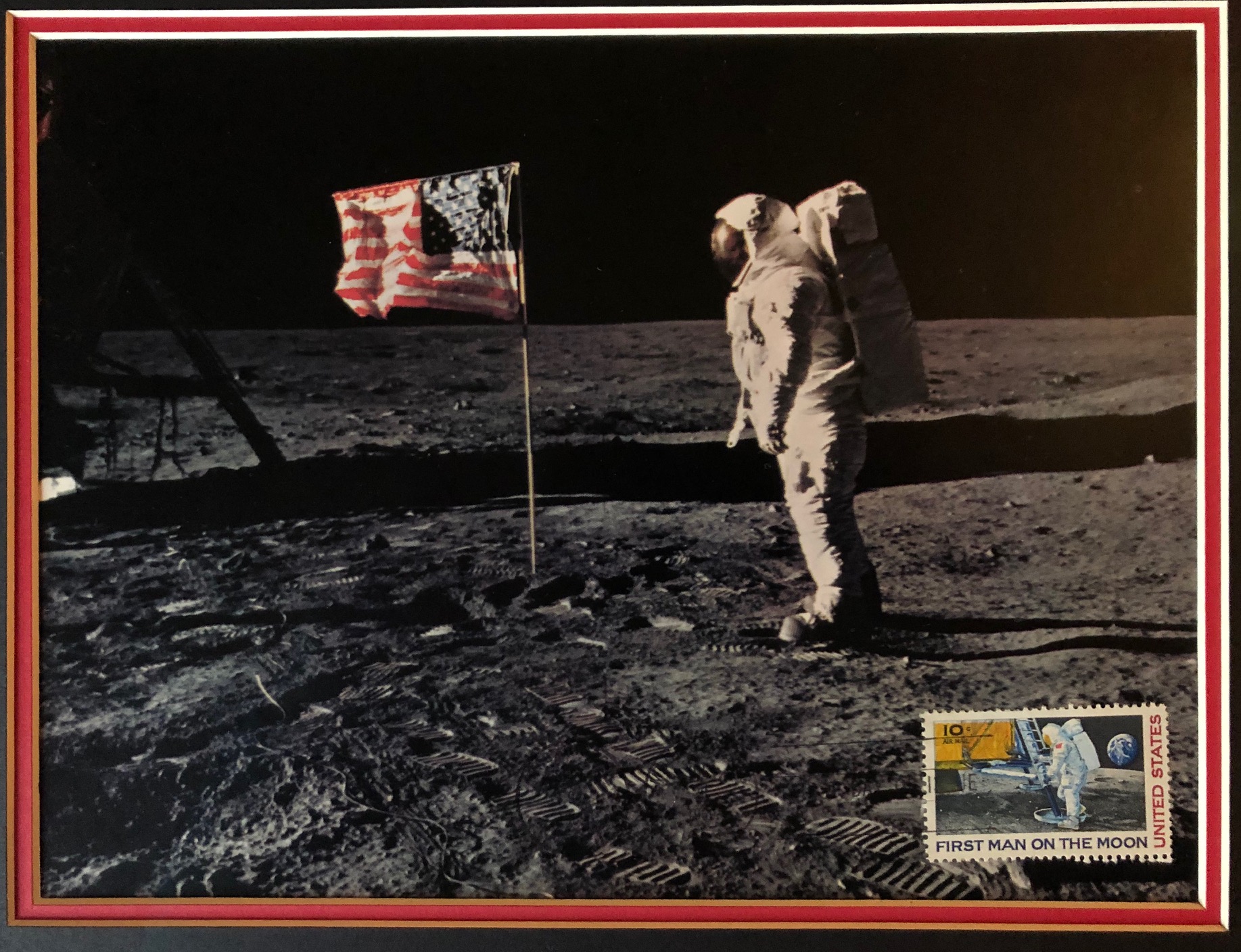
What I remember most was being amazed at seeing the astronauts hop around easily and not understanding how that could be. We had watched the launch on TV and were getting updates nightly from Walter Cronkite on the evening news. Normally my dad would sit at a TV table to eat dinner and watch the news as my mom sat with my sister and me at our kitchen table, but this week was different.

With all of the news this past week on the 50th Anniversary of the first moonwalk, it triggered a couple of memories. One of them was that I purchased a collectible item in 2005 at the annual Children’s Circle of Care leadership conference in San Diego, CA. A luncheon was held on the USS Midway Museum deck, and afterward, I took a tour. It is an incredible place to visit if you are ever near San Diego.
Before leaving that day, I went to the gift shop to get my wife and children a few trinkets. What I found was a beautiful display, which I immediately purchased and shipped home. This display was taken to school a couple of times for “show and tell.” It hung on my office wall for 3 years and then went into storage with other artwork. It then sat for the past decade, and I almost forgot it.
To me, this display is both beautiful to see and very inspirational. Human creativity is an incredible thing! As an aside, I have never seen anything like this display, so I thought I would share it with you.
Today I also ran across a good article regarding this event that provided information I had not seen before. It is very interesting and can be found here: https://go.usa.gov/xyVGh
Edit: This was another good article that discusses the advanced flight control computer used at the time – https://www.linkedin.com/pulse/apollo-11-moon-landings-fourth-crew-member-computer-far-fishman/
This anniversary is a great reminder of the power of individuals, teams, and partnerships when they are mission-focused. I find people like the men and women of NASA extremely motivating, and the few I have met have all been very friendly. They are the humble heroes!


Commentary on an HBR article about Start-ups & Entrepreneurship
A friend posted this article on LinkedIn.com. Because of character limits for comments, I decided to post my response here. Below is a link to the article referenced: https://hbr.org/2019/07/building-a-startup-that-will-last
The article is interesting, but emphasizing “second and third acts” assumes that the start-up will successfully navigate the first act. Even with addressing what the author views as key points, this is still a very big assumption. The reasons for Longevity and Success are far more complex and multi-dimensional, but it highlights some of the more important areas of focus.
Long-term success requires several things: The right combination of having a unique goal that has the potential to make a big impact (think “No software” from Salesforce.com); Innovative ideas to achieve that goal; A diverse team to build the product (a mix of visionaries, insightful “translators,” technical experts, designers, planners, adept doers, etc.); Very good sales/business development/marketing to describe a better way of doing things and converting that to new business; and ultimately a management team focused on sustainable and scalable growth.
The point about the need to “Articulate a value framework oriented toward societal impact, not just financial achievement” seems superficial and too tactical.
First, most new technologies have unintended consequences. Social Media is a recent example, but Genetic Editing and AI are two areas that are likely to provide more examples over the next decade. Not every societal impact will be positive, and having a negative impact could very well lead to the untimely demise of that company.
Second, the two ideas (societal impact and financial achievement) are not mutually exclusive. When I owned my consulting company, we aimed to fund $1M of medical research to find a cure for Arthritis. We allocated half of our net profits to this goal. Every employee was on board with this because there was a tangible example of why it mattered (my daughter). We invested $500K and helped launch a few careers for some brilliant MD/Ph. Ds, and at least one national protocol came out of their research.
Mission and Vision are important to a company, yet many fail to view this as anything more than a marketing effort. Those companies fail to realize that this is as much about motivating and inspiring employees as it is about grabbing a prospective customer’s attention. These should be inspirational and aspirational, such as the “BHAG” (Big Hairy Audacious Goals) Collins and Porras wrote about 25 years ago.

Regarding Endurance and the assertion that “…the best businesses are intrinsically aligned with the long-term interests of society,” my take is slightly different. The best businesses look for trends and opportunities in an ever-changing global competitive landscape instead of looking to their competitors and trying to ride on their coattails. Companies with a culture of fostering innovation as a way to learn and grow (Amazon and Google are two great examples) can find that intersection of “good business” and “positive societal impact.” It is much more complex than a simple one-dimensional outlook.
But it was a good article to help reframe ideas and assumptions around growth.

