
success
One Successful Approach for Managing Innovation
When I owned a consulting company, we viewed innovation as an imperative. It was the main driver of differentiation, credibility, and opportunity. We had an innovation budget, solicited ideas from the team, and evaluated those ideas quarterly.
Almost as important to me was that this was fun. It allowed everyone on the team to suggest ideas and participate in the process. That was meaningful and supported the collaborative, high-performance culture that had developed. The team was inspired and empowered to make a difference, and that led to an ever-increasing sense of ownership for each employee.
The team also had a vested interest in having the process work, as quarterly bonuses were paid based on their contributions to the company’s profitability. There was a direct cause-and-effect correlation with tangible benefits for every team member.
We developed the following 10 questions to qualify & quantify the potential of new ideas:
- What will this new thing do?
- Be very detailed, as this was used to create a shared vision of success based on the presented idea.
- What problem(s) does this solve, and how so?
- This seems obvious, but selling this new product will be an uphill challenge if you are not solving a problem (such as “lack of organic expansion”) or addressing an immediate pain point.
- What type of organizations have those problems and why?
- This was fundamental to understanding whether a fix was possible from a practical perspective, what value that fix might have for the target buyer, and how much market potential existed to scale this new offering.
- What other companies have created solutions or are working on solutions to this problem?
- The lack of competition today does not mean you are the first to attack this problem. Due diligence can help you avoid repeating others’ failures by learning from their lessons and avoiding similar pitfalls.
- Will this expand our existing business, or does it have the potential to open up a new market for us?
- Each answer has upsides and downsides, but breaking into a new market can take more time and be more difficult, time-consuming, and expensive.
- Is this Strategic, Tactical, or Opportunistic?

- An idea may fall into multiple categories. When the Sarbanes-Oxley (SOX) Act became law, we viewed a new service offering as a tactical means to protect our managed services business and an opportunistic means to acquire new customers and grow the business. While this is not true innovation, it was an offering that flowed from this defined process.
- What are the Cost, Time, and Skill estimates for developing a Minimally Viable Product (MVP) or Service?
- What are the Financial Projections for the first year?
- Cost to develop and go to market.
- Target selling price, factoring in early adopter discounts.
- Estimated Contribution Margin Ratio (for comparison with other ideas being considered).
- Break-even point.
- Would we be able to get an existing customer to pre-purchase this?
- A company willing to provide a PO committing to purchasing the MVP within a specific timeframe increased our confidence in the idea’s viability.
- What are the specific Critical Success Factors to be used for evaluation purposes?
- This lesson learned over time helped minimize emotional attachment to the idea or project and provided objective milestones for critical go/no-go decision-making.
This process was purposeful, agile, lean, and fairly aggressive. We believed it gave our company a competitive advantage over larger companies that tended to respond more slowly to new opportunities and smaller competitors that did not want to venture outside their wheelhouse.
With each project, we learned, became more efficient and effective, and made better investment decisions that positively impacted our success. We monitored progress on an ongoing basis relative to our defined success criteria and adjusted or sunset an offering if it stopped providing the required value.
The process was not perfect…
For example, we passed on some leading-edge ideas, such as a “Support Robot” in 2003, an interactive program that used a pseudo machine-learning algorithm. It would be trained using historical log files, tested quickly and safely in a representative pre-production environment, refined as needed, and ultimately validated and rolled out.
This automation could have been used with our existing managed services and Remote DBA customers to further mitigate the risk of unplanned outages. Most importantly, it would have provided leverage to take on new business without jeopardizing quality or adding staff – thereby increasing revenue and profit margin.
At the time, we believed this would be too difficult to sell to prospective customers (“pipe dream” and “snake oil” were some of the adjectives we envisioned), so it appeared to lack a few items required by the process. Live and learn.
In summary, a defined approach to something as important as business needs innovation to grow and prosper, as best demonstrated by market leaders like Amazon and Google (read the 10-K Annual Reports to better understand their competitive growth strategies, which are largely based on innovation).
Implementing this approach within a larger organization requires additional steps, such as securing buy-in from a variety of stakeholders and aligning with existing product roadmaps, but it remains key to scalable growth for most businesses.
Non-Linear Thought Process and a Message for my Children
I have recently been investigating and visiting universities with my eldest daughter, a Senior in High School. Last week we visited Stanford University (an amazing experience) and spent a week in Northern California on vacation. After being home for a day and a half, I am in Texas for a week of team meetings and training.
On the first night of a trip, I seldom sleep, so I listened to the song “Don’t Let It Bring You Down” by Annie Lennox, a cover of a Neil Young song. That led to a YouTube search for the original Neil Young version, which led to me listening to “Old Man” – a favorite song of mine for over 30 years. That led to some reflection, which ultimately led to this post.
I mention this because it is an example of the nonlinear or divergent thought process (generally viewed as a negative trait) that occurs naturally for me. It helps me “connect the dots” faster and more naturally. It is a manner of thinking associated with ADHD (again, something generally viewed as negative). The interesting thing is that to fit in and succeed with ADHD, you tend to develop logical systems for focus and consistency. That has many positive benefits for me – such as systemic thinking, creating repeatable processes, and automation.

The combination of linear and non-linear thinking can really fuel creativity. The downside is that it can take quite a while for others to see the potential of your ideas, which can be extremely frustrating. But you learn to communicate better out of necessity. The upside is that you tend to create relationships with other innovators because they think like you, making you relatable and interesting to them. The world is a strange place.
It is funny how there are several points in your life when you have an epiphany, and things suddenly make complete sense. That makes you realize how much time and effort you could have saved if you’d figured something out sooner. As a parent, I always try to identify and create learning shortcuts for my children so they reach those points much sooner than I did.
I started this post thinking that I would document as many of those lessons as possible to serve as a future reminder and possibly help others. Instead, I decided to post a few things I view as foundational truisms in life that could help foster that personal growth process. So, here goes…
- Always work hard to be the best, but never let yourself believe you are the best. Even if you truly are, it will be short-lived, as there are always people doing everything they can to be the best. Ultimately, that is a good thing. You need to have enough of an ego to test the limits and capabilities of things, but not one that is so big that it alienates or marginalizes those around you.
- Learn from everything you do – good and bad. Continuous improvement is so important. By focusing on this, you constantly challenge yourself to try new things and find better (i.e., more effective, more efficient, and more consistent) ways to do things.
- Realize that the difference between a brilliant and a stupid idea is often perspective. Years ago, I taught technical courses, and occasionally someone would describe something they did that seemed strange or wrong. But if you asked questions and tried to understand why they did what they did, you would often identify the brilliance in that approach. It is both exciting and humbling.
- Incorporating new approaches or the best practices of others into your own proven methods and processes is part of continuous improvement, but it only works if you can set aside your ego and keep an open mind.
- Believe in yourself, even when others don’t share that belief. Remain open to feedback and constructive criticism as a way to learn and improve, but never give up on yourself. There is a huge but sometimes subtle difference between confidence and arrogance, and that line is often drawn at the point where you can accept that you might be wrong or that there might be a better way to do something. Become the person people like working with and not the person they avoid or want to see fail.
- Surround yourself with the best people that you can find. Look for people with diverse backgrounds and complementary skills. The best teams I have ever been involved with consisted of high achievers who constantly raised the bar for each other while simultaneously creating a safety net for their teammates. Those teams grew and did amazing things because everyone was very competitive and supportive of each other.
- Keep notes or a journal because good ideas are often fleeting and hard to recall. Remember, good ideas can come from anywhere, so keep track of others’ suggestions and make sure you attribute them to the proper source.
- Try to make a difference in the world. Try to leave everything you “touch” (job, relationship, project, whatever) in a better state than before you were there. Helping others improve and leading by example are two simple ways of making a difference.
- Accept that failure is a natural obstacle on your path to success. You are not trying hard enough if you never fail. But you are also not trying hard enough if you fail too often. That is very subjective, and honest introspection is your best gauge. Be accountable, accept responsibility, document the lessons learned, and move on.
- Dream big, and use that as motivation to learn new things. While I funded medical research, I learned about genetics, genomics, and biology. That expanded into interests in nanotechnology, artificial intelligence, machine learning, neural networks, and interfaces such as natural language and non-verbal/emotional communication. Someday I hope to tie these together to help cure a disease (Arthritis) and improve the quality of life for millions of people. Will that ever happen? I don’t know, but I do know that if I don’t try, it will never happen because of anything I did.
- Focus on the positive, not the negative. Creativity is stifled in environments where fear and blame rule.
- Never hesitate to apologize when you are wrong. This is a sign of strength, not weakness.
- And above all else, honesty and integrity should be the foundation for everything you do and are.
Hopefully, this will help my children become the best people possible, ideally early on in their lives. I was 30 years old before I had a clue about many of these things. Until that point, I was somewhat self-centered and focused on winning. Winning and success are good things, but are better when accomplished the right way.
It’s not Rocket Science – What you Measure Defines how People Behave
I previously wrote a post titled “To Measure is to Know.”

The other side of the coin is that what you measure defines how people behave. This is an often forgotten aspect of Business Intelligence, Compensation Plans, Performance reviews, and other key areas in business. While many people view this topic as “common sense,” based on the numerous incentive plans you run across as a consultant and compensation plans you submit as a Manager, that is not the case.
Is it wrong to have people respond by focusing on specific aspects of their job that they are being measured on? That is a tricky question. This simple answer is “sometimes.” This is ultimately the desired outcome of implementing specific KPIs (key performance indicators), OKRs (objectives and key results), MBOs (Management by Objectives), and CSAT (Customer Satisfaction), but it doesn’t always work. Let’s dig into this a bit deeper.
One prime example is something seemingly easy, yet often anything but: compensation plans. When properly implemented, these plans drive organic business growth through increased sales, revenue, and profits (three related items that should be measured). This can also drive steady cash flow by closing deals faster and within specific periods (usually months or quarters) and focusing on models that create the desired revenue stream (e.g., perpetual license sales versus subscription license sales versus SaaS subscription sales). What could be better than that?
Successful salespeople focus on the areas of their comp plan where they have the greatest opportunity to make money. Presumably, they are selling the products or services that you want them to based on that plan. MBO and OKR goals can be incorporated into plans to drive positive outcomes that matter to the business, such as bringing on new reference accounts. Those are forward-looking goals that increase future (as opposed to immediate) revenue. In a perfect world, with perfect comp plans, these business goals are codified and supported by motivational financial incentives.
Some of the most successful salespeople are the ones who primarily care only about themselves (although not at the expense of their company or customers). They are in the game for one reason—to make money. Give them a well-constructed plan that lets them win, and they will do so predictably. Paying large commission checks should be a goal for every business because properly constructed compensation plans mean their own business is prospering. It needs to be a win-win design.
However, suppose a salesperson has a poorly constructed plan. In that case, they will likely find ways to personally win with deals that don’t align with company growth goals (e.g., paying a commission based on deal size but not factoring in profitability and discounts). Even worse, give them a plan that doesn’t provide a chance to win, and the results will be uncertain at best.
Just as most tasks tend to expand to use all the time available, salespeople tend to book most of their deals at the end of whatever period is used. With quarterly payment cycles, most of the business tends to book in the final week or two of the quarter, which is not ideal for cash flow. Using shorter monthly periods may increase business overhead. Still, the potential to level out the flow of booked deals (and associated cash flow) from salespeople working harder for that immediate benefit will likely be a worthwhile tradeoff. I pushed for this change while running a business unit, and we began seeing positive results within the first two months.
What about motivating Services teams? What I did with my company was to provide quarterly bonuses based on overall company profitability and each individual’s contribution to our success that quarter. Most of our projects used task-oriented billing, where we billed 50% up-front and 50% at the time of the final deliverables. You needed to both start and complete a task within a quarter to maximize your personal financial contribution, so there was plenty of incentive to deliver and quickly move to the next task. As long as quality remains high, this is a good thing.
We also factored in salary costs (i.e., if you make more than you should, you’re bringing more value to the company), the cost of rework, and non-financial items that benefited the company. For example, writing a white paper, giving a presentation, helping others, or even providing formal documentation on lessons learned added business value and would be rewarded. Everyone was motivated to deliver quality work products on time, help each other, and do things that promoted the company’s growth. My company prospered, and my team made good money to make that happen. Another win-win scenario.
This approach worked very well for me and was continually validated over several years. It also fostered innovation because the team was always looking for ways to increase their value and earn more money. Many tools, processes, and procedures emerged from what would otherwise be routine engagements. Those tools and procedures increased efficiency, consistency, and quality. They also made it easier to onboard new employees and incorporate an outsourced team for larger projects.
Mistakes with comp plans can be costly – due to excessive payouts and/or because they are not generating the expected results. Backtesting is one form of validation as you build a plan. Short-term incentive programs are another. Remember, without some risk, there is usually little reward, so accept that some risk must be taken to find the point where optimal behavior is fostered, and then adjust the plan accordingly.
It can be challenging and time-consuming to identify the right things to measure, the right number of things (measuring too many or too few will likely fall short of goals), and the incentives that motivate people to do what you want and need. Anything worth doing is worth doing well. Hopefully this post provided ideas on how to make that happen.
Profitability through Operational Efficiency
In my last post, I discussed the importance of proper pricing for profitability and success. As most people know, you increase profitability by increasing revenue and/or decreasing costs. However, cost reduction does not necessarily mean slashing headcount, wages, benefits, or other factors that often hurt morale and cascade into lower quality and customer satisfaction. There is often a better way.

The best businesses generally focus on repeatability and reliability, realizing that the more you do something, the better you get at doing it well. You develop a compelling selling story based on past successes, build a solid reference base, and identify the sweet spot from a pricing perspective. People keep buying what you are selling, and if your pricing is right, money is available at the end of the month to fund organic growth and operational efficiency efforts.
Finding ways to increase operational efficiency is the ideal way to reduce costs, but it takes time and effort. Sometimes this happens through increased experience and skill. But, often optimization occurs through standardization and automation. Develop a system that works well, apply it consistently, measure and analyze the results, and then make changes to improve the process. An added benefit is that this approach increases quality, making your offering even more attractive.
Metrics should be collected at a “work package” level or lower (e.g., task level), which means they are related tasks at the lowest level that produce a discrete deliverable. This project management concept works whether you are manufacturing something (although a Bill of Materials may be a better analogy in this segment), building something, or creating something. This allows you to accurately create and validate cost and time estimates. At this level of detail, it becomes easier to identify ways to simplify or automate the process.
When I ran my company, we used this approach to win more business with competitive fixed-price project bids that provided healthy profit margins while minimizing risk for our clients. Higher profit margins let us invest in our own growth and success by funding ongoing employee training and education, innovation efforts, and international expansion, as well as experimenting with new things (products, technology, methodology, etc.) that were fun and often taught us something valuable.
Those growth activities were only possible because we focused on doing everything as efficiently and effectively as possible, learning from everything we did – good and bad – and having a tangible way to measure and prove that we were constantly improving.
Think like a CEO, act like a COO, and measure like a CFO. Do this and make a real difference in your own business!
Doing it like Mike
My son is playing basketball this year (he previously played football and soccer), and we recently went shopping for new shoes. Each store had pictures of Michael Jordan. I used to love watching MJ play with the Chicago Bulls. He was the epitome of skill and professionalism. To this day, he inspires me.
Some people are naturally talented but must still work hard to achieve their full potential. Hard work is an important aspect of being the best at anything, but it takes more than that. It takes doing things in a way that allows you to continuously improve, along with a positive mindset and a commitment to success. Once people reach that high-performance level, their jobs look easy, and they may even appear to be a “natural” – just like Mike. But that is just the tip of the iceberg.
Most of my career changes have been unplanned. For example, in 2010, our VP of Sales was fired, and the guy intended to fill the slot quit to go work for Salesforce.com. We had our sales kickoff less than five days away, and nothing was planned yet. The SVP of Sales told me that if I wanted the job, he would give me six months. But if I didn’t cut it at the end of six months, no other job would be waiting for me.
Opportunities presented themselves, the job seemed interesting, and before I knew it, I was fully immersed in something related but different. The potential reward outweighed the real risk.
Many of these things have not come naturally to me. Each time, I focused on understanding the requirements for doing the job well, then looked for examples of exceptional performance, and finally created a systematic approach that let me measure performance and identify areas for improvement on an ongoing basis. From then on, I analyzed my results, thought daily about even the smallest improvements I could make, and tried to do even better the next day.
Good enough was never good enough. Introspection can be challenging, so one thing that I have done is to take time to celebrate wins and intentionally focus on remembering how that feels. Those memories can be motivational in times of stress or frustration and help you get back on track quickly.
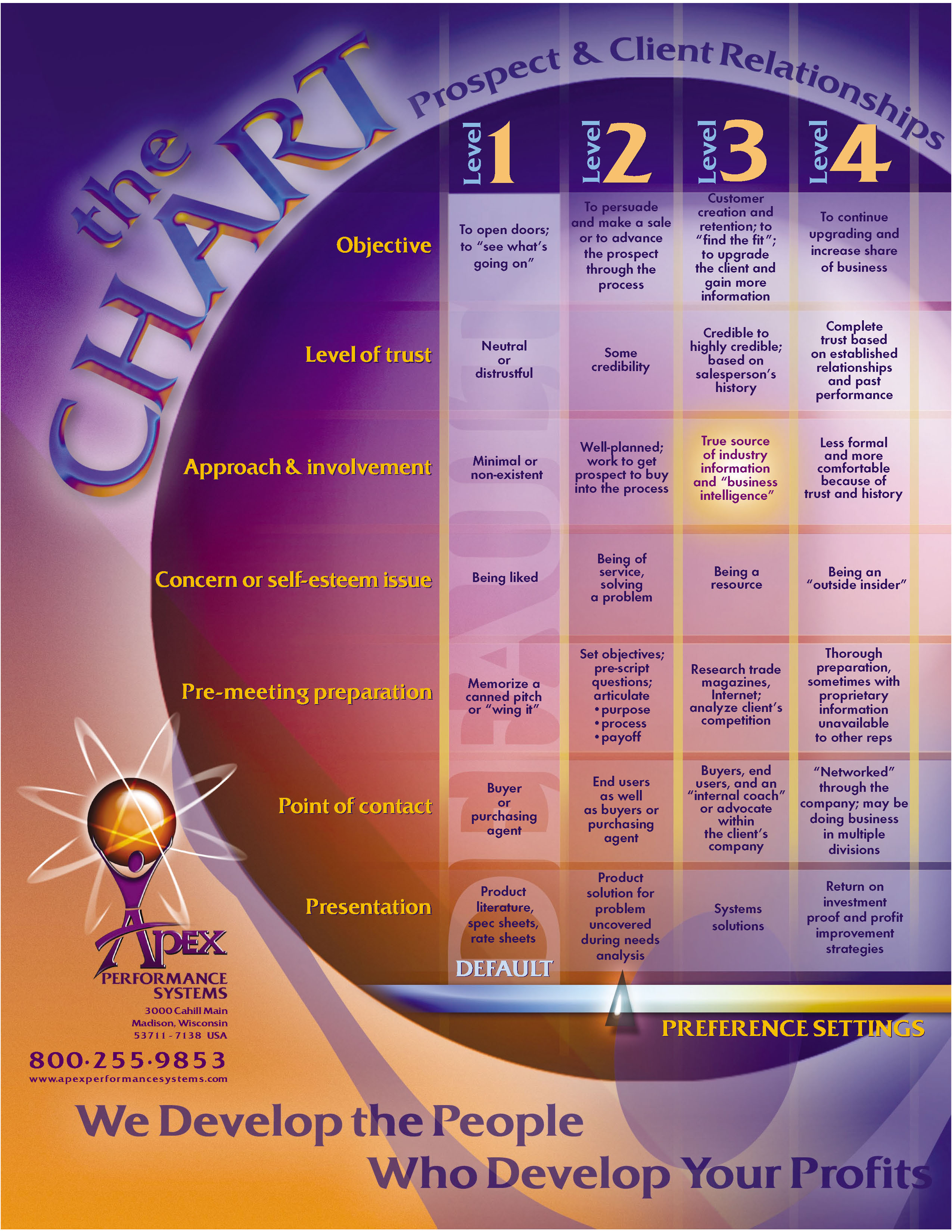
Sales has been a major part of my consulting and management jobs since the mid-1990s, but it wasn’t until I owned my own company that it became a true priority. I ran across a good book, The Accidental Salesperson, by Chris Lytle. Back then, Chris Lytle had “MAX Training,” and a large part of their focus was on increasing your “level” in prospect and client relationships. The training was good and complemented systems like Miller Heiman.
Each of these systems helps you prepare, plan, and execute to the best of your ability. And just like basketball, it takes practice to master. With mastery comes success and the illusion that something is easy (or you are lucky). The Seneca quote, “Luck is what happens when preparation meets opportunity,” is so true.
Regardless of the system you use, what matters most is that you try to be the best at examining both positive and negative examples to learn from them. There are lessons to be learned everywhere – especially when you make mistakes! Understanding what makes it good or bad helps you improve as part of an ongoing improvement process.
Incorporating new tools and techniques into what has already been proven to work will help you improve your game. Returning to the sports analogy, this could be part of what made Michael Jordon so good. He would see something interesting, improve it, and then make it his own.
For example, I get many horrible sales calls and emails. The people have obviously not done any preparation, do not know anything about the company I work for or about me, and often remind me why I stopped listening to them by citing how many times they have tried to contact me.
On the other hand, some talented sales professionals have done their homework, understand their products and the competition, and understand why what they are selling should matter to me – and can articulate that quickly and confidently. I will speak with them and occasionally buy from them. And in either case, I provide my team with real-life examples of good and bad sales techniques.
So, focus on becoming the best example of whatever it is you do, learn from others, and never stop improving. This isn’t about imitation; it’s about uncovering the secrets of their success and learning from them. And if you are lucky, you will have some fun doing it!

