Life
Are you Visionary or Insightful?
Having great ideas that are not understood or validated is pointless, just as being great at “filling in the gaps” to do amazing things does not accomplish much if what you are building achieves little toward your needs and goals. This post is about Dreaming Big and turning those dreams into actionable plans.
Let me preface this post by stating that both are important and complementary roles. But, if you don’t recognize the difference between the two, it becomes much more challenging to execute and realize value/gain a competitive advantage.
The Visionary has great ideas but doesn’t always create plans or follow through on developing the idea. There are many reasons why this happens (distractions, new interests, frustration, lack of time), so it is good to be aware of that, as this type of person can benefit by being paired with people willing and able to understand a new idea or approach, and then take the next steps to flesh out a high-level plan to present that idea and potential benefits to key stakeholders. People may view them as aloof or unfocused.
The Insightful sees the potential in an idea, helps others understand the benefits and gain their support, and often creates and executes a plan to prototype and validate the idea – killing it off early if the anticipated goals are unachievable. They document, learn from these experiences, and become more and more proficient with validating the idea or approach and quantifying the potential benefits. They are usually very pragmatic.
Neither of these types of people is affected by loss aversion bias.

I find it amazing how frequently you hear someone referred to as being Visionary, only to see that the person in question could eliminate some of the noise and “see further down the road” than most people. While this skill is valuable, it is more akin to analytics and science than art. Insight usually comes from focus, understanding, intelligence, and being open-minded. Those qualities matter in both business and personal settings.
On the other hand, someone truly visionary looks beyond what is already illuminated and can, therefore, be detected or analyzed. It’s like a game of chess where the visionary person is thinking six or seven moves ahead. They are connecting the dots for the various future possibilities while their competitor is still thinking about their next move.
Interestingly, this can be a very frustrating situation for everyone.
- The Visionary with an excellent idea may become frustrated because they feel an unmet need to be understood.
- The people around that visionary person become frustrated, wondering why that person isn’t able to focus on what is important or why they fail to see/understand the big picture.
- Others view the visionary ideas and suggestions as tangential or irrelevant. It is only over time that the others understand what the visionary person was trying to show them – often after a competitor has started executing a similar idea.
- The Insightful wanting to make a difference can feel constrained in static environments, offering little opportunity for change and improvement.
Both Insightful and Visionary people feel that they are being strategic. Both believe they are doing the right thing. Both have similar goals. What’s truly ironic is they may view each other as the competition rather than seeing the potential of collaborating.
A strong management team can positively impact creativity by fostering a culture of innovation and placing these people together to work towards a common goal. Providing little time and resources to explore an idea can lead to remarkable outcomes. When I had my consulting company, I sometimes joked, “What would Google do?” to describe that amazing things were possible and waiting to be done.
The insightful person may see a payback on their ideas sooner than the visionary person, and that is due to their focus on what is already in front of them. It may be a year or more before what the visionary person has described shifts to the mainstream and into the realm of insight – hopefully before it reaches the realm of common sense (or worse yet, is entirely passed by).
I recommend that people create a system to gather ideas, along with a description of what the purpose, goals, and advantages of those ideas are. Foster creative behavior by rewarding people for participation regardless of what becomes of the idea. Review those ideas regularly and document your commentary. You will find good ideas with luck – some insightful and possibly even visionary.
Look for commonalities and trends to identify the people who can cut through the noise or see beyond the periphery and the areas having the greatest innovation potential. This approach will help drive your business to the next level.
You never know where the next good idea will come from. Efforts like these provide growth opportunities for people, products, and profits.
Investing in Others – Becoming a Mentor
I have been very fortunate throughout my career. There have been incredible opportunities, risks with big rewards, and lessons learned from mistakes and failure (e.g., one of the biggest lessons learned early is that most mistakes will not kill you, and therefore you can find a way to recover from them). In hindsight, the people who saw something in me and invested in my career – my mentors – have been most valuable in shaping my career.
None of these people had to help me. It’s possible that they did so for their own benefit (i.e., the better I do my job, the easier it is for them), but I believe they were passing along a valuable gift. I was lucky to have been given these gifts early in my career, as they have been invaluable personally and professionally.

As a mentee may not recognize either the value of what you are receiving, or the effort that has gone into providing that gift to you. You fully appreciate what others have done for you only years later.
In my first programming job, my manager (Jim) assigned me to work with different key people and would follow up every time to ask what I had learned. One day he gave me my first project. I was excited but anxious because I did not want to fail my mentor.
I only had six months of experience, and this was a big project for an important automotive customer (Subaru, for the first fully customized customer loyalty coupon system for a major auto manufacturer in the late 1980s). It was a stretch for me, and the system had to be production-ready in six months.
Jim let me build it, checked daily to see if I had questions, and would provide feedback and direction if I asked. Aside from that he pretty much left me alone. He seemed more confident in my ability to succeed than I did at the time.
After two months, I thought I was finished. We reviewed everything, and Jim constructively picked apart my system – pointing out various flaws and then discussing the logic and reasoning behind my decisions. We spent half a day on this exercise, and it was only years later I realized that he was helping me learn more than simply validating the system design.
After another two months, we reviewed this system’s second iteration. He told me while this version would work and would be acceptable from anyone else, I still had time remaining, and he was confident that I could do even better next time. He provided a couple of tips about high-level areas he focused on while designing and developing systems and left it at that.
When I returned with the third iteration system, he reviewed it, smiled, and said he could not have done this better himself. At first, I was proud of completing my first independent project, but later I realized how much I had learned in those six months. This experience provided me with a lifelong benefit as well as provided the motivation to help others in a similar manner. My mentor was (and still is) a great leader!
As a manager this person had so many reasons not to give me the project, to just tell me what to do, and to not let me redo it (twice). From a short-term management perspective, what he did was wasteful. But, from a big-picture perspective, he was doing things that helped me create more value for the company for the 3-4 years I continued working there. The benefits outweighed the cost; Jim was wise enough to see that.
Several years ago, a young woman in Australia contacted me via LinkedIn, asking for suggestions on improving her skills to advance her career. I gave her many assignments over a year and she did amazing work. She advanced in her company, later relocated to another country, and then switched industries. She currently holds a high-level position and has been very successful. It made me feel good knowing that my efforts played a small part in her advancement.
From my perspective, it all comes down to how you view people and relationships. Are they like commodities that are used and replaced as needed, or are they assets that can grow in value? I like to think that I have helped several people’s “career portfolios,” which helps ensure that business is not a zero-sum game. Hopefully, those people will do the same thing, increasing leverage on those investments that started with Jim.
So, what do you think?
Failing Productively
As an entrepreneur, you will typically get advice like, “Fail fast and fail often.” I always found this somewhat amusing, similar to the saying, “It takes money to make money” (a lot of bad investments are made using that philosophy). Living this yourself is an amazing experience – especially when things turn out well. But as I have written about before, you learn as much from the good experiences as you do from the bad ones.
Innovating is tough. You need people who always think of different and better ways of doing things or question why something has to be done or made a certain way. It means shifting away from the “how” and “why” and focusing on the “what” (outcomes). It takes confidence to ask questions that many would view as stupid (“Why would you do that, it’s always been done this way.”) But, when you have the right mix of people and culture, amazing things can and do happen, and it feels great.
Innovating also takes a willingness to lose time and money, hoping to win something big enough later to make it all worthwhile. This is where many companies fall short because they lack the patience, budget, or appetite to fail. I personally believe that this is the reason why innovation often flows from small companies and small teams. For them, the prospect of doing something cool or making a big impact is motivation enough to try something, and the barriers to getting started are often much lower.
It takes a lot of discipline to follow a plan when a project appears to be failing, but it takes even more discipline to kill a project that has demonstrated real potential but isn’t meeting expectations. That was one of my first and probably most important lessons learned in this area. Let me explain…
In 2000 we looked at franchising our “Consulting System” – processes, procedures, tools, metrics, etc., developed and proven in my business. We believed this approach could help average consultants deliver above-average work products in less time. The idea seemed to have real potential.
Finding an attorney who would even consider this idea took a lot of work. Most believed it would be impossible to proceduralize a somewhat ambiguous task like solving a business or technical problem. We finally found an attorney who, after a 2-hour no-cost interview, agreed to work with us. When asked about his approach, he replied, “I did not want to waste my [his] time or our money on a fool’s errand.”
We estimated it would take 12 months and cost approximately $100,000 to fully develop our consulting system. We met with potential prospects to validate the idea (it would have been illegal to pre-sell the system) and then got to work. Twelve months turned into 18, and the original $100K budget increased nearly 50%. All indications were positive, and we felt very good about the success and business potential of this effort.
Then, the terror attacks occurred on Sept. 11th and businesses everywhere saw a decline. In early 2002 we reevaluated the project and felt that it could be completed within the next 6-8 months and would cost another $50K+.
After a long and emotional debate, we decided to kill the project – not because we felt it would not work, but because there was less of a target market, and now the payback period (time to value) would double or triple. This was one of the most difficult business decisions that I ever made.
A big lesson learned from this experience was that our approach needed to be more analytical.
- From that point forward, we created a budget for “time off” (we bought our own time, as opposed to waiting for bench time) and other project-related items.
- We developed a simple system for collecting and tracking ideas and feedback. When an idea felt right, we would take the next steps and create a plan with a defined budget, milestones, and timeline. If the project failed to meet any defined objectives, it would be killed – No questions asked.
- We documented what we did, why we decided to do it, our goals, and expected outcomes and timelines. Regardless of success or failure, we would conduct postmortem reviews to learn and document as much as possible from every effort and investment.
We still had failures, but with each one, we took less time and spent less money. More importantly, we learned how to do this better, which helped us realize several successes. It provided both the structure and the freedom to create some amazing things. Since failing was an acceptable outcome, it was never feared.
This approach was more than just “failing fast and failing often”; it was “intelligent failure,” which served us well for nearly a decade.
Doing it like Mike
My son is playing basketball this year (previously, he played football and soccer), and recently we went shopping for new shoes. Each store had pictures of Michael Jordan. I used to love watching MJ play with the Chicago Bulls. He was the epitome of skill and professionalism. To this day, he inspires me.
Some people are naturally talented but must still work hard to achieve their full potential. Hard work is an important aspect of being the best at anything, but it takes more than that. It takes doing things in a manner that allows you to continuously improve, as well as a positive mindset and a commitment to success. Once people reach that high-performance level, their jobs look easy, and they may even appear to be a “natural” – just like Mike. But that is just the tip of the iceberg.
Most of my career changes have been unplanned. Opportunities presented themselves, the job seemed interesting, and before I knew it, I was fully immersed in something related but different. The potential reward outweighed the real risk.
Many of these things have not come naturally to me. Each time I focused on understanding the requirements for doing the job well, then looked for examples of exceptional performance, and finally created a systematic approach that allowed me to measure performance and identify areas of improvement on an ongoing basis. From then on it was analyzing my results, thinking daily about even the smallest improvements, and then trying to do even better the next day.
Good enough was never good enough. Introspection can be challenging, so one thing that I have done is to take time to celebrate wins and intentionally focus on remembering how that feels. Those memories can be motivational in times of stress or frustration and help you get back on track quickly.
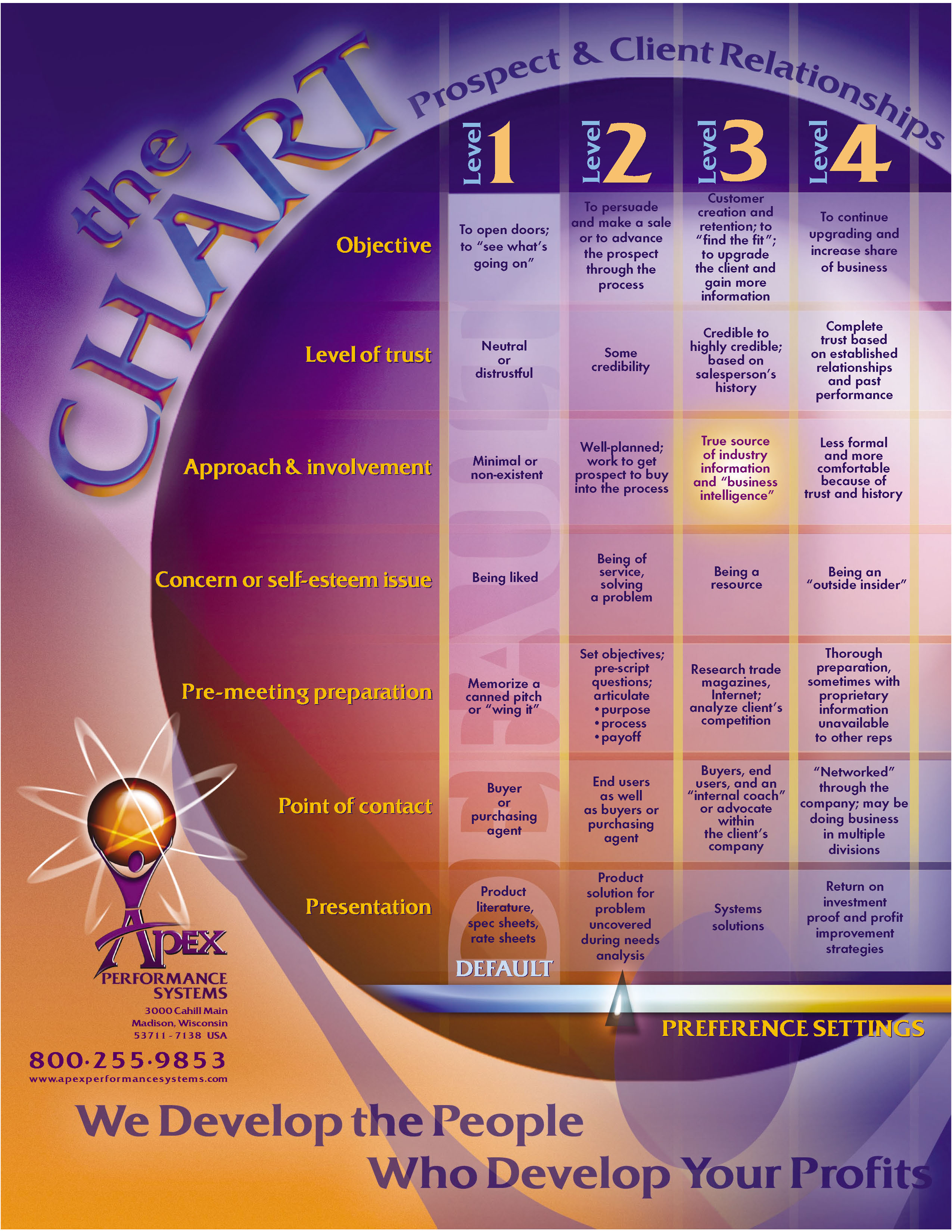
Sales have been a large part of my consulting management jobs since the mid-1990s, but it wasn’t until I owned my own company that this became a true priority. I ran across a good book, The Accidental Salesperson, by Chris Lytle. Back then, Chris Lytle had “MAX Training,” and a large part of their focus was increasing your “level” with regard to Prospect and Client relationships. The training was good and was complementary to systems like Miller Heiman.
What each of these systems do is help you prepare, plan, and execute to the best of your ability. And just like basketball, it takes practice to master. With mastery comes success and the illusion that something is easy (or you are lucky). The Seneca quote, “Luck is what happens when preparation meets opportunity,” is so true.
Regardless of the system used, what is most important is that you are trying to be the best at is to look at both positive and negative examples to see what you can learn from them. There are lessons to be learned everywhere! Understanding what makes it good or bad helps you improve as part of an ongoing improvement process.
Incorporating new tools and techniques into what has already been proven to work will help you improve your game. Returning to the sports analogy, this could be part of what made Michael Jordon so good. He would see something interesting, improve it, and then make it his own.
For example, I get many horrible sales calls and emails. The people have obviously not done any preparation, do not know anything about me or the company I work for, and often remind me of why I stopped listening to them by referring to the number of times they have tried contacting me. On the other hand, some talented sales professionals have done their homework, understand their products and the competition, and understand why what they are selling should matter to me – and can articulate that quickly and confidently. I will speak with them and occasionally buy from them. And in either case I provide my team with real-life examples of good and bad sales techniques.
So, think of the best example of whatever it is you do, and see what you can do to become more like them. This isn’t about imitation but rather about uncovering the secrets of their success and learning from them. And have some fun doing it!
Lessons Learned from Small Business Ownership

I learned many valuable lessons over the course of the 8+ years that I owned my consulting business. Many were positive, a few were negative, but all were educational. These lessons shaped my perceptions about and approaches to business, and have served me well. This post will just be the first of many on the topic.
My lessons learned covered many topics: How to structure the business; Business Goals; Risk; Growth Initiatives and Investment; Employees and Benefits; Developing a High-Performance Culture; Marketing and Selling; Hiring and Firing; Bringing in Experts; Partners and Contractors; The need to let go; Exit Strategies and more.
In my case these lessons learned were compounded by efforts to start a franchise for the consulting system we developed, and then our expansion to the UK with all of the challenges associated with international business.
It’s amazing how more significant those lessons are (or at least feel) when the money is coming out of or going into “your own pocket.” Similar decisions at larger companies are generally easier, and (unfortunately) often made without the same degree of due diligence. Having more “skin in the game” does make a difference when it comes to decision making and risk.
Businesses are usually started because someone is presented with a wonderful opportunity, or because they feel they have a great idea that will sell, or because they feel that they can make more money doing the same work on their own. Let me start by telling you that the last reason is usually the worst reason to start a business. There is a lot of work to running a business, a lot of risk, and many expenses that most people never consider.
I started my business because of a great opportunity. There were differences of opinion about growth at the small business I was working for at the time, and this provided me with the opportunity to move in a direction that I was more interested in (shift away from technical consulting and move towards business / management consulting). Luckily I had a customer (and now good friend) who believed in my potential and the value that I could bring to his business. He provided both the launch pad and safety net (via three month initial contract) that I needed to embark on this endeavor. For me the most important lesson learned is to start a business for the right reasons.
More to come. And, if you have questions in the meantime just leave a comment and I will reply. Below are some of the statistics on Entrepreneurship that can be pretty enlightening:
Bureau of Labor Statistics stats on Entrepreneurship in the US
 Where Ideas, Experiences, and Lessons Learned Intersect