
high performance culture
Are you Visionary or Insightful?
Having great ideas that go misunderstood or unvalidated is pointless, just as being great at “filling in the gaps” does little if what you are building achieves little toward your needs and goals. This post is about Dreaming Big and turning those dreams into actionable plans.
Let me preface this post by stating that both are important and complementary roles. But if you don’t recognize the difference between the two, it becomes much more challenging to execute and realize value/gain a competitive advantage.
The Visionary has great ideas but doesn’t always create plans or follow through on developing the idea. There are many reasons why this happens (distractions, new interests, frustration, lack of time), so it is good to be aware of that, as this type of person can benefit by being paired with people willing and able to understand a new idea or approach, and then take the next steps to flesh out a high-level plan to present that idea and potential benefits to key stakeholders. People may view them as aloof or unfocused.
The Insightful sees the potential in an idea, helps others understand the benefits and gain their support, and often creates and executes a plan to prototype and validate the idea – killing it off early if the anticipated goals are unachievable. They document these experiences, learn from them, and become increasingly proficient at validating the idea or approach and quantifying the potential benefits. They are usually very pragmatic.
Neither of these types of people is affected by loss aversion bias.

I find it amazing how often you hear someone referred to as a visionary, only to see that person could eliminate some of the noise and “see further down the road” than most people. While this skill is valuable, it is more akin to analytics and science than art. Insight usually comes from focus, understanding, intelligence, and being open-minded. Those qualities matter in both business and personal settings.
On the other hand, someone truly visionary looks beyond what is already illuminated and can, therefore, be detected or analyzed. It’s like a game of chess, where the visionary person thinks six or seven moves ahead. They connect the dots across various future possibilities while their competitor is still thinking about their next move.
Interestingly, this can be frustrating for everyone.
- The Visionary with an excellent idea may become frustrated because they feel an unmet need for understanding.
- The people around that visionary person become frustrated, wondering why that person can’t focus on what is important or why they fail to see/understand the big picture.
- Others view the visionary ideas and suggestions as tangential or irrelevant. It is only over time that the others understand what the visionary was trying to show them – often after a competitor has already begun implementing a similar idea.
- The Insightful, wanting to make a difference, can feel constrained in static environments, which offer little opportunity for change and improvement.
Both Insightful and Visionary people view themselves as strategic. Both believe they are doing the right thing. Both have similar goals. What’s truly ironic is that they may view each other as competitors rather than seeing the potential for collaboration.
A strong management team can boost creativity by fostering a culture of innovation and bringing these people together to work toward a common goal. Providing little time and resources to explore an idea can lead to remarkable outcomes. When I had my consulting company, I sometimes joked, “What would Google do?” to describe how amazing things were possible and waiting to be done.
The insightful person may see a payoff from their ideas sooner than the visionary person, because they focus on what is already in front of them. It may be a year or more before what the visionary person has described shifts to the mainstream and into the realm of insight – hopefully before it reaches the realm of common sense (or worse yet, is entirely passed by).
I recommend that people create a system to gather ideas, along with a description of the purpose, goals, and advantages of those ideas. Foster creativity and innovation by rewarding people for participation, regardless of what becomes of the idea. Review those ideas regularly and document your commentary. You will find good ideas with luck – some insightful and possibly even visionary.
Look for commonalities and trends to identify the people who can cut through the noise or see beyond the periphery and the areas having the greatest innovation potential. This approach will help drive your business to the next level.
You never know where the next good idea will come from. Efforts like these provide growth opportunities for people, products, and profits.
Doing it like Mike
My son is playing basketball this year (he previously played football and soccer), and we recently went shopping for new shoes. Each store had pictures of Michael Jordan. I used to love watching MJ play with the Chicago Bulls. He was the epitome of skill and professionalism. To this day, he inspires me.
Some people are naturally talented but must still work hard to achieve their full potential. Hard work is an important aspect of being the best at anything, but it takes more than that. It takes doing things in a way that allows you to continuously improve, along with a positive mindset and a commitment to success. Once people reach that high-performance level, their jobs look easy, and they may even appear to be a “natural” – just like Mike. But that is just the tip of the iceberg.
Most of my career changes have been unplanned. For example, in 2010, our VP of Sales was fired, and the guy intended to fill the slot quit to go work for Salesforce.com. We had our sales kickoff less than five days away, and nothing was planned yet. The SVP of Sales told me that if I wanted the job, he would give me six months. But if I didn’t cut it at the end of six months, no other job would be waiting for me.
Opportunities presented themselves, the job seemed interesting, and before I knew it, I was fully immersed in something related but different. The potential reward outweighed the real risk.
Many of these things have not come naturally to me. Each time, I focused on understanding the requirements for doing the job well, then looked for examples of exceptional performance, and finally created a systematic approach that let me measure performance and identify areas for improvement on an ongoing basis. From then on, I analyzed my results, thought daily about even the smallest improvements I could make, and tried to do even better the next day.
Good enough was never good enough. Introspection can be challenging, so one thing that I have done is to take time to celebrate wins and intentionally focus on remembering how that feels. Those memories can be motivational in times of stress or frustration and help you get back on track quickly.
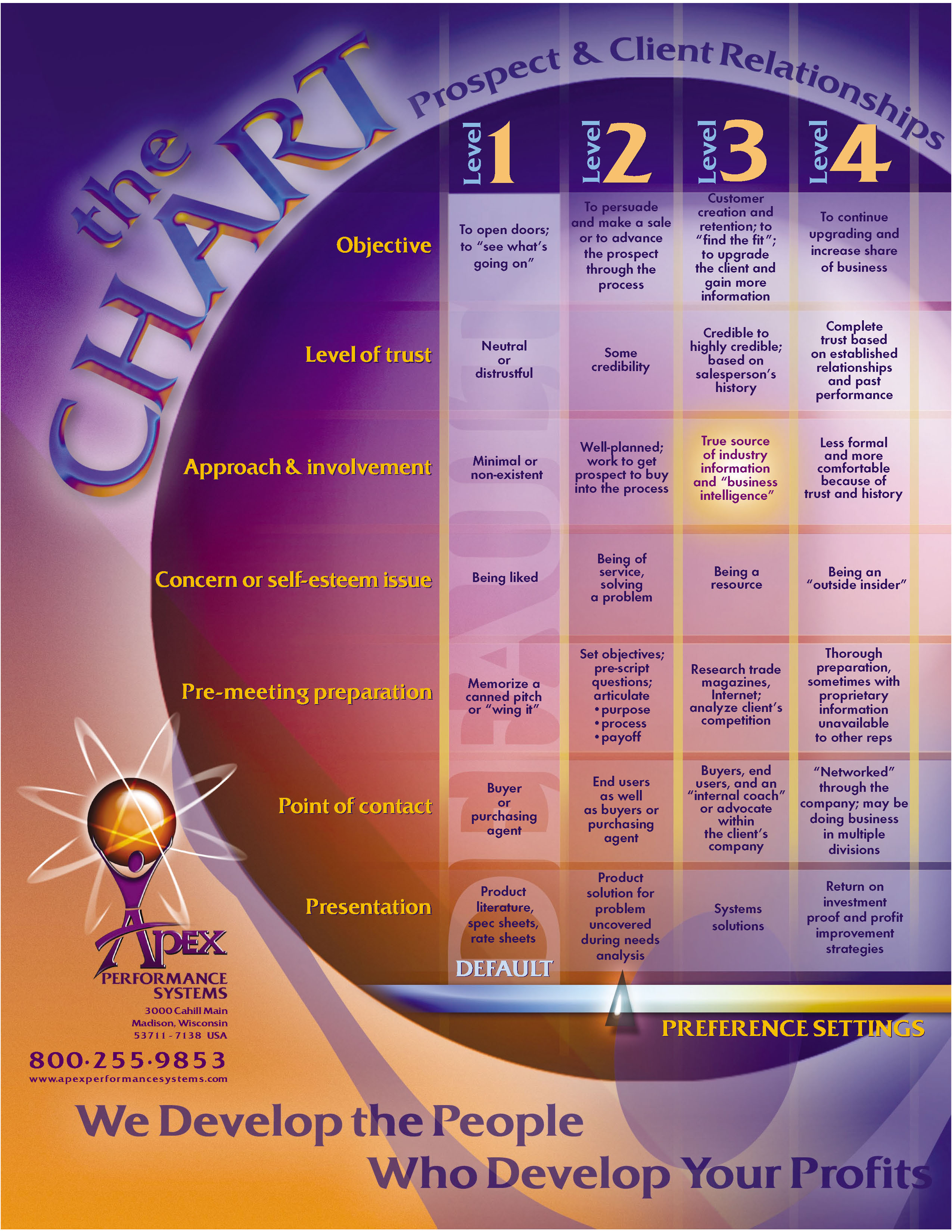
Sales has been a major part of my consulting and management jobs since the mid-1990s, but it wasn’t until I owned my own company that it became a true priority. I ran across a good book, The Accidental Salesperson, by Chris Lytle. Back then, Chris Lytle had “MAX Training,” and a large part of their focus was on increasing your “level” in prospect and client relationships. The training was good and complemented systems like Miller Heiman.
Each of these systems helps you prepare, plan, and execute to the best of your ability. And just like basketball, it takes practice to master. With mastery comes success and the illusion that something is easy (or you are lucky). The Seneca quote, “Luck is what happens when preparation meets opportunity,” is so true.
Regardless of the system you use, what matters most is that you try to be the best at examining both positive and negative examples to learn from them. There are lessons to be learned everywhere – especially when you make mistakes! Understanding what makes it good or bad helps you improve as part of an ongoing improvement process.
Incorporating new tools and techniques into what has already been proven to work will help you improve your game. Returning to the sports analogy, this could be part of what made Michael Jordon so good. He would see something interesting, improve it, and then make it his own.
For example, I get many horrible sales calls and emails. The people have obviously not done any preparation, do not know anything about the company I work for or about me, and often remind me why I stopped listening to them by citing how many times they have tried to contact me.
On the other hand, some talented sales professionals have done their homework, understand their products and the competition, and understand why what they are selling should matter to me – and can articulate that quickly and confidently. I will speak with them and occasionally buy from them. And in either case, I provide my team with real-life examples of good and bad sales techniques.
So, focus on becoming the best example of whatever it is you do, learn from others, and never stop improving. This isn’t about imitation; it’s about uncovering the secrets of their success and learning from them. And if you are lucky, you will have some fun doing it!
Teaching & Learning in a Business Environment
In the past, I had occasion to teach technical courses, often to groups of 20 or more people. It was always interesting. There were one or two people trying to prove how much smarter / better than you they were. There were one or two people who were there just so they didn’t have to work. But most of the people were there to learn. You figured out who was who pretty quickly. Even so, falling into the trap of labeling them and then only focusing on a subset can be problematic.
My teaching approach was to ask people about real issues (current or past) and use them as case studies for the class. This made the lessons more tangible for everyone. People were forced to develop an understanding of the problem with incomplete knowledge, ask clarifying questions, and then offer suggestions that may or may not work.
Sometimes someone would suggest a solution that just seemed completely off the wall. You wanted to understand their line of thinking to show them a better way. Occasionally you would find that their unorthodox approach was brilliantly simple and/or highly effective – and very different from what you expected.
Every time I taught a course, I would learn something. Different perspectives lead to a different understanding of the problems at hand, which can lead to creative and innovative solutions. The best ideas sometimes come from the places where you least expect them.
Even with the most seasoned teams, there are opportunities for teaching and learning. You may hear questions or statements that initially lead you to believe someone doesn’t understand the problem or goal. It becomes easy to dismiss when you don’t feel they are adding value.
But, if you take the extra effort to drill into their thinking, you could be very surprised. If nothing else, your team should feel more motivated and empowered with the process, leading to them taking ownership of the problem and finding a solution. Results improve when everyone is focused on a common goal and feels their contributions matter.
Everyone wins as long as you give them the chance.
The People Who Move the Dial
Whether you are a business owner, a manager, or a parent, finding the right way to motivate your team is important to maximize performance and results. Each person is a little bit different and is looking for something a little different, and once you figure out what is important, you can help increase their impact. Not everyone wants to be a star – which is usually OK (as long as they have the right attitude, skills, and work ethic and add value).
Then there are those exceptional people who want to be the best, are willing to take risks, work hard, and “think differently” in order to succeed. These people are self-motivated and continue to raise the bar for the entire team as part of a high-performance culture. These are the people who move the dial.
I’ve had the pleasure of being taught by people like this, working with people like this, managing people like this, and helping a few become people like this. Occasionally, you have a few special people working together, which is when amazing things happen. These people are generally curious and wonder, “Why not?” They are confident (not arrogant), intelligent, and passionate about success.
Back when I was funding medical research projects, I had a trip scheduled to Philadelphia. I asked a friend at a local hospital to make an introduction to meet someone from “CHOP” (the Children’s Hospital of Philadelphia). They were ranked as a top hospital and research facility, and I wanted to learn why. She made the introduction, and we scheduled a lunch meeting. I was looking forward to the meeting but had no real expectations (other than being asked for money).
To my surprise, a half-dozen people in a large conference room with a catered lunch greeted me. They presented on their various projects (such disclosures were unusual, as they did not know me and, even riskier, knew I was involved with research projects at other facilities). Everyone in the room was amazing, and the department head (Dr. Terri Finkel) was one of the most impressive people I had ever met.
After lunch, I told Dr. Finkel I appreciated the lunch, but wondered why she went to so much trouble when I never promised to do anything in return. She smiled and replied, “We love what we do and love having the opportunity to talk about our projects and passions to people with similar interests.” That made a huge impression on me, and within a few months, we were funding projects using a unique new approach that Terri suggested. The approach was in response to my question about getting the most “bang for my research dollars” (thinking more like a businessperson than a researcher).
Over the next few years, this team did incredible things that had a tangible impact on Pediatric Rheumatology and the quality of life for children with Juvenile Arthritis. Many great researchers were involved, but two of them really stood out (Drs. Sandy Burnham and Randy Cron – both continue to do amazing things to this day). The results of this team were so much better than everyone else we supported. They provided a huge return on my investment, and I can take pride knowing that I made a difference through these efforts while helping launch their careers.
To me, it came back to the basics. Intelligent people who were passionate about making a difference, confident enough to be challenged, and led by a visionary person who saw an opportunity to motivate her team and help me achieve my goals. It’s the best type of win-win scenario possible.
These people moved the dial back then and continue to move it today. It is a thing of beauty to watch stars like this perform. These people shine twice as bright as they guide others toward success. And you can find them in every industry and every walk of life – you just need to look.
- ← Previous
- 1
- 2
- 3

